Tuesday, February 04, 2014

Rape Culture and Right Conduct...

I recently had a Twitter exchange with someone who I respect greatly about the whole Dylan Farrow/Woody Allen issue.  I found Woody Allen funny for many years - and still do watching his earlier movies, but that wasn't hardly the motivation  for my comments entreating a larger perspective on the issue.

It was the McMartin preschool affair that did that.

In the 1980s and 1990s, crazy things happened in the American justice system, besides the Woody Allen sexual abuse charges: Eric and Lyle Menendez, the McMartin preschool trials, the Roxanne Pulitizer divorce trial, the William Kennedy Smith rape trial,  etc., etc., leading up to the O.J. Simpson trials and finally, the Bill Clinton affair.

The thing that sticks in my mind is the McMartin preschool trial.  People paid with years of their lives for what we learned from that, and we're fools if we don't put those lessons into practice. 


The McMartin preschool trial was a day care sexual abuse case of the 1980s. Members of the McMartin family, who operated a preschool in California, were charged with numerous acts of sexual abuse of children in their care. Accusations were made in 1983. Arrests and the pretrial investigation ran from 1984 to 1987, and the trial ran from 1987 to 1990. After six years of criminal trials, no convictions were obtained, and all charges were dropped in 1990. When the trial ended in 1990 it had been the longest and most expensive criminal trial in American history.[1] The case was part of day care sex abuse hysteria, a moral panic over alleged Satanic ritual abuse in the 1980s and early 1990s.


Read the whole thing...people had their lives destroyed over false testimony.  IT HAPPENS.  I, for one do not want that to happen to anyone.  More to come...


Saturday, January 25, 2014

NO THEY'RE WRONG!!!

I find it really easy to look over what some other folks are doing and say "NO THEY'RE WRONG!!!"

It's really  easy.

I see stuff on the 'net... heck this happens all the time if you read stuff on line... that really misapprehend this 公案  (kōan) or that one.  Sometimes with USDA certified "teachers" of Zen.

I see people get stuff wrong all the time...

Some folks approach on-line information and reporting by writing with facts and questions, like in this piece from Justin.  But does that style of communication help things? Mais ces gens-là sont toujours aussi ignorants que les moutons.  Obviously wrong.   Oozing Dunning-Kruger slip-on-a-bannana-peel wrong. 

(This post is not about Justin's post by the way, just in case the casual reader didn't get that. )  It might be about my reaction to a guy like Teacher X, accused and probably guilty about sexual harassment...it might also be about my reaction to folks who react one way or another to Teacher X.  It might be about my reaction to the long line of hucksters that populate the "spiritual" space...or it may just be all about me - an exercise in narcissism disguised as compassion.  I hope it's not that...but it might be.

I hope it's about the finding what is the best reaction to finding wrong.  The skill in encountering wrongfulness might not be to ask a question only.   But there certainly are questions.  Among them, is, given that we find wrong,  just what do we want to do about it?   It's really easy to be attached to one's moral superiority and do something that makes us feel good or puffs us up but really doesn't address the idea of going beyond the wrongfulness. 

It's freakin' trivially easy  to find wrong in others.  Can we see it in ourselves? Can we do something about it?  Can we get  better at seeing it in ourselves and doing something about it? 

I myself need to continually keep in mind that when "NO THEY'RE WRONG!!!" goes through my mind that it should be a trigger to take a step back, and observe in a relaxed, calm manner. Then consider what,  if anything to do.  Because I'm really not very good at doing that...and I'm often rather  wrongful and wrong.


Saturday, January 11, 2014

Online harassment and precepts...


And I thought... how could people be this way?  How ignorant or wounded or what could these people be to stalk someone like this?


And then I thought of the situation of  the inability of people to deal with some of the issues affecting the Buddhist community in their on-line presence; some of these incapable people are said to be teachers of Zen, too! 

I would hope that all beings experience relief and transcendence from any wrongful actions towards them, including wrongful speech.

Wednesday, January 08, 2014

"-isms," narratives, and Zen Buddhism

TLDR: Sweeping Zen seems to be more personality driven than teaching and practice driven.  Moreover,  a lot of what's on that blog doesn't even seem to be informed by strong teaching and practice.  One post there by Herb Deer illustrates this, especially compared with what we know from the patriarchs.  I can't justify giving them linkshare, even if a teacher, such as Genjo Marinello might have an article there now and then.


There's been a bit of hubbub lately in the Buddhist blogosphere about the abuse of power sexually with a few zen "teachers," and what this means for "Zen Buddhism" in "the West."  Due to some of this hubbub I've decided to not promote the Sweeping Zen blog, but not for the hubbub that you might think; not for the issues I've alluded to in the past few days, although I think the post today might be identifying more of a root cause of those other posts.

The root cause is that a heck of a lot of people don't seem to be demonstrating in their verbal communication at least what Zen Buddhism is - people who seem to include some signed, sealed, and delivered "authorized" "teachers" of "Zen."  And Sweeping Zen, (a "who's who of Zen") is more personality driven than teaching and practice driven.

Tuesday, January 07, 2014

I've updated the list of blogs I follow...

I realize that a couple of the blogs mentioned I wouldn't recommend to the casual visiter to this site.   I've had specific reservations - rather deep reservations about some of the stuff posted on some of the sites on my list.  I've added a couple too.  In case you didn't know, one of the ancestors of my part of the Rinzai school, Soen Shaku, spent a significant portion of time with Theravadin monks; I definitely feel an affinity to a lot of what they put forth (though not everything in all cases).  Soen Shaku, contrary to narratives of Japanese Zen adepts whose heirs and teachers reached the West, namely  Nyogen Senzaki and Ryobo-an Sokatsu  were scandal-free.

I think it's better to not promote those questionable blogs in my own way.   In two cases especially it appeared that what was being promoted was so at variance with Zen Buddhism as I've apprehended it that it's better not to promote it as a blog I recommend, even if listing it only as "one I follow." Barry Ritholtz is a more reliable Zen guide, even if he never blogs about Zen (and I recommend his writings, even when I disagree with them if you're tasked with managing your retirement).   I will probably have a more in-depth post on it later, but to make a long story short (for now), there's a lot of people that want to "make Zen better,"  and they're not doing sentient beings many favors in doing so.

You know, Buddhist blogosphere, there's a bunch of other precepts besides the sex ones...

Sexual harassment and other misuse of sexuality is unacceptable.

Speaking ill of whole classes of people is unacceptable.

In fact wrongful speech is unacceptable.

Not endeavoring to understand is unacceptable.

Misusing intoxicants is unacceptable.

Taking what's not given is unacceptable.

Mindlessly killing is unacceptable.

I haven't gotten into the good stuff...like having compassion for all beings, cultivating wisdom and generosity, etc.

There's a lot more to Buddhism, and hence Zen Buddhism, than a) sitting on cushions, and b) going into internet outrages over some "reporting."


Monday, January 06, 2014

Is there a fundamental difference between your teacher and Eido Shimano? And what does that mean for our own conduct?

Beyond, of course whether one should be in a position of authority or not.  At least one of the above should not be, that would be at least the latter should not be.  Of course if your teacher by this point is Eido Shimano, you've got  bigger problems than I can address here; I would suggest an alternative.

That's not my point here, or rather everyone stipulates to the point that these sexual abusers don't belong in a position of authority.

My point is that there may be some people who think that beyond the authority question, there is a fundamental difference between Teacher X (insert your teacher here) and Eido Shimano or Sasaki etc.

Or me. Or you.  If someone's Teacher X says they are fundamentally different from Eido Shimano,  I can't imagine who would have authorized them.  If someone's Teacher X says they are not fundamentally different from Eido Shimano, then what does that say about how we conduct ourselves with regard to the wrongful behavior of Shimano?


Sunday, January 05, 2014

Right Speech, Right Livelihood, and the Exploitation of Zen Sexual Abusers for Profit and Leisure


The problem of leisure
What to do for pleasure
Ideal love a new purchase
A market of the senses
Dream of the perfect life
Economic circumstances
The body is good business
Sell out, maintain the interest
Remember Lot's wife
Renounce all sin and vice
Dream of the perfect life
This heaven gives me migraine
The problem of leisure
What to do for pleasure

Coercion of the senses
We are not so gullible
Our great expectations
A future for the good
Fornication makes you happy
No escape from society
Natural is not in it
Your relations are of power
We all have good intentions
But all with strings attached

Repackaged sex keeps your interest

The problem of leisure
What to do for pleasure
Ideal love a new purchase
A market of the senses
Dream of the perfect life
Economic circumstances
The body is good business
Sell out maintain the interest
Remember Lot's wife
Renounce all sin and vice
Dream of the perfect life
This heaven gives me migraine
                          - Gang of Four


I had an interesting exchange yesterday  regarding Sweeping Zen and whatever Adam's latest scandal du jour.  They've become Adam's scandals as much as Sasaki's or Shimano's scandals by now, because of his association with his propensity to propagate these stories.  

To what end?

Saturday, January 04, 2014

Hearing the Sutras, Proper Belief...

Nathan quotes  and comments a bit from Chapter 6 of the Diamond Sutra, and I wanted to comment on that as well.

The relevant part of Chapter 6 is:


Subhåti said to the Buddha, “World Honored One, in the future will there be living beings, who, when they hear such phrases spoken will truly believe?"


The Buddha told Subhåti, “do not speak in such a way! After the Tathàgata’s extinction, in the last five hundred years, there will be those who hold the precepts and cultivate blessings who will believe such phrases and accept them as true.

“You should know that such people will have planted good roots with not just one Buddha, two Buddhas, three, four, or five Buddhas, but will have planted good roots with measureless millions of Buddhas. All who hear such phrases and produce even one thought of pure faith are completely known and completely seen by the Tathàgata. Such living beings thus obtain measureless blessings and virtue. And why? Those living beings have no further mark of self, of others, of living beings, or of a life; no mark of dharmas and no mark of no dharmas. If living beings’ hearts grasp at marks, then that is attachment to self, to others, to living beings, and to a life. For that reason you should not grasp at dharmas, nor should you grasp at no dharmas. Regarding that principle, the Tathàgata often says, ‘all you bhikùus should know that the Dharma which I speak is like a raft. Even dharmas should be re- linquished, how much the more so no dharmas.’

The heading of the chapter I'm quoting from says "Proper Belief is Rare."  The thing about Buddhist texts is that they tend to be more mentally challenging than the monotheists' writings; there's more subtlety going on here than might meet the eye at first.  In Subhåti's  question to the Buddha,  "such phrases" mean the teaching of the Diamond Sutra itself.  Like the Lotus Sutra, it's simultaneously self-referential and pointing outside of, that is, beyond the text of the Sutra itself.   As has been commented by others,  this pointing refers to one's appropriation and manifestation of the Dharma (including lack of attachment to it) in one's own life. 

There's one other point I'll make here: the rare "proper belief" is the mindset of not being concerned about any outcome here.   Furthermore the "people who have planted good roots" are those who have belief in the Buddha, Dharma, and Sangha, but that belief is a belief borne of observation having first taken refuge, as can be seen by reading a little further down in text I've not quoted.

But this is way too too much analysis.  It has so much analysis, that in fact what I wrote has nothing whatsoever to do meaningfully with reality.

Let me put it this way.  Consider Case 29 of the Hekigan Roku:


A monk asked Daizui,
"When the great kalpa fire is inflamed, the whole universe1 will be
destroyed. I wonder if 'that' will also be destroyed or not."
Daizui said,
"Destroyed."
The monk said,
"If so, will 'that' be gone with the other?"2
Daizui said,
"Gone with the other."


This is clearly related to the same thing mentioned in the Diamond Sutra. (For what it's worth, you can read a Sanbo Kyōdan commentary by Yamada Koun here.)

A "proper belief" mindset is one in which belief,  the question of belief,  doubt, and/or lack of doubt just doesn't arise.  It just does not matter in relation to the resolution of the Great Matter. This is not to say that one is not practicing good deeds, nor does one stop practice/refuge.  Of course not.   But this "proper belief" mindset is  not even like  not being aware of being wet when swimming.


Wednesday, January 01, 2014

Money, Bitcoin, and bad economics


To walk in money through the night crowd, protected by money, lulled by money, dulled by money, the crowd itself a money, the breath money, no least single object anywhere that is not money, money, money everywhere and still not enough, and then no money or a little money or less money or more money, but money, always money, and if you have money or you don't have money it is the money that counts and money makes money, but what makes money make money? - Henry Miller


This post is hopefully an attempt at a well-mannered response to C4Chaos's pro-Bitcoin post here.  I say "hopefuly" an attempt at well-mannered but I'm not especially optimistic, because somewhere percolating through all this Bitcoin ideology is a lot of libertarian junk, and Austrian School libertarian junk at that.  C4Chaos's post featured about 40 minutes worth of video as a response to Paul Krugman, who I'm sure knows better than to respond to that sort of thing.  I, myself, have no patience for video responses on pretty much anything that's not intended at least partially for entertainment (yeah, I include academic lectures as well - they should be entertaining).  Anyway, I replied to C4Chaos by asking for text links which he dutifully supplied...and so here we go...


First of all, let me start out by saying that Ludwig von Mises was worse than a crackpot.  Don't believe me?  Check out the man in his own words.  Von Mises seems to be intimately related to these so-called "Bitcoin theorists," and that should raise a warning flag pretty much immediately.  Von Mises was an apologist for laissez-faire capitalism, funded lock, stock and barrel by the 1%.   Anyone who's had a basic course in Macro-ecomomics  can refute such clap-trap standing on 1 foot. 

The key point I'd like to make, as long as C4Chaos indirectly referenced von Mises in re: Bitcoin, is that one of the von Mises points is that somehow money is  "good money" if people want to hold money "as cash," as a "store" of value. But, given the nature of capitalism to generate more and more goods and services of value, that "store" doesn't remain constant, and so that position is a political position inherently favoring deflation,  And the political position inherently favoring deflation is in fact a position inherently against labor in favor of capital, and in these times such a position is not ethically defensible.

Another class of objects has recently been touted as a "store" of value as well, and that class of objects are precious metals.  Precious medals experienced a very nice bubble in the last decade or so, which popped in 2012.  You can still hear hucksters on AM right-wing talk radio pushing gold as a store of value.  And yes, I made a few bucks on that bubble.  But that doesn't mean that the bubble was good.  But the capitalism in which we currently dwell requires we all participate to some extent in the Prisoner's Dilemma, and hopefully we do that skillfully towards helping people rather than exploiting them

There was yet another class of objects in the last decade that sort of was a "store" of value though that class wasn't touted as a "store" of value.  That store of value was ... drumroll... US government securities, despite (actually due to) the fact that deficit hawks reigned supreme after 2009.

In the case of precious metals  and  Bitcoin, a "store" of value was touted as a bulwark against some perceived "threat" from central banks, yada yada yada, but in the Greater Fool theory fueled speculative bubbles.

Bitcoin will be accepted as a medium of exchange in barter long as people accept it, of course, but Bitcoin will never really be money unless, ironically for Bitcoin believers,  at least one government can mandate settlement of transactions in Bitcoin.  But then the Bitcoin believers tend to be suspicious of governments.  While it is true that governments commit many crimes and atrocities, their existence is still preferable to crimes and atrocities committed in failed states whether you're talking about Somalia or that libertarian paradise of yore, the Roman Republic.

Yeah, C4Chaos is right that Bitcoin is more than an object of "value", it's a protocol, but so what? Really, so what? It's not going to replace commerce that exists now, including internet commerce.  And the end of the day you're going to want to have dollars and yen and krona and euros and pounds and yuan, because that's what the rest of the world will take to buy bread and rice and vegetables.  Moreover,  Bitcoin will almost certainly be exploited maliciously.  Unlike robbing a bank (which compromises the bank, not the medium of exchange), if Bitcoin is compromised it does compromise the medium of exchange.

It's really a tremendous waste of time and energy and labor, in my view.   And not particularly useful from a Buddhist ethics standpoint...


Saturday, December 21, 2013

Zen "teacher" scandals, their critics, and the fetishism of the "teacher" of Zen

One reason I'm kind of bored with the Shimano thing is that in looking at the Sweeping Zen stories (they don't seem to stop), I kind of get to wondering what this all has to do with Zen practice, with the practice of most of us who aren't involved in Zen teacher scandals,  and who aren't in any of the sanghas that have been blacklisted.

I mean, yeah, the jokers are still out there, but if you google "genpo," the number 2 suggestion is "genpo roshi affiar."  A similar result holds for "Eido Shimano."   While it's not the sole focus of the Sweeping Zen website by any means,  scandals do seem prominently displayed.  So why the focus, especially when anyone could google a Zen osho these days to find out if there's any dirt on them?

I think it has to do more with issues of attachment than many of the people talking about his would like to admit, and the fact that there are avowed "Zen teachers" in the thick of this leads me to question their credentials,  at least in terms of the root meaning of the word (i.e., what do they have that would give you credence in them).   I'm not talking about Genjo Marinello here, by the way.

This stuff doesn't have to do with the improvement or edification of  my practice, and I suspect it's true for others as well, at least directly. 

I do think for many of the people who are ostenisibly "Zen teachers" who are commenting on this stuff there is a dynamic of the fetishism of the "teacher" of Zen - and this doesn't just express itself as a positive idealization of the "guru," but also  but also as a condemning idealization of the guru.

Let me ask a question: Ethics aside, does anyone think Dennis Merzel or Eido Shimano or Sasaki knows nothing  or has no experience about Zen?  Are they worthy of compassion?  Yeah, don't let them near attractive women students...but then again I wouldn't recommend anyone go near a "teacher" who says things like


Japanese men in power and Western men in power tend to indulge in sexual encounters with subordinates as part of their privileged position. Whether they are US President, congressman, or business man, or spiritual teacher or minister, sexual liaisons seem to be included in male privilege all over the world.


This "teacher," in my view,  raises red flags to me just as much as Shimano or Merzel would.

I happen to be a white male working in an international company in a managerial role; I have had numerous dealings with professionals from pretty much every name electronics company you can think of outside of some industrial applications.   In my experience of about 35 years in the profession, there have been, amongst the thousands of people I've been working with there have been just two cases of sexual indiscretions. One was clearly consensual, and in the other the woman was hardly powerless in the situation.

Companies in the West have good reasons for ethical guidelines they have about these things (less so in Japan, but on the other hand there are other forces at work in Japan that put a lid on this to some extent).  Disturbing the 和 (wa or harmony) of the workplace is very bad for business, and most business people get that.  Even in government, it's the exception rather than the rule.  For every Bill Clinton or Jack Kennedy you've got more than a couple of a Richard Nixons,  Jimmy Carters, and Barack Obamas.   They arguably misuse their power anyway,  but they are generally acting on behalf interests that want power misused that way.

From someone who claims to be a "Zen teacher" who writes the above,  I would question their credentials as a "Zen teacher."   From someone who claims to be a clinical psychologist, I would wonder what kind of professional and ethical criteria relate to someone who makes such generalizations.  I wonder how this attachment to stereotypes of males in power ripples through their practice. 

I realize that my criticism can be applied to myself here, and I wouldn't say I'm completely free of attachments myself,  but then again, I think it does harm to perpetuate a false stereotype, and that ought to be in the "public interest" as much as any "Zen scandal."

I'm done with this post, I've got to take a long shower.


Friday, December 20, 2013

Scandals Schmandals...I've been busy...

I haven't had much time in the past few months to post here; there's been a lot to do at work, so much so that even home life has not been given the attention I should have given to it.

It's not that I haven't had ideas of what to post...for example, the nature of giving and charity, and what that ought to mean from my meager understanding of Buddhism.

For another example, I have thought of posting about holiday blues and family turmoil in light of the Lotus Sutra.

It's been so that I haven't even had much attention to give to the rest of the Buddhist blogosphere, and with the notable exception of Barbara's blog, it looks like the  same old same old.

I think much of the Buddhist blogosphere is overly attached to  the "Zen master scandal" stuff  and there's a kind of inverse guru fetishism implied in it.

And I really don't have time for that,  although I did comment on a post by Gracie Myoan Schireson regarding a review of a book on the Shimano scandal here;  and I stand by those comments.

My own practice has been woefully inadequate of late, or perhaps I'm realizing that it's been woefully inadequate to begin with (and a knee situation hasn't made sitting easy of late, to put it mildly).

It's time for compassion.

Tuesday, November 26, 2013

Competitive yoga?

I'm not part of the whole yoga culture thing, but there you are.

So much about that I don't' understand.

I mean, martial arts are sometimes competitive - and those that are competitive often aren't good for their intended purpose.  And as a movie character said, the main principle behind the best of martial arts is founded on benevolence.

So I don't get competitive yoga at all.

Tuesday, October 22, 2013

The Asian Version of the Dharma Money Issue

I was recently asked by a Christian person whether or not there was a similarity between asking for indulgences that the Catholic Church of yore used to have and, in Asia, the practice of offering money in Buddhist temples followed by a chant/offering of incense.  The Christian used to think it was similar.

I was at a loss for words temporarily (other than to say, well, you'd have to deeply understand karma and interdependence), mostly because the topic at hand wasn't the topic of this blog post; it was a tangent to a more important topic.  I wasn't exactly satisfied with my answer...of course a better answer came to me later:

  • When one offers money at a temple, like everything else at a temple, one just does it, and does it wholeheartedly.  In effect, the act of offering at a temple is the offering of one's own life itself at that moment.  In that sense, it's more like the Christian communion in reverse than the other way around.

  • Typically, though people often come to the temple indeed for some reason such as a sick relative, what they say isn't an "I'd like to get something" prayer of course; it's an invocation of the form "Homage to X."  It's declarative.

  • I was however not off-base with the words karma and interdependence.  Most Buddhist chants when they aren't declarative, are in the 2nd person, but the identity of the 2nd person is not of course, separate from the chanter.  In Buddhism, of course, there is the principle of no-self.  So who is invoking what to whom, or who could possibly be trying to get something from whom?

  • Of course, there is the money for services thing, but that's not wholly unreasonable, I'd point out. Temples have to operate on budgets too.

There, that's better.

Saturday, October 19, 2013

Huguosi (護国寺), "Protect the Nation Temple" - Emerging Buddhism?

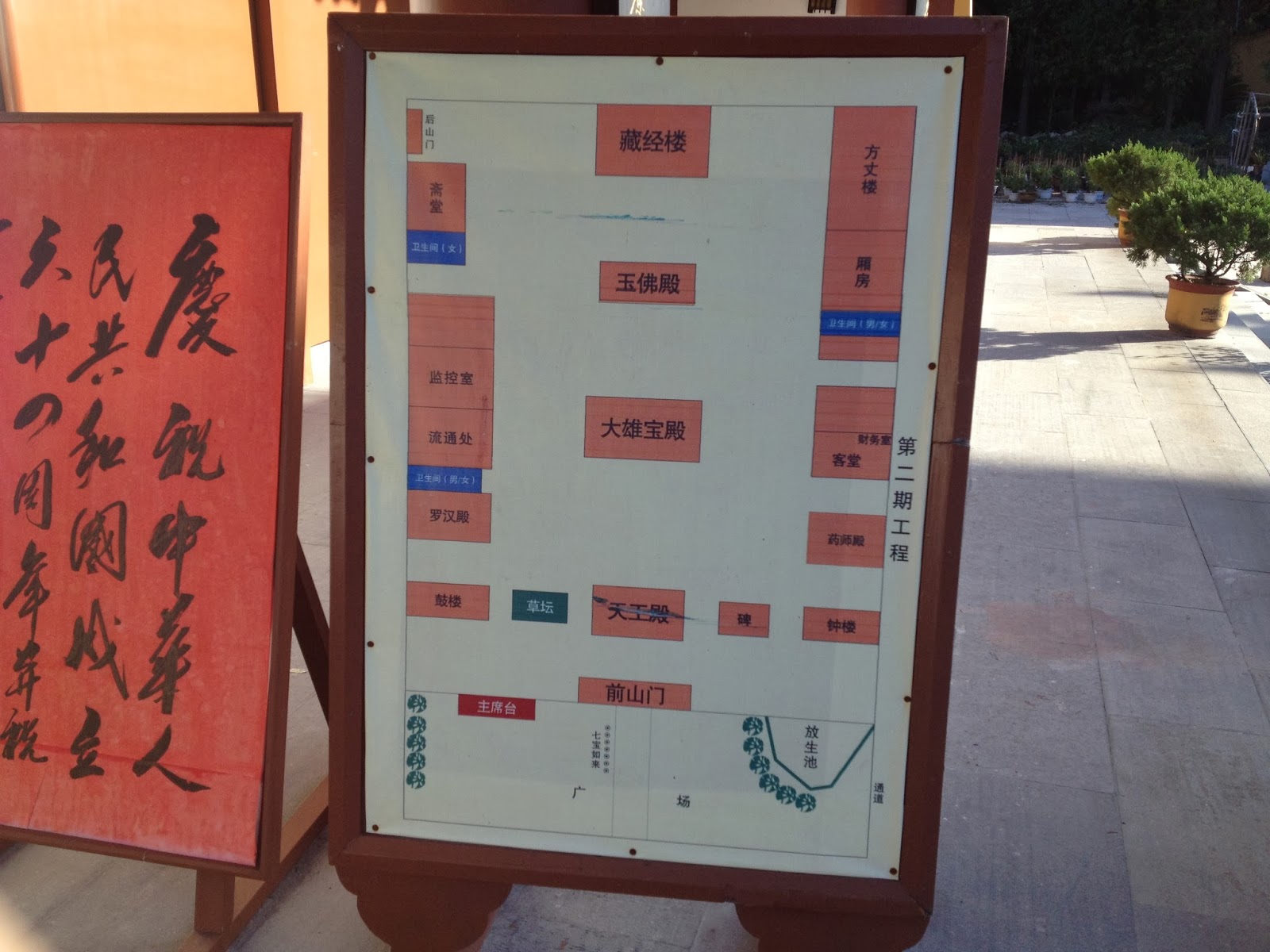
On my recent trip to China I stopped off in Wenzhou.  I had a chance to visit 護国寺.  Evidently there used to be a 護国寺 in Beijing, but it was destroyed in the 1950s. So originally 護国寺 was about protecting the nation in imperial times. You can read into the name of the temple now all kinds of cynical things about the government, but about my visit there, well, it's clear the people going there don't seem particularly cynical about it.  Like many temples this one seems brand spanking new; in fact construction is still going on there.  It's evidently a Pure Land temple - no 禅堂 to be seen, but typically the schools of Buddhism tend to mix.

In the main hall (2nd picture down) there was a chanting service going on with lots of lay people being led in chanting by a monk, on a Saturday mid-afternoon.

I saw a bunch of blue collar guys - in their 20s- entering the temple smoking cigarettes, and having a regular Chinese bro early fall afternoon, laughing loudly.  A few minutes later  a monk was showing these guys how to offer incense, which they reverently did.

Say what you will about China and religion, but on this day, 護国寺 was bringing people calmness and tranquility and peace, and yes, compassion.   You might say China is trying to co-opt Buddhism, but I might point out it seems to be the other way around as well.  Wenzhou tends to have a high population of Christians (yeah, there's brand spanking new Christian churches there too) but it's clear that there's a resurgence of Buddhism amongst people here.

So just to let you know, there's more forms of emerging Buddhism than you can shake a stick at, which of course you can't.


Tuesday, October 08, 2013

Quick Review: Journey to the West

It really is a shame we don't get enough foreign movies in the US.  On my recent trip over to Asia, I did get a chance to see - in the air - the movie "Journey to the West: Conquering the Demons."  If you get a chance to see this, you should. This is the most explicitly Buddhist film I've seen in a long time, but being as it's produced by Stephen Chow,  it is very fictional and very funny (among other things.)  It is very loosely based on  "Journey to the West," which is a classic of Chinese literature. 

It purports to tell the story of how Xuanzang came to go to the West to get the sutras, and is sort of a prequel, I'd guess to the other Journey to the West. So imagine a Buddhist themed movie in the style of Kung Fu Hustle.  In this movie, Xuanzang is a hapless demon hunter who attempts to tame demons by singing to them from the children's book "300 Nursery Rhymes."  He believes that within the demons there is good, and they will respond to compassion with compassion.

Needless to say the demons don't actually see it that way, being that there's demons, and Xuanzang has competition from other demon hunters with less lofty ideals, but in the end, Xuanzang umm...gets enlightened.  No, seriously.

What is really odd in this movie, and I'd say ultimately what makes this movie great -  is the rather extremes of things that take place in the movie.  One minute a  child is eaten by a demon, and a few minutes later there is extreme slapstick.  However, the message of compassion in the movie is clear. It is clear that the violence that does exist in the movie is a motivator for Xuanzang's compassion as well as constancy in his practice.  This really is a Buddhist-themed movie, and that's what's interesting to me as well.  What other religion could have such a movie  about one of its iconic figures that generates laughter?  OK, there's probably some Bollywood movie somewhere that does something similar, or, I suppose if it was to your taste, some of the relatively humorous parts of Bagger Vance. But Bagger Vance has nothing at all on this movie.

Stephen Chow is one of the greatest artists working in cinema today; it's a real pity that this and movies like it don't get wider distribution in the United States.


Saturday, September 28, 2013

Attention Relaxation Time

It is true if you have decent enough hearing and you practice this practice long enough, you can hear the ash falling from a joss stick if you are being attentive enough to it.   On the other hand, there's  tricks the mind does with the senses, which you can profitably employ if you  are, yeah, being mindful.  

The human body appears to privilege certain senses over others.  I suspect that's why everyone I see walking down the street while I'm driving is walking in time to the music I'm playing in my car, even though they don't hear it. (I suppose if I were more woo-ful I would attribute that effect to an underlying rhythm of the universe, but I also suspect this is a field fertile for YouTube-ery if it hasn't already been covered.)

I have mentioned that one of the things I have learned from Wing Chun Kuen  (詠春券) is just how naturally  tense everyone tends to be, especially me, especially when confronted by a someone with 8 or more inches and 100 lbs than I have.  I have been working to try to be aware of how tense I am at a given moment, especially under high stress situations, such as running late for an appointment, or meeting deadlines at work. 

I have found that, for example, when waiting at a red light, the experience of time really changes if I am  preoccupied with doing something else  mentally instead of focusing on how silly the light timing is (a wide variety of activities are not recommended for this.)  In particular, if I focus the mind on practicing being relaxed, the time indeed goes quicker paradoxically.

Try it.

Thursday, September 26, 2013

One more comment I don't want to let pass...

I like Justin Whitaker's on-line writing.  He and I would probably get on quite well in person.  However,  one of my comments didn't make it through Justin's filter on the comments for his blog entry "Are Mormons Christians?"  I'm not entirely sure why; I was dead serious compassionate when I wrote it.

Justin wrote:


The split, however, between Mormons and (other) Christians comes in the understanding of the Trinity as three separate beings in a unified purpose rather than one God in three Persons: the Father, Son, and Holy Spirit. The Christian belief in the unity of the Trinity, or “triune God” is found most clearly in the Nicene Creed, or Nicene-Constantinopolitan Creed, completed in 381 CE. Before that, and after, there were other followers of Jesus who held different conceptions of both Jesus’ divinity/humanity and the nature of God. The List of Christian Heresies compiled over at wikipedia is telling of the amazing diversity of beliefs within the community of people claiming to follow Jesus. That diversity should tell us something: that the ascendance of this one particular way of understanding the nature of Jesus and his teachings was one historical contingency among many...

But perhaps, in this age of increasing cosmopolitanism, the best thing to do is simply ask: Dude, are you a Christian? Yes? Okay then. Cool. Let’s talk about what that means to you and I can share what that means to me. Allowing others to identify themselves empowers them. Accepting their choices opens the door to dialogue, where both parties can learn and grow.


"Allowing others to identify themselves empowers them.  Accepting their choices opens the door to dialogue, where both parties can learn and grow."

I am an ex-Christian.  I'm an ex-Catholic, in particular, though for a spell I tried liberal Presbyterianism. Christians who follow the Nicene and other creeds are very particular about how they self-identify. For them, "Christian" has meant a very particular thing. To admit Mormons as Christians would be to challenge Christians' own self-identity.  It's sort of disrespectful to them not to acknowledge that.

Moreover, the Church of Jesus Christ of Latter Day Saints carries rather unique baggage for traditional Christians; it's absurd to downplay that.  The facts of Joseph Smith's life are well-documented, unlike, say Jesus (if he even existed.)  It's easy to doubt much of the claims of the Mormon faith. (And don't get me wrong, the Mormons I've met are by and large some of the nicest people I've met, unless the subject of discussion turns to religion or politics.) 

So given that it's so easy to doubt the Mormon faith, putting that in an equivalence class, "spiritually" with the mainstream -and yes, even fundamentalist Christian religion is going to be a non-starter for the majority of Christians.

It will call into question their faith, and will, in so doing, be disempowering to them.

Really, I'd be insulting Asians or African-descended folks or others if I claimed to be anything but of European descent (though way back when, no doubt, all "races" were one.)

Moreover, I agree with fundamentalist Christians that Christianity is fundamentally different from other religions.  All paths do not lead to the same place, and if I'm wrong and go to hell, I hope I can do some good there.

I think this Mormon versus Christian thing is a really trivial issue, given the issues we face right now.  As an ex-Christian, can't we just recommend that Christians who say that Mormons aren't Christians and Mormons who say they are  to agree to politely disagree on this point?

A Response to Herb Eko Deer on money and Buddhism


Now before I begin with Eko's post, let me just say there are some things I can see paying for regarding the Dharma; it would seem unseemly to me not paying honoraria to oshōs to officiate at weddings and funerals and what-not. That's not what we're talking about here. We're talking about a situation where someone that wants to cultivate the Way in all aspects of his life is providing a significant portion of the sustenance of another person who ostensibly is helping that person along the Way.


Think about that for a second. OK? Uh...Shouldn't everyone be helping each other cultivate the Way without an explicit "quid pro quo"? And the real question of course, is what is the quo for which quid is requested.


Thanks. Oh and one other thing, see my previous posts if you happen to take umbrage at my placing "teach" or "teacher" and the like in quote marks.   Now on to Eko:


Why isn’t meditation taught in schools? Why not in police stations and hospitals? Why isn’t it offered in corporations or government administrations? Why not in the military?

It is simply not valued enough, not as a religion, but as a practical way to foster peace and serenity, not to mention spiritual awakening. 

I believe it would shift the planets energy towards peace if it were valued, implemented and supported for its full potential. Compassion and wisdom are priceless. This is because they are more valuable than any price we could pay, not because they are impractical or not valuable enough.

The issues with teaching meditation in schools, corporations, and what not  are several:
  • Ethical issues of power and the potential for coercion:  in schools, police stations, hospitals, and work-places there are hierarchies of power, and those hierarchies of power should not be compromised by anyone's beliefs, whether for or against meditation.
  • Ethical issues of religious freedom: While I very highly value a meditative practice, it's absurd to think in this society that everyone values it equally.   Although I find their way of life problematic on so many levels, we have to dwell with fundamentalists.

There is a sort of “free dharma” movement who’s members think Dharma teachers should not be compensated financially for their teachings. These voices, in my experience, are usually practitioners who are not authorized teachers themselves.
So what are we talking about? Well, the teachings for example include “introductions” to meditation, perhaps extended workshops, dharma talks, face to face teachings, books, articles or blogs, or “just” holding the space for meditation to happen. These are offered by teachers who must pay for utilities, maintenance, insurance, food, etc.
As i understand the complaint, since the Buddha didn’t charge set fees for his teachings no students seeking teachings should ever be asked to contribute to any of these teachings or activities. But, since the Buddha accepted offerings it is ok for teachers to accept their money as long as it is not asked for.

The complaint that's been made is the one I've referred to above.  Nobody in his right mind would challenge a fee to attend a retreat, or the above honoraria.  We're talking about people claiming explicitly - explicitly - to be enlightened (with or without wishy-washy language to try to walk back any claims to being a Buddha themselves) charging money so that you, too, Bucky, can see what the Buddha saw.

The issue, Eko, is that  you can't sell it and  a student can't pay for that. Because ultimately the trainee is living his own life.  


Let me be clear about my perspective, in our modern American culture, expecting the teacher to cover the overhead for you to come and be taught for free is ludicrous. Not to mention I don’t hear anyone pining for the good old celibate days. Things have changed, but the teachings are still pure, in their impurity...

I have to say, what kind of teacher teaches what cannot be taught?  But putting that aside, Eko is making what, at least from my perspective is a straw-man argument.


Money is empty, it is not good or bad, asking for it is not good or bad, giving it is not good or bad. Renunciation also is empty, it is not valuable or ethical in itself. It does not really exist and we cannot absolutely renunciate the basic necessities of life. The buddha never turned down a meal and he accepted offerings, this is not renunciation, this is modesty. He simply took what he needed and didn’t ask for more. Of course when he expected others to dedicate their entire lives to his path and support his cause full time was no modest compensation.

Well. The goodness or badness of giving and receiving money depends on the circumstances, no?  And we baldly have to ask the question here: Is Herb Eko Deer fundamentally more of a Buddha than you are I? And did the Buddha expect something in the way of a guaranteed middle class lifestyle from either his monks or lay supporters? 


Herb Eko Deer, like everyone else, needs money for food and shelter.   That's a given.  And people who patronize him as "teacher" should certainly support him.   I'm not talking about supporting someone who chooses to do this (mostly) full time at levels significantly different than what I would pay another trained person.

However...

  • We're talking about levels of payment significantly more than compared to compensation of a music teacher or martial arts teacher.
  • It's unrealistic and  ahistorical to think that, unless one is an abbot of a temple, that one did this kind of thing full time in the past, at least in the Chinese and Japanese traditions.  This is not about not giving to those who need it.  It's partly about how the word "cynic" evolved.  But above all, it's about humanizing the provider; to what degree is the provider a person of accomplishment (in the sense of 功夫) if all they can claim is to be able to "teach?" 
That last point is a major one in my book: what good is your "teaching" if you can't allow someone to authenticate it outside of the context of a reference as explicit teaching, if it's not tangible like playing music or demonstrating proficiency at martial arts?

In fact, Daido Loori mentioned various "outside" practices, namely art practice and body practice in his book "The Eight Gates of Zen." 

By contrast, there's Genpo Merzel ("Big ___") and a guy litigating his former sangha who was not embraced by Myoshinji.

Herb Eko Deer seems to have an interest in the martial arts.   Hopefully he has access to a good tradition here. Some work better than others, as Sam Harris pointed out.   I probably won't have the time to learn Brazilian Ju Jitsu in my life.  But I'd encourage  Eko to  continue to practice martial arts if he isn't already, because this is a skill that can be taught well from the background of Zen training.


Wednesday, September 25, 2013

Even in academia, this is a pretty serious offense, isn't it?

Despite what some denialists say,  even in the corporate world, there's a lot of effort made to get the science right, because the company wants to be able to make informed decisions.  It may not propagate the right science to the world at large, but at least it tries to figure out what's going on my experience  of my career of working at over 4 companies.  (Yes, that's 5.)

Seriously, if someone working in my organization was found to be deliberately making results up, results that were defining our company's future  he'd be fired. 

So I had to scratch my head when I read Jundo Cohen's piece on Brian Victoria the other day, and asked myself, "Where is that guy?"  And I read it again when I saw Jundo had sent me an e-mail asking me about his piece at Sweeping Zen.  But, Jundo, truth be told, I really started asking that when I read this at the Zen site: D. T. Suzuki and the Question of War by one Kemmyō Taira Satō, translated in collaboration with Thomas W. Kirchner.  Satō is a Shin Buddhist priest; unfortunately (I'm a bit pressed for time especially today) I wasn't able to look up further credentials of Satō  other than being a "scholar."  But as I'll explain shortly that doesn't matter so much.

Victoria, like Cohen, are Soto Zen priests.  Victoria is well-known in our neck of the woods for writing Zen at War, which did point out that there was some pretty nasty things said by Hakuun Yasutani, who has directly or indirectly influenced much of Zen in the West, including the Maezumi White Plum folks. (Yasutani's been said - I forget where - to have created a new school of Zen apart from Soto/Rinzai but I forget where I read that, incidentally.)

Victoria has been associated with Antioch University; assuming that last link is still valid apparently he can be contacted at:  bvictoria@antioch.edu .  Time permitting, I may try to contact him in the next few days, because it behooves all concerned to come to some kind of agreement here. I encourage Jundo to do so as well.

What does Victoria think of what Satō  wrote? Why does that matter? From the Zen site:


Despite its many contributions, however, Zen at War left me with the impression that the author, in his desire to present as strong a case as possible, often allowed his political concerns to take precedence over scholarly accuracy. This was especially the case with regard to his portrayal of Daisetsu Teitarō Suzuki (1870–1966), whom Victoria depicts as an active supporter of the Japanese WWII war effort. This is a very serious accusation, given the importance of the issues raised in Zen at War.

I had the opportunity to become closely acquainted with Suzuki and his views on war when I worked at the Matsugaoka Bunko 松ヶ岡文庫 in Kama- kura under his guidance from 1964 until his death in 1966. This period of contact with Suzuki, as well as my own study of his works in the years since then, have left me with an impression of Suzuki and his thought that is far dif- ferent from the picture presented by Victoria. This disparity, combined with the desire to set the record straight, have inspired the present attempt to clarify what I regard as Suzuki’s true attitude to war.

All scholars employ quotations from relevant texts to support and develop their arguments, and are of course at liberty to select those passages that best suit their purposes. Even so, Victoria’s highly selective citations from Suzuki’s works often seem motivated less by a desire to clarify Suzuki’s actual views than by a determination to present a certain picture of the man and his work. As I read Zen at War, wondering if Suzuki had indeed taken the positions that Victoria attributes to him, I checked each and every quotation against the original Japanese texts, an experience that left me with a number of ques- tions regarding his use of Suzuki’s writings. Ideally, every position attributed to Suzuki in Zen at War deserves close reexamination, but considerations of space do not allow this. I will attempt, nevertheless, to evaluate the points Victoria raises and the evidence he presents as I clarify what I feel are Suzuki’s true views. In the process I will quote rather liberally from his works in order to provide the reader with as a full a context as possible. 


I've read most of Satō's piece and the charges he makes are pretty serious.  Either Victoria was working from highly edited texts himself, or was indeed cherry-picking quotes, but if Satō is to be believed, in any event D. T. Suzuki's not represented based on the context of what Suzuki wrote.  In particular, Suzuki's views of Japan after the war, and his views of Nazi Germany appear to be significantly misrepresented, though in the latter case,  it would not surprise me if a resurrected Suzuki would admit to harboring racist feelings in the 1930s.  But then that was the norm throughout the world then, and to a large extent is now.

One of the interesting notes in the piece was that Suzuki not only had deep connections with  Sōen Shaku (釈 宗演), the first man to bring Zen to America (and the 4th generation of myself), but also Imakita Kōsen (今北洪川)  Shaku's immediate ancestor.

Another point of contention, a serious one, in my opinion, is the idea that Zen and Buddhism should be automatically linked to pacifism.   This is absurdly ahistorical not simply considering the history of Japan, and famous Buddhists such as Suzuki Shōsan,  but geez, going all the way back to Shaolin-si, at least.

So I'm left scratching my head,  if the above is true, why would Victoria have written what he's written?  Does he plan to correct the record if  the critics are found to be true?  And how can that be done?  And what of the academic institutions linked to him? What's their position?

It is true that there was some horrible things done in the name of Buddhism in Japan during the 1930s-1940s.   But that doesn't justify faulty scholarship, if that's the case, here, which though I haven't read the Japanese, seems to be the case if the English versions of what I'm reading are accurate.