Showing posts with label China. Show all posts

Tuesday, August 05, 2014

"Buddhist sect leader detained"...?

So reads the headline in an article in the NY Times about the detention of one Wu Zeheng, who is said in the article to run a group called "Huazang Dharma."  The NY Times article links to his group's website.  The Times article states:


According to its website, the group calls on followers to perform a good deed each day and to fast several days a month and then to donate to charity the money they would have spent on food. The website also speaks of the group’s “commitment to the prosperity of the Chinese nation and world peace.” 
Mr. Wu, who is also addressed by followers as His Holiness Vairocana Xing Wu, founded Huazang Dharma in the late 1980s and traces its teachings back to the earliest days of Buddhism. A number of followers believe he possesses healing powers and say the traditional Chinese medicine he prescribes can cure cancer and other diseases. 
Nicole Ho, who lives in the United States and who credits Mr. Wu with saving the life of her ailing father, has been a devout follower since 1995. “His ability and level of wisdom is simply different from anyone else,” she said. “With Master Wu, you listen and feel good from head to toe.” 
Mr. Wu had been briefly detained twice by the police in recent years, but his followers said the current detentions of him and his followers suggested the authorities were determined to crush the group. 
According to several witnesses, the police entered Mr. Wu’s home in Zhuhai on July 29 saying they wanted to examine his residency registration papers and then took him away. A number of followers living in apartments in the same complex were also detained at the same time, including children who were studying meditation and martial arts. Meanwhile, the police in the nearby city of Shenzhen raided two businesses affiliated with Huazang Dharma and the homes of people working there.

Nobody can support taking kids away by police, assuming that's what happened. 
But... His Holiness Vairocana...?  According to his website:

Mr. Wu Zeheng, with an alias Xin Yu and Buddhist name His Holiness the Vairocana Xing Wu, is the Patriarch of Buddhism, the 88th successor of Buddha, the 61th Successor of Zen Dharma, the 51th Successor of the Caodong Dharma, and the 32nd Successor of the Offspring Sangha Dharma. Holding the Symbol of Buddha Dharma - the”Kashaya and alms bowl ” (the hundreds patched robe and the alms bowl) that is the direct line of descent from Supreme Shakyamuni Buddha.


Well all right...seriously... there's claims there about being a direct successor of the Buddha, "61st successor of Zen Dharma,"... elsewhere on the site you can see claims about faith healing and what-not. Such a person who makes such claims isn't so much a Buddhist leader as a Buddhist antagonist, and one who really obscures the Way.

My point is,  as you might expect, I'm not overly fond of charlatans, and I'm not overly fond of propaganda critical of the Chinese government that glosses over the chicanery of folks like Wu.  And donning Taiwanese scarves prominently on one's website is going to be just about as popular as honoring the Naqba in some West Bank Israeli settlement.

I really can't get all that worked up on the "religious freedom" of hucksters like Wu - to me he comes across as more or less a Chinese Frederick Lenz.




Saturday, October 19, 2013

Huguosi (護国寺), "Protect the Nation Temple" - Emerging Buddhism?

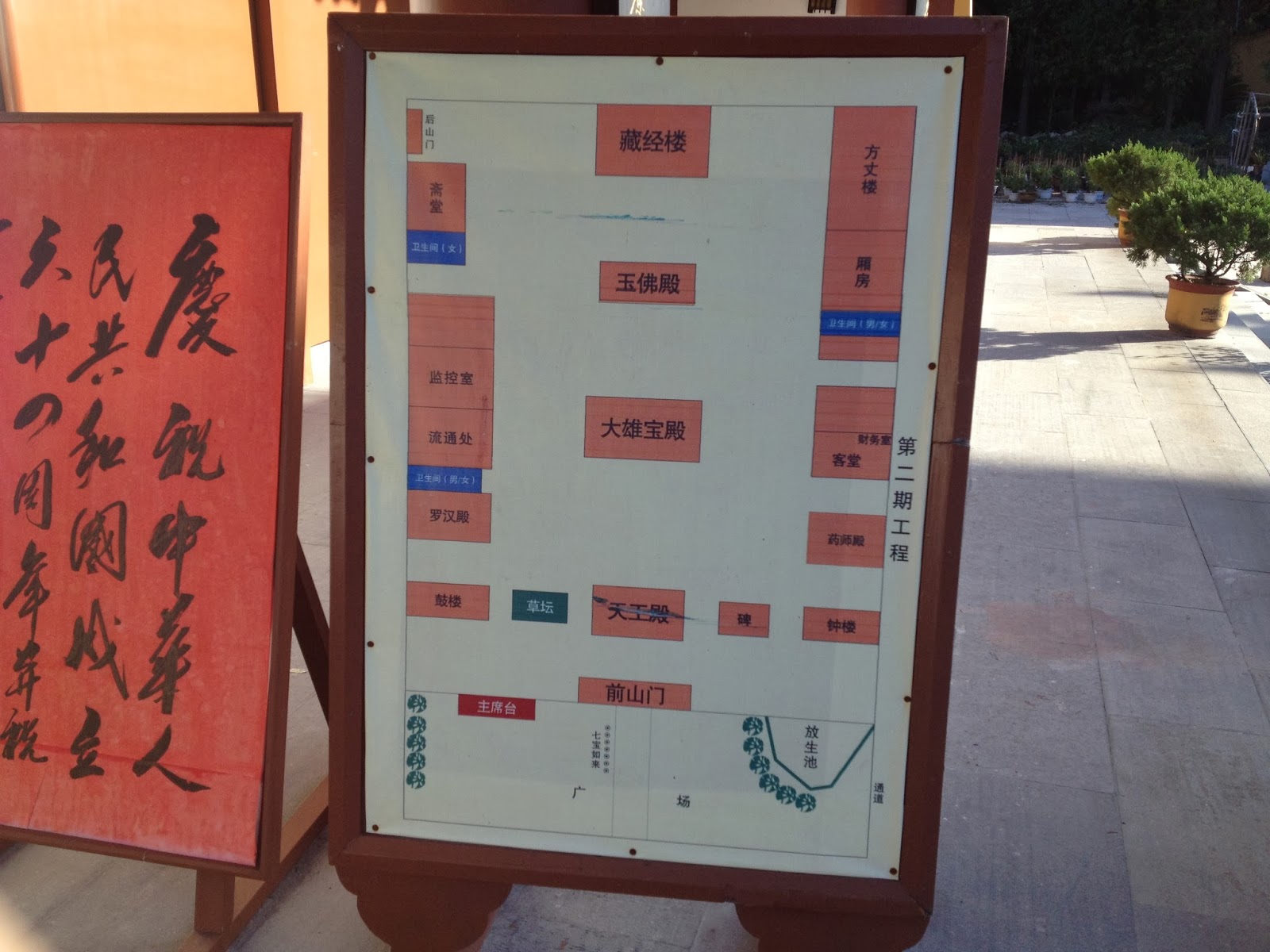
On my recent trip to China I stopped off in Wenzhou.  I had a chance to visit 護国寺.  Evidently there used to be a 護国寺 in Beijing, but it was destroyed in the 1950s. So originally 護国寺 was about protecting the nation in imperial times. You can read into the name of the temple now all kinds of cynical things about the government, but about my visit there, well, it's clear the people going there don't seem particularly cynical about it.  Like many temples this one seems brand spanking new; in fact construction is still going on there.  It's evidently a Pure Land temple - no 禅堂 to be seen, but typically the schools of Buddhism tend to mix.

In the main hall (2nd picture down) there was a chanting service going on with lots of lay people being led in chanting by a monk, on a Saturday mid-afternoon.

I saw a bunch of blue collar guys - in their 20s- entering the temple smoking cigarettes, and having a regular Chinese bro early fall afternoon, laughing loudly.  A few minutes later  a monk was showing these guys how to offer incense, which they reverently did.

Say what you will about China and religion, but on this day, 護国寺 was bringing people calmness and tranquility and peace, and yes, compassion.   You might say China is trying to co-opt Buddhism, but I might point out it seems to be the other way around as well.  Wenzhou tends to have a high population of Christians (yeah, there's brand spanking new Christian churches there too) but it's clear that there's a resurgence of Buddhism amongst people here.

So just to let you know, there's more forms of emerging Buddhism than you can shake a stick at, which of course you can't.


Sunday, January 08, 2012

I hope it's not a Buddhist Theme Park they have in mind...


LUOYANG, Henan - "It's unusual to see exotic Buddhist buildings at such an ancient Chinese temple. They're so delicate and look so different from the traditional Chinese temples next to them," said Tang Chan, a 22-year-old college student, looking at the Indian shrine at Baima Temple.
The Baima Temple - White Horse Temple - aspires to be not only the oldest, but also the largest and most international Buddhist temple in China.
Henan province, in Central China, has approved a plan to expand and renovate the temple into a 1,300 mu (87 hectare) cultural park over eight years, the largest in China by then. It currently covers 20 hectares.
The almost 2,000-year-old temple is creating an International Temples Zone to showcase 10 exotic shrines from foreign countries, said Wang Xiaohui, director of the religious affairs bureau in Luoyang, where the temple is located.
The Indian shrine opened in May 2010. A Thai shrine built in the 1990s is being expanded and will open in April. 

In case you don't know, Baima temple -  白馬時 - or Hakubaji in Japanese- or White Horse Temple - is a famed temple that is said to be the first (or one of the first) Buddhist temple(s) in all of China.   When I had visited there last summer, I had actually seen the Thai and Burmese shrines there, but it was the "Chinese stuff" about the temple that kept my attention e.g., the place where the Sutra in Forty Two Sections - the first sutra said to have been translated into Chinese - was translated.  The Sutra in Forty Two Sections was also the first sutra translated into English by D.T. Suzuki around about the time when he went to the US with Soen Shaku.

Now in reality it won't be like Buddhist Disneyland - I mean, when you're there its obvious you're among antiquity that predates Hagia Sophia in Istanbul so anything they add will look pasted on. And probably they'll want to keep some kind of Chinese feel to the overall place anyway - it is China, after all.

But despite the impermanence of everything, I don't see the point of speeding up the inevitable.

Monday, October 03, 2011

China, History and the United States

I haven't said anything prior to today on Barbara's recent posts on Tibet (latest here.)  Mostly I think it's because we mutually consider that the other has drank Kool-Aid.

I'm not going to convert her, and the information about Tibet that challenges the Tibet independence movement  narrative I've posted all over the place in the past.

I'd like to bring your attention to something tangentially related instead, which should put your mind in a new way about this whole China thing.

Over the weekend I saw Legend of the Fist: The Return of Chen Zhen which is only the umpteenth film I've seen from China in which there is an over-riding narrative of exploitation of China by foreigners whose propaganda value is redeemed by its amazing cinematography, and, in this case, a nice homage to  Casablanca wherein The Internationale replaces La Marseillaise as the patriotic song played in the nightclub, which immediately appears completely incongruous to a Westerner (for reasons I won't mention here). 

Behind that cinematic stunt though, is something important and undeniable: China was being heavily exploited by the Western and Japanese powers during the 20s & 30s.  This particular movie takes places in the mid-1920s, the so-called "Warlord Era" of China.  To get an idea of how screwed up China had become, take a look at the Wikipedia article on it, and try summarizing the whole period in 2 paragraphs.  Then remember that the current ruling entities in China today, the Chinese Communist Party and the Republic of China, owe their very existence to support from the Soviet Union (the Western powers, including the United States, were pretty much content to let China become colonized). Needless to say both the ROC and the PRC consider Tibet part of China, which is not surprising since the relevant warlords took the same position.

I've said over and over that the issue of Tibet is for the Chinese and Tibetans to work out amongst themselves.  There's about the same order of magnitude of Tibetans in the world as there are speakers of Catalan - I won't post a link; you can find that out for yourself.  I'm sure the parties involved can work something out if they want to do so.
But now I wish to consider the United States instead of Tibet.

At this moment, after reading that article about the warlords, I'm struck by the parallels between what happened in China in the 20s and what is happening now here.  The Occupy Wall Street movement is only just now starting to pick up steam in response to the corporate warlordism that has infected the structure of the United States government.  In effect, corporate oligarchs control the government, rendering the social contract with the people null and void.  Corporate warlordism has rendered American narratives of "freedom" and "justice" and "liberty" are being shown to be as hollow as the Qing emperor's "mandate of heaven."  Partly this is a feature, not a bug of the American governmental structure (remember the whole edifice was put in place in the first place to ensure that the haves continued to have and get more of  what they had, even if  what the haves "had"  included slaves.   It's not for nothing that the recent movements in the Middle East are replacing their dictatorships with parliamentary styles of government as opposed to the American model, which has been pretty sad in most of the rest of the world where it's been tried (the Philippines and Argentina, in case you were wondering.)

The inevitable result of "smaller government is best" pushed to its reductio ad absurdum is warlordism.  You read it here first.

But it appears for the US that the chickens are coming home to roost now; the fat's in the fire.  We're in for some wild times here and in much of the rest of the world.  I'm concerned that what's immediate is going to get a lot bigger, and a lot more serious than we've seen previously.

Let's hope we all have the wisdom to do the right thing, and in particular, that at least in the US the Democratic Party wakes up and figures out which way the wind is blowing.

Thursday, September 15, 2011

"Stop fighting! You're fighting!" or, "What's Chan got to do with it?


I'm thinking a bit more about the Shaolin/Buddhism/commercialism issue and Barbara's recent post here on this subject, and I think it might be a bit useful to expound a bit on the martial arts from my rank beginner point of view.  It might inform the discussion on why folks might flock to Shaolin and why folks at Shaolin might seek to protect their name.

I don't come naturally to martial arts, and I suspect most folks don't.  One has to seriously practice to get to a level of skill.  It seems part of the "fight or flight" response, triggered by the rush of adrenalin, is that "fight" tends to mean a tense hyper-vigilance.

One of the aspects of Wing Chun, which, I think is shared in other martial arts (it's too profoundly useful not to have been exploited by others), is the notion that force and tenseness are not usually used to the exclusion of relaxed action.  In fact, the vast majority of such moves are made in a relaxed, smooth, flowing manner.  This can be quite difficult when one has been conditioned from late toddler-hood to expect a "fight" simply because someone is facing you who is going to punch you.

In fact, it is so conditioned that folks, myself included don't even know how to punch effectively at first.  Even experienced students in my class will hear the sifu chiding them with a chuckle, "Stop fighting! You're fighting me now!"  All well know the guy is pretty much impenetrable when it comes to actually, uh, fighting. And it's not the point of the exercise anyway.

If you're "fighting" you're not going to be applying the iota of force in the right place and time that makes it all devastatingly effective.

All of the above is to say that martial arts can, and if practiced will teach aspects of ourselves that we didn't even know we needed to learn.

Of course it's the same with a Zen practice as well; thus in John Daido Loori's book The Eight Gates of Zen a chapter is devoted to "body practice," an application of Zen practice in the awareness of the body which might otherwise be called "body kung fu" (功夫) perhaps.

To me, it's an extremely important thing to learn because it has implications for pretty much near everything I do from day to day, most of which I'm not remotely aware of at this time.

And it goes beyond this: it calls into question (just like good Zen practice should) the most basic preconceptions and conditioning I have about myself and others.

If what they do at Shaolin is remotely related to the above, I could see why they would want to make sure it's not ripped off by cheap knock-offs. 

Friday, August 19, 2011

Stirring a bit of life back into this blog...a summary....

                                                       Buddha from Longmen Grottos, Henan Province


It's not for lack of material; largely it's been for lack of time. As my family is in China for the summer, I've had less time for blogging than usual, especially given the fact that I started taking Wing Chun from a teacher some 25 or so miles from where I live. And today I have to go to Greece - I'm looking forward to the weather (it's been a rather cold summer here in the Pacific NW). But I get this feeling I'm going to be witnessing something close to the collapse of a government/social disorder/etc. But for want of a few blog posts here and there, here's a few points for those who might still follow this blog from time to time: 

  • Barbara's recent posts on Tibet - especially her latest -  are remarkably free of perspective at how disingenuous the Tibetan exile organization sounds to the Chinese. I mean really.
  • I had been meaning to put a comment on her site that she might be being indirectly subsidized by the Chinese government; China Daily accepts branded content from the NY Times every now and then, and About.com is owned by the NY Times. 
  • Having actually, really, taken a martial arts class from a teacher in one of the world's most renowned lineages of the art (hence the 25 mile drive each way twice/week), I think I can begin to write about martial arts and Zen Buddhism.  And the martial arts themselves.  But instead I should be practicing both Zen and Wing Chun.  
  • One post would be how a martial arts practice informs a Zen practice from  a purely physical point of view.  
  • One post would be - I have done yoga  as part of my pre-zazen practice, and I have taken a few classes in other martial arts, but really practicing a martial art such as Wing Chun (and there are others, I'm sure) results in a deep re-assessment of one's self that yoga, I'm afraid, can't really provide.  It's true.
  • I could write 3 or 4 posts on Wing Chun itself. It is a system that whoever invented  it - some say Ng Mui - whoever invented it was a smack down absolute freakin' genius.
    • One thing that is amazing about it is how little you need to learn to actually begin to replicate what you see in the movies.  Ah, but to perfect those moves takes a hell of a lot of practice, because...
    • Another thing that is amazing about it is how profoundly counter-intuitive aspects of it are, relative to some arts such as Tae Kwon Do and various schools of karate.
  • Regarding martial arts - as in Zen - I'd say the specific school is nowhere near as important as finding a good teacher.
  • And yet another post would be a re-assessment of the "yoga & zen" thing.
  • I'm also meaning to post on "Buddhism and the Internet of Things," mostly because as a guy who actually researches the "Internet of things" and studies Buddhism the "topic" comes across to me as "Buddhism and Consumer Product  R&D," or something like that - it's an almost absurd juxtaposition of terms.
  • I'd also been meaning to post on the recent economy of late.
  • And how to get back into practice.

That's all for now.  That should stir up some stuff...

Tuesday, July 19, 2011

Americans do not get China, as we head to oblivion

I remember hearing recently - I might have been in China when I heard this - that China recommended that the United States engage in more social spending and less defense spending in order to more reliably pay its debts.  Say what you want about the flaws of the Chinese system, they're right on the money here.


In Kaifeng, Henan province, they've opened a "historical theme park" based on a scroll created in the Song dynasty (roughly our Middle Ages - a high point of Chinese civilization).  This is clearly a country that wishes to tie its past to its present (wait til I show you what the Confucius temple/home looks like).  It is clearly a country identifying itself as the leading force in the world.  While I was in China, there was wall-to-wall "coverage" of  the 90th anniversary of the founding of the Chinese Communist Party.  The Chinese governmental system is best described as hopelessly complex, and not without its own problems.  I read the Wikipedia entry on it, and still don't understand all the details of it.  But one thing is for certain: it seems to have been attempted to create a structure that doesn't simply put an oligarchy based on wealth in a privileged position in the country.

And the USA?  Well, our system is more or less deliberately designed to favor the wealthy and powerful.

And we are currently debating whether we shall be impoverished by benign warlords or by vicious, psychopathic warlords.

I'm not saying this because there's these pictures I took either - this "theme" seemed to be apparent everywhere I went in China.  I'll probably be repeating it a lot.

Thursday, April 28, 2011

Turns out Zen is about Buddhism


NellaLou has a great post on the continuing saga at Madhushala, and hits all the right notes, in my opinion, about Merzel and what his Sangha and Board should do.

But in writing about that, and  doing some stuff at work related to my company's business as well as searching for temples in which to visit in my upcoming trip to China this summer, I became aware of a few things, not all of which appear to be immediately related to the subject at hand, at least at first:
  1.  I was still wondering why this Rube Goldberg financial structure existed that to the casual visitor's mind, conflated "Big Mind" with "Kanzeon Zen Center." It was, I think, clear enough in retrospect: "Big Mind" served as Genpo Merzel's way of introducing "Zen-like" things into non-Buddhists.  It would  end up  to be a case of the tail wagging the dog here.
  2. Ditto for this "Integral" stuff:  It still appears - to me - that this whole "Integral" thing is nothing more and nothing less than a clumsy attempt to try to "make Buddhism better" by blending it with pop-psychology and New Age woo. 
  3. In Southeastern China, there is a plethora of Zen temples; some of which are undoubtedly brand spanking new (like the one in North East China I wrote about in 2009) but many of which are remnants and regrowth of the original temples. And there's an obvious reason for the original temples and the growth of Chan in this part of China if one thinks about  the realities of that part of the world: Guangdong, Fujian, Zhejiang, and Jiangsu provinces are a melting pot of dialects/languages, more than a few of which are not mutually intelligible in any meaningful degree; look up each of the places on Wikipedia if you want more information about that.  If ever there was a place that needed a doctrine of "no reliance on words or letters" it was this place.  And if there was any place here that was "the right" place to see Chan Buddhism in China, it would be here. But exact temples and locations might not matter all that much, eventually; it was the practice itself that mattered. 
  4. Introducing Zen Buddhist concepts to non-Buddhists is not in any way an easy task facilitated by "dialogues" with other "gurus" or creating meta-concepts in order to "bridge" or "transcend" ideologies.  It took Japan over a thousand years to come up with the concepts of Ma ( 間) and Wabisabi (侘寂 ) - not to mention the application of Zen to the martial arts the like.  And they're still struggling with what kind of a culture they want to have!
All of which is to say that Zen Buddhism is about the cultivation of skill of Buddhism.  It took folks a long time to figure out a whole bunch of things related to how we live, including, but not limited to why it's good to boil water, how to get to eat rice, vaccines, karma, how much sleep to get, and 10,000 other things.  Ditto for how to cultivate the skill of Buddhism. And we have to practice it, even when it's painful or not what we "like" or what others "like."

It is true we take vows in Mahayana Buddhist to save all beings, but we do that through living our own mundane little lives which briefly flicker in this place in the blink of the blink of an eye in the life of this small speck of iron in an unfashionable part of the Milky Way galaxy.  And there are no shortcuts in our own little mundane lives. If there were, we'd be cutting out the profundity of it all along with the mundaneness.

Zen Buddhism is about the cultivation of skill of Buddhism. That means that our lives are crafted by us, slowly but surely, imperfectly, impermanently, and surely incomplete.  As NellaLou points out, there is an infusion of doubt (and I'd also add faith) in this.   This skill may be passed to others in the way a craftsman passes his skill to an apprentice; in the same way it's folly to think that one can pass the gist of any highly refined skill to just anyone without emphasizing that diligent training is needed to be able to make any fruitful use of skills.

Temples and sanghas are good of course, but there's a time and a place  for everything, and if the "sangha" in question is more devoted to something that goes against the way in which a life is rightly to be lived, it's time to re-examine what that sangha is all about, just as in finding "the" historical temple of Chan Buddhism overlooks the Much Bigger Thing.

Thursday, April 14, 2011

The Wenzhou region is replete with Chan Temples

As I had previously mentioned, this year I'm going to spend a near two weeks in China, visiting my wife's family, among other things, in China. My wife comes from Wenzhou, which, as Wikipedia describes it:

Wenzhou, also known as Yongjia (or Yung-chia,永嘉) has a history which goes back to about 2000 BC, when it became known for its pottery production. In the 2nd century BC it was called the Kingdom of Dong'ou. Under the Tang Dynasty, it was promoted to prefecture status and given its current name in 675 AD.

Throughout its history, Wenzhou's traditional economic role has been as a port giving access to the mountainous interior of southern Zhejiang Province. In 1876 Wenzhou was opened to the foreign tea trade, but no foreign settlement was ever established there. Between 1937 and 1942, during the Second Sino-Japanese War, Wenzhou achieved importance as one of the few ports still under Chinese control. It declined in the later years of the war, but began to recover after coastal trade along the Zhejiang coast was re-established in 1955...

Wenzhou is also the birthplace of China’s Mercantilism. From the Southern Song Dynasty, in contrasted to the Confucianism represented by Zhu Xi and Lu Jiuyuan in China urging people to study to be officials in the future, the theory of Wenzhou’s Yongjia School represented by Ye Shi, emphasized the importance of business. The theory has an enduring impact on the mindset of Wenzhou natives and has become the “cultural gene” in the economic development of Wenzhou ever since.

Renowned as the cradle of mathematicians in China, the city has teemed with over 200 mathematic professors in the recent 100 years, among whom Su Buqing, Gu Chaohao, Jiang Lifu and other mathematicians have enjoyed great fame both at home and abroad. Furthermore, Wenzhou is also reputed as the “Home of Swimming in China”, “City of Chess” and “City of Poetry in China”.

They speak a rather unusual dialect/language

Anyway, I've been there a few times before, and whether it's an improvement in Google maps, an improvement in the opening up of China or what-not, it seems now that there are many more Chan temples in Wenzhou than I'd been able to find before. I do hope to visit at least one of them, as I have when I went to Tianjin and Xi'an, to talk to the monks, and perhaps find an afternoon for practice at a temple.

That last part might be difficult, since it is difficult for a layman to actually spend time practicing at a Chinese Chan temple, for the moment at least. But then again, my darling wife is one heck of a negotiator...but then again, we're talking theA-list of top seeded world class negotiators when we're talking about Wenzhou, as the rest of the Wikipedia entry would imply.  These are the folks who basically started China's upward climb to economic dominance.


(Click on the link below and it has 3 links at the lower left, with increasing radius.)


View Larger Map

And oh...they have a Shangri-La Hotel there now! Considering that it's only slightly more expensive than the Shiloh Inn in Long Beach Washington  (and substantially cheaper than anything 3 steps down in comfort and quality from its price equivalent in any major American city)...and this is the finest hotel chain I've stayed at in Asia...well...I gotta do some negotiating on my own...maybe I'll bring them for the breakfast at least. You can't beat a Shangri-La breakfast...

Thursday, March 10, 2011

Ah, I won't be going to the Buddhist Geeks Conference


I woke up this morning realizing that a colleague had been overbooked for two important appointments.  I am not sure why that clicked at that moment for me, and I'm not sure exactly why that woke me up.   Though I understand how it got that way - there wasn't an awareness of how time needs to be allocated.  But probably he's making the right decision to not attend one of the appointments.

And so it is with myself and the "Buddhist Geeks Conference."  I'll be in China that week.  Perhaps my apprehension of the "emerging face of Buddhism" will have a international and intercultural than at the conference in California.  Regardless, I'll be spending some long-overdue time with my family.  And that's good.  I am hoping, in addition to long overdue visits with in-laws to be able to visit another of the temples in China that are as much or more an emerging face of Buddhism as at the conference in California.  As I'd mentioned previously much of the Chinese evolution of Chan Buddhism is unknown in the West.  My Mandarin is practically nonexistent (thankfully - hey, this post is getting Buddhist geeky! - I can write Hànzì via my knowledge of Japanese & my iPhone in real time, which served me well negotiating with a cab driver in Xi'an). Others have had more success than I in discovering this practically unknown treasure . (Unknown that is to non-Chinese Buddhists in the US - where's an Angry Asian Buddhist when you need one?)  But in the conversations I have had, I have been highly impressed with both the parallels with other Buddhist practices I've known and with the depth of practice in China.
 
Buddhist practice is emerging, to be sure. In the corners of the world where I live, which increasingly is a life lived in different times at different times in different places thousands of miles away from  each other, it is where I find it.   It's at home. It can be on the streets of Wenzhou.  It can be in Kobe, not far from the place reputed to be Yamaguchi-gumi headquarters. It can be in Little Italy, not far from the streets of Ground Zero, or in Flushing, where religious freedom was born in the United States, or in Elmhurst, where Chan practice continues in the US via Sheng Yen's lineage.  It can be in Europe.  Mostly though, it is with those with whom I am highly privileged to share my life, wherever we find ourselves.   It can be trying to teach my son to maintain equanimity in the face of those who want to convert him to their religion.  It can be cleaning up someone else's mess. It can be sitting with the early March rain pouring down outside.  It can be writing report after report after report. It can be endeavoring maintaining my own equanimity in the face of others' frustration which erupts as anger. (Ah, that can be an endeavor.)  It can be on-line.  It can be in a politician's town hall meeting, or at the county fair. It can be the moment when a fundamentalist Christian tries to "witness" to my wife's friends at the local Chinese New Year festival. It can be anywhere, really.  But it requires showing up. It's time for me to show up, with great faith, great doubt, with a mindfulness that is neither too taut nor too loose.

Friday, December 17, 2010

Wikileaks: Putting some context to the Dalai Lama and the 2008 unrest in Lhasa, Tibet, China

Here's a few things to read:

The Dalai Lama said Thursday that he supported Beijing’s hosting of the Summer Olympics, but he insisted that pro-Tibet demonstrators had the right to voice their opinions during the international torch relay as long as they refrained from violence.  
During a brief stopover in Japan on his way to the United States, the Dalai Lama, the exiled Tibetan spiritual leader, told reporters no one should try to silence demonstrators who are protesting Chinese rule in Tibet. But he struck a conciliatory tone toward Beijing, apparently distancing himself from calls in the West for a boycott of the Olympic opening ceremony.
“We are not anti-Chinese,” he said at a news conference at Tokyo’s main international airport in Narita. “Right from the beginning, we supported the Olympic Games.” Speaking of pro-Tibetan protesters, he said nobody “has the right to tell them to shut up.”
He faulted Beijing for suppressing antigovernment unrest in Tibet last month, saying its use of violence was “an outdated method” that did not solve the underlying problems. That unrest, the most severe in the region in two decades, and the resulting Chinese crackdown have touched off sympathy protests around the world, with demonstrators demanding greater freedom in Tibet. 

The Dalai Lama related an earlier conversation with a Chinese scholar that convinced him the "positive scenario" he outlined on March 28 -- where the PRC agrees to dialogue and permits a degree of Tibetan autonomy -- was a possibility. The Dalai Lama described this unnamed scholar as interpreting the regular use of the Dalai Lama's name by Chinese leaders and references to 'the Dalai clique' as signs they were prepared to engage with him. If PRC leaders ignored the Dalai Lama and focused instead on the Tibetan Youth Congress and Tibet-based leaders of the uprising, that would indicate the PRC planned to bypass him, according to this scholar... Immediately prior to meeting with PolCouns, the Dalai Lama met with XXXXXXXXXXXX. The Dalai Lama said XXXXXXXXXXXX had been in touch with Chinese interlocutors who convinced XXXXXXXXXXXX that a deal could be made: if the Dalai Lama supported peaceful transit of the Olympic torch through Tibet, then the PRC would simultaneously release Tibetans who had been detained since March 10. Comment: XXXXXXXXXXXX... While Indian observers believe that pressure on the PRC to engage with the Dalai Lama is growing, his candid comment that "Tibet is a dying nation" indicates increasing desperation as a result of his ability to affect events in his homeland.

    So what we can say is:
    • There isn't any credible evidence that the Dalai Lama knew, or orchestrated events in regard to the riots in Lhasa.
    • However,  his admission of a lack of control of what is going on in Tibet implies as well that at least part of the Chinese version of events: violence against Han Chinese in Lhasa could well be true.
    • The Dalai Lama's failure to speak in regard to any violence against Han Chinese in this incident  - or even to acknowledge that this might be a possibility! clearly is something his fans in the United States ought to consider.  Instead,  representatives of the Dalai Lama's organization immediately claimed they were "baseless" allegations.
    • Also his relative insouciance towards anti-China protests after the riots in Lhasa didn't seem to do his cause any good, and he seemed to have an indication that it wouldn't.

    Thursday, November 04, 2010

    A bit more on the experiences of the 20th Century Chan Masters

    Information related to this particular post seems to be like Brigadoon - it seems to appear in some places in some searches but then disappear.  But Wikipedia has the information I wanted to note about Hsu Yun:


    After returning to China, During the Master's fifty-third year, he joined with the Venerable Masters P'u Chao (Universal Illumination), Yueh Hsia (Moon Aura) and Yin Lien (Lotus Seal) to cultivate together. They climbed Chiu Hua Shan Mountain and repaired the huts on Ts'ui Feng Summit, where Dharma Master P'u Chao expounded the Mahavaipulyabuddha Avatamsaka (Flower Adornment) Sutra [11].
    When the Master was fifty-six, the Abbot Yueh Lang (Clear Moon) of Gao Min Monastery Gaomin Temple, 高旻寺)in Yangzhou was going to convene a continuous twelve-week session of dhyana meditation. Preparing to leave, the group asked the Master to go first. After reaching Ti Kang at T'ung (Great Penetration), he had to cross the water, but had no money. The ferry left without him. As he walked along the river's edge, the Master suddenly lost his footing and fell into the rushing water, where he bobbed helplessly for a day and night [12]. and was caught in a fisherman's net. He was carried to a nearby temple, where he was revived and treated for his injuries. Feeling ill, he nevertheless returned to Yangzhou. When asked by Gao Ming whether he would participate in the upcoming weeks of meditation, he politely declined, without revealing his illness. The temple had rules that those who were invited had to attend or else face punishment. In the end, Gao Ming had Hsu Yun beaten with a wooden ruler. He willingly accepted this punishment, although it worsened his condition.
    For the next several days, Hsu Yun sat in continuous meditation. In his autobiography, he wrote: "[in] the purity of my singleness of mind, I forgot all about my body. Twenty days later my illness vanished completely. From that moment, with all my thoughts entirely wiped out, my practice took effect throughout the day and night. My steps were as swift as if I was flying in the air. One evening, after meditation, I opened my eyes and suddenly saw I was in brightness similar to broad daylight in which I could see everything inside and outside the monastery..." But he knew that this occurrence was only a mental state, and that it was not at all rare. He did not become attached to this achievement, but continued his single-minded investigation of the topic, "who is mindful of the Buddha?" over and over again, he delved into this topic without interruption [13].
    During the twelfth lunar month, on the third evening of the eighth week of the session, after six hours of sitting meditation, the attendant made his rounds, filling up the tea cups. The Master's hand was burned by spilling boiling water, and his cup fell to the floor. At the sound of the crash, the root of his doubt was instantly severed. He was joyous beyond words at having fulfilled his lifelong ambition. It was as if he had just awakened from a dream, and he observed how the conditions of the past unravel. If he had not fallen into the river and become gravely ill, if he had not met good advisors who plied him with both adversity and felicity, how would this present experience have been possible?
    The Master's verse explanation says:
    When a cup fell down and struck the floor,
    The sound of the crash was distinctly heard;
    Emptiness was pulverized
    And the mad mind stopped on the spot.
    Another verse by the Venerable Master Hsu Yun says:
    The hand let go-the cup was shattered.
    Family broken up, people have died-there's no way to talk about such things.
    Spring arrives, flowers are fragrant, and everywhere is infused with splendor.
    The mountains, rivers, and great earth itself are just Tathagatas.[14].

    All of the above evidently comes from here


    Oddly enough, links related to this - as well as an inquiry about this - keep appearing and disappearing.  Perhaps what's written here is embellished.  Perhaps not.  But what is clear is that despite perceived hardship, like other masters and seekers who find, Hsu Yun persevered. Oddly enough though, it appears that his successors' sites are a bit less Chan flavored, at least as far as the public is concerned. That is why, as many before me have said, Great Determination, along with Great Faith and Great Doubt is necessary.

    I might have more to say on this later.

    Saturday, October 30, 2010

    Another post on "nurturing" versus "marine boot camp" Buddhism

    I have sat with two teachers who are women in my days...two of which were in the same general lineage as Barbara O'Brien.  And I am very grateful for their teachings. 

    But...also...

    My doctoral thesis adviser was a Holocaust survivor.  Another teacher at Polytechnic routinely failed 2/3 of his class - from him I truly learned how to bring elegance, beauty and clarity and discipline to real world engineering problems.  There's a guy mentioned on the Tricycle blog who says wisdom isn't found at universities, and I call BS on that. If you are in the right place at the right time you may meet a real teacher, even if he's not a Buddhist.

    Teachers in my lineage had to endure much in Japan during and after the war.  They had to practice amidst those conditions.  As I noted on Barbara's blog, the great mainland Chinese Chan masters of the 20th century endured unspeakable hardships both in and outside  the temple and not only due to the Communists. 

    That's why eventually on Barbara's blog I wrote that the experience of these people - and their students make Nomura-san's experience at Eihei-ji, even if true, seem like a paper cut by comparison.  It seems self-evident to me that there is a point to the hardship at these temples, and it is to teach the student that the hardship ain't nuthin' compared to the unspeakable hardships untold millions of beings have faced and do face.

    It is true that, um...hardship is hard.  And not everyone can pass through it - or should.  But to those who can and do, to those who can meet their greatest fear and pass through it, in the midst of it,  there is a skill given that enables one to help.

     Barbara wrote,


    But the point is that this monastery -- an all-male enclave in a patriarchal society-- sounds out of balance; way too much yang, not enough yin. It seems that the old boot camp feel was an echo of hyper-masculine qualities of Japanese Zen, and now that echo is fading away.

    That sentiment can't help but seem to me to be "out of balance" itself; it seems like she is practicing a feminist reaction to perceived and actual injustices of a patriarchy rather than Zen.  And I'm sorry if she's offended but Zen will still be Zen and the Dharma will still be the Dharma no matter how much there is a Yin/Yang "imbalance." 

    Although it's Taoist, and not Buddhist, it seems fitting to quote Lao Tzu here:


    When the great Tao is lost spring forth benevolence and righteousness.
    When wisdom and sagacity arise, there are great hypocrites.
    When family relations are no longer harmonious, we have filial children and devoted parents.
    When a nation is in confusion and disorder, patriots are recognized.
    Where Tao is, equilibrium is. When Tao is lost, out come all the differences of things.


    Do away with learning, and grief will not be known.
    Do away with sageness and eject wisdom, and the people will be more benefited a hundred times.
    Do away with benevolence and eject righteousness, and the people will return to filial duty and parental love.
    Do away with artifice and eject gains and there will be no robbers and thieves.
    These four, if we consider them as a culture, are not sufficient.
    Therefore let there be what the people can resort to:
    Appear in plainness and hold to simplicity;
    Restrain selfishness and curtail desires.


    Sometimes it isn't a bad idea not to try and fix and improve everything.  The Dharma will still be the Dharma whether we practice in a way too much "Yin" manner or way too much "Yang" manner.

    Thursday, October 21, 2010

    Hsu Yun, Lai Guo, and Chinese Chan Buddhism

    It is not often known in the West, especially with all the Dalai Lama Hoopla, but in fact one of the founders of the PRC-run Chinese Buddhist Association was, in fact, a legit, real-life, legendary dyed in the wool Chan Buddhist, Hsu Yun. This was despite the fact that like many Buddhists, Hsu Yun was mistreated and tortured by the Communists at that time.

    Both Hsu Yun and Lai Guo (whose Dharma heirs were also mistreated or killed) are today both revered as ancestors at temples such as Wolong-si.

    Master Lai-Guo was one of the great masters of the early twentieth century. He preside over Gao Min Monastery during one of the most difficult times in China, yet he was able to maintain all the rules of a traditional Chan "Forest" Monastery. He refused to hold any non-Chan-related activities (Fo Shi), the traditional way monasteries generate income. Often the monks only had rice bran to eat. Once, on Buddha's Birthday, they had no food to offer so they boiled hot water, offered it to the Buddha, drank some themselves, and went back to meditate.

    Master Lai-Guo passed away in the early 1950s, a few years after China's "liberation". The lineage was passed to his disciple Master Chan-Hui, who was later classified as a "Rightist". I never found out what happened to Master Chan-Hui. Perhaps he was beaten to death. (Master Hsu-Yun was severely beaten during this time, and his only written work, an annotated Surangama Sutra, was burned. A few of his disciples were executed after being classified as a "Rightist").

    During the Cultural Revolution, Gao-Min Monastery was bitterly attacked. All was destroyed including the famous Chan hall where numerous masters became enlightened and which housed five “Flesh Body Bodhisattvas” (Ro Shen Pu Sa i.e. “whole body relics”). Like Master De-Lin told us, “Gao Min Monastery had disappeared.” The place was turned into a sweater factory. Only the old mountain gate, a gift from Emperor Kang-Xi, survived, perhaps because it was made of stone and would be too difficult to destroy. During the revolution, despite the enormous destruction, many things were spared because they were far away, made of stone, covered by pictures of Mao, or protected by monks willing to burn themselves to scare away the mobs.

    In 1985, several years after the revolution ended, in accordance with Deng Xiaoping’s “Reform and Open” policy, the local government decided to restore Gao Min Monastery. Elder Master De-Lin was invited to take care of business. He was already 72 years old. “People retire in their 50s. I started working in my 70s,” he said.

    It does appear that some of Hsu Yun's teachings survive, however, thanks to Charles Luk.  Reading these teachings one does indeed find strong parallels with Rinzai teaching from Japan.

    That Lai Guo and Hsu Yun are revered in China today amongst Buddhists is certainly true, and yes, at Wolong-si, there are people, ordinary people who are learning Buddhism again.

    Sunday, October 10, 2010

    From Discomfort and Loathing to Awe at Wolong-Si

    It’s a rough ride traveling internationally these days, and the prospects aren’t anything but dim for the future. I had a typically more than uncomfortable experience going economy to my trip to Xi'an, where I'll be on business. Luckily I did have time to make it to Wolong Temple. I'll have more to say about this Chan temple, the amazing recent history of Buddhism in China, and the immediate ancestor of this temple (and of Gao Min Temple in Yangzhou), Lai Guo.  He was a contemporary of the other great Chinese Chan teacher of the twentieth century, Hsu-Yun.

    This is an aspect of Chan Buddhism, and Chinese Buddhism you pretty much never hear about, in the Western Buddhist media.  Meanwhile, feast on some photos. The first one before is a photo of Lai Guo, the ancestral teacher of the current generation at Wolong Temple.  One of the monks there was amazed to meet an American Zen person, and gave me a copy of Lai Guo's Seven  Chan Gate Record.  Unfortunately my Chinese is horrendously bad - I do not say that I speak any bit of Chinese and would have been thought a complete fool had not some student who just happened to know much much more English than I could type words into my iPhone Chinese dictionary could muster.  So, I have no idea what's in this work of Lai Guo, but if you Google him you'll find out a bit about him.  I'll have more to say on this later.  (Click pictures for more detail.)


    Monday, June 21, 2010

    The Dalai Lama on Violence and Dog Whistling

    I think the man is out of touch when he starts to opine about what Japanese youth should do in light of Japan's economic stagnation, although more English skills being learned by Japanese can never hurt.

    But in today's Guardian there's another article about the Dalai Lama, and a message from him in support of the UK's Armed Forces Day.

    I have always admired those who are prepared to act in the defense of others for their courage and determination. In fact, it may surprise you to know that I think that monks and soldiers, sailors and airmen have more in common than at first meets the eye. Strict discipline is important to us all, we all wear a uniform and we rely on the companionship and support of our comrades.

    Although the public may think that physical strength is what is most important, I believe that what makes a good soldier, sailor or airman, just as what makes a good monk, is inner strength. And inner strength depends on having a firm positive motivation. The difference lies in whether ultimately you want to ensure others’ well being or whether you want only wish to do them harm.

    Naturally, there are some times when we need to take what on the surface appears to be harsh or tough action, but if our motivation is good our action is actually non-violent in nature. On the other hand if we use sweet words and gestures to deceive, exploit and take advantage of others, our conduct may appear agreeable, while we are actually engaged in quite unacceptable violence.  

     Mark Vernon in the Guardian writes:

    The Dalai Lama has sent a message of support for Armed Forces Day, which is next Saturday. In it, he writes of his admiration for the military. That is perhaps not so surprising. As he explains, there are many parallels between being a monk and being a soldier – the need for discipline, companionship, and inner strength.
    But his support will take some of his western admirers by surprise, not least when it comes to his thoughts on non-violence...

    What the present Dalai Lama argues, in his message of support, is that violence and non-violence are not always what they seem. "Sweet words" can be violent, he explains, when they intend harm. Conversely, "harsh and tough action" can be non-violent when it aims at the wellbeing of others. In short, violence – "harsh and tough action" – can be attitudinally non-violent. So what should we make of that?

    "What would not be a traditional Buddhist way of talking is to imply that violence is in fact non-violence, given the right motivation", explains Paul Williams, professor of Indian and Tibetan philosophy, University of Bristol. "This is certainly an interesting but perhaps extremely dangerous sentiment."...
     
    But before rushing to too fast a conclusion, another factor must be borne in mind. The Dalai Lama quite routinely says different things to different audiences, an approach that is valued in Buddhism and is known as "skilful means". It is not a kind of duplicity. Rather, it aims to have the right word for the right time and context. The difficulty is that when his words ripple out across the internet, as they do, they are also ripped out of their original context. Skilfully interpreting the Dalai Lama then becomes very hard.

    For example, when speaking in the west, he has drawn much from Gandhi's broadly Jain understanding of non-violence, "ahimsa". "Man lives freely by his readiness to die, if need be, at the hands of his brother, never by killing him", Gandhi wrote in All Men Are Brothers – effectively precluding killing. But such an approach would be odd amongst Tibetans, and the Dalai Lama would hardly be likely to advocate it amongst his fellows.


    In fact, it is possible to get some sense of this greater sophistication by considering his life story. This is man who has lived with the reality of state violence from his youth, and who receives reports of it almost daily, now that he is old. He has previously argued that violence in Tibet is wrong, not on principled but pragmatic grounds, as it would have no chance of succeeding.

     When Mark Vernon writes about the Dalai Lama that "when speaking in the west, he has drawn much from Gandhi's broadly Jain understanding of non-violence,"  that's something we in America call dog whistling.  He's speaking to a select group of people, telling them what they want to hear.  Yet he's still the guy who, with a change of clothes and a change of culture would be in a mold somewhat like  a significantly less virulent form of Jefferson Davis, with differences of serfdom compared to  slavery, and with Han Chinese as the marginalized ethnic group. And yes, the Chinese Communist Party stands in for the Radical Republicans.   Once again, I have to say sorry folks, I'm an American and I don't like racism in any guise.

    It's a recurring point on my blog that Americans who are "fans" of Tibetan Buddhism have heavily idealized beliefs about the Dalai Lama.  (I would not include all practitioners of Tibetan Buddhism as "fans" by any means - I think they're more sophisticated than that.)

    Now I agree with the Dalai Lama's sentiments about the military;  but I also have to give a wag of the finger to him as he, himself, is one of the biggest culprits for presenting "teachings" as bromides that are "truisms trite enough to appear on a T-shirt."  But let's face it folks: the guy with the Twitter aphorisms who dog-whistles non-violence to the West is also not willing to take steps that would be real measures for reconciliation with China.   Don't believe me? He acts as  the titular head of a government in exile.   And here's one aspect Chinese positionAnd here's the most recent Chinese position.   Remember, China has for hundreds of years been recognized as the supreme governmental authority in Tibet, and Chinese heads of state have given authorization to various Tibetan Buddhist leaders, with authorizations as intermingled religious and political roles.  While I know many in the West wish to analogize this to India, or Vietnam, the reality is different.

    Now truth be known, given where he is, he probably has to deal with the inherent conflicts between his role as Buddhist leader and his role as political leader, but I think he is really not being skillful in his execution of his political role as Buddhist.  And I wish he were.

    Let's not place anyone on pedestals, and let's not place on pedestals our attachments to idealizations of people that don't exist and never did exist.

    Saturday, June 12, 2010

    "Buddha remains" unveiled in east China temple

    This bit, which is summarized in the title and in this Xinhua article,  was treated as an event of major importance on CCTV-9.  From Xinhua:


    NANJING, June 12 (Xinhua) -- Chinese Buddhist monks and archaeologists revealed what they believed to be top part of the skull of Sakyamuni, the founder of Buddhism, Saturday morning in east China's Jiangsu Province.
    The object, taken out for the first time around 9 a.m. from a miniature gold coffin nestled inside a silver one, was part of Buddha's parietal bone, said Master Chuan Yin, president of the Buddhist Association of China, after attending the worshipping ceremony held in Qixia Temple in Nanjing, capital of Jiangsu Province.
    The bone, irregular and light brown, looked like a small rock. "It is full of cell-like cavities, just like a honeycomb," said Hua Guorong, deputy head of Nanjing City Museum.
    "Our findings conform with the descriptions of the parietal bone in historical records," said Master Xue Cheng, vice president of the association, adding the bone was hugely sacred for Buddhists.
    Besides Sakyamuni's remains, ten sacred pieces of remains of other Buddhas were also found in another gold and silver mini-coffin.
    All the relics had been enshrined at Qixia Temple by 108 eminent Buddhist monks from the Chinese mainland, Macao and Taiwan. The relics would be open to believers at the temple for one month, Hua said.

     Now I've got a few quick points on this:


    • I tend to be skeptical that these remains are actually related to Shakyamuni Buddha, but...
    • As with any other form of the Buddha,  it is a reflection of the minds that brought it forth.
    • It was evidence from the prominence of this TV show that China really, really, wants to show that they approve of Buddhist practices in their country; as I noted in a comment on Barbara's Buddhism blog, their "background" information could have been written by Karen Armstrong.  But
    • In terms of Buddhist practice, it's nice but it's not like, you know, actually doing it.
    • There are equivalent ceremonies in the Zen tradition; there is a chant in the chant-book in the DBZ tradition that would be applied just for this purpose.  I never knew what it was for, but now I know.
    • I should say though, that I'm not going to accept anyone's narrative on such issues as true or false simply because it is someone's  "official" narrative.
    That's all for today folks.

    Thursday, June 10, 2010

    Politics, Buddhism, American Buddhism, and China - Tibet Policy: Barbara's Buddhism Blog Shows What Not to Do

    Barbara of the About.com Buddhism Blog posted another anti-China screed yesterday.  There's really nothing else to accurately call it, in my view.  Now as I said on a previous post, it's not too surprising that there are Buddhists whose international and politics differ.  What we should try to avoid though is conflating political issues with Buddhist issues, that is, assuming a particular political question, viewed a certain way is a Buddhist question, and I think Barbara has crossed the line.  Before I  go to the tape, let me point out a few things that should be axiomatically obvious to any non-Tibetan lineage Buddhist:
    • The Dalai Lama, as a manifestation of the Boddhisattva of compassion, is specifically a Tibetan Buddhist school designation and in no way encumbers anyone else to recognize that beyond that which is such in anyone else.  
    • Mutatis mutandis for the Panchen Lama and Amitabha.
    • The offices of the Dalai Lama and Panchen Lama are political offices if they are considered as operating within the realm of Chinese/Tibetan domestic and international politics.  Strictly speaking those offices as political offices per se do not encumber any Buddhist to recognize anything.
    I've been very critical of the Dalai Lama, and the conflation of attempts at international support of a political position with Buddhism  for a variety of reasons, not the least because many people speaking on this issue are utterly ignorant or dismissive of the history, geography, and geopolitics  involved.  China has asserted political control over Tibet for hundreds of years; Tibet is seen as crucial strategically to China's stability and ability to defend itself, and it's simply not useful if one is truly interested in peace to be dismissive or vituperative in response to these issues.


    The Panchen Lama is the second highest lama in Tibetan Buddhism. The faux Panchen Lama is Gyaltsen Norbu, son of a Tibetan Communist Party official, who was appointed to the position by Beijing in 1995 a few weeks after the legitimate tulku, Gendu Choekyi Nyima, and his family disappeared. Both boys were six years old at the time.

    As I mentioned here, can't we at least recognize that the "find the kid who's the incarnation of the dead lama" game is one of those practices we can do without?  But this paragraph illustrates my point: a) we Zen Buddhists are in no position to judge who is a legitimate tulku and who is not; only those who choose to become adherents to said tulku do, and b) the office of the Panchen Lama is also a political position, and it is not accurate in the least to say that since China appointed that official (albeit in an atavistic way that is similar to what's been done before)  that he is somehow "false."


    Gyaltsen Norbu lives in Beijing, and his visit to Tibet is a rare event. Xinhua tells us the pretender led a prayer service in Jokhang Temple in Lhasa  and was greeted by lamas bearing incense and silk scarves.

    Beijing can be reasonably certain that no monk of Jokhang would disrupt the ceremonies, since most of the monks were removed for "re-education" during the summer of 2008. Once the Beijing Olympics were over, monks who did not have families in Lhasa were not allowed to return but were sent to their home provinces. The few hundred monks remaining in Lhasa's monasteries -- which are vast complexes that housed thousands of monks in the past -- are approved by government.

     Not just Xinhau's reported on the Chinese-chosen Panchen Lama's activities, but also the BBC (scroll to bottom of post), and The Economist (see my blog entry here; the link is behind a subscription wall, and yes, I do subscribe).  Both posts contradict Barbara's "See? Everyone hates that nasty faux Panchen Lama!" narrative. Big time.

    Towards the end of the post Barbara quotes an article from The Asia Sentinel;  this article too conflates the religious and political.  Most other news sources, recognize there is a political aspect to this, even if they do conflate them.   Barbara ends her post with a quote from that article comparing the fate of the Dalai Lama-chosen Panchen Lama to Pu Yi:


    "Presumably much as the famed last Emperor Pu Yi ended up working as a gardener in the Beijing Botanical Gardens," the Asia Sentinel says. However, the government remains extremely vague about Gendu Choekyi Nyima, and I still think it is unlikely the boy and his family are still alive.


    The Pu Yi reference sort of gives away all the points here.  As anyone who's seen The Last Emperor knows, Pu Yi was not quite a person  one should have shed many tears over; his life was tragic, he was not the sharpest pencil in the drawer, but his life of pampering in no way prepared him for what lay ahead, and he ultimately wound up serving China best as a gardner in the Beijing Botanical Gardens.  Barbara offers no other reason for her belief  about Gendu Choekyi Nyima's demise; that is a statement of prejudice, but then by this point, we are well beyond discussing Buddhist issues, but rather geopolitical issues.

    On edit: It is certainly true that there's been horrific violence done in the past few decades; in China  but that does not justify a belief that the Chinese government is currently disappearing innocent people.    Of course examining that belief, questioning it, wasn't the point of that post, and that's why I considered the stated "belief"  of the killing of these people to be prejudicial, in a similar vein as it would be to suppose that the average Mormon wants to install a Mormon theocracy in the United States, and violently defend it, based on the Mountain Meadows Massacre.  Conflating the China of the Cultural Revolution or Tiananmen Square with the China of today is not accurate either, and  Western and Chinese news outlets are reporting events in China, such as going on at Foxconn and Honda that were unthinkable just five years ago.


    Thursday, May 13, 2010

    Barbara of the Buddhist Blog May Get to Ask the Dalai Lama a Question!

    Her post explaining this is here. I've got a host of blog posts about Tibet, which ought to raise enough questions.

    My question to her would hinge on this post however:

    The man born as Gyancain Norbu was chosen by the Chinese government years ago as an emanation of Amitabha, the so-called Panchen Lama.  Given that there are serious practicing Buddhist clergy in China - any visitor can meet them - and given that the man born as Gyancain Norbu has dedicated his life - literally, as much as you have - to reconciling Tibetan Buddhism with political realities - does HH expect other observers to believe that the Chinese government is trying to "deliberately annihilate Buddhism" as he was recently quoted as saying?  And how can you show compassion for Gyancain Norbu?


    I never quite did get an answer to the first question when I e-mailed it in at the Dalai Lama website.

    Update:  Looking at the questions posed at Barbara's blog, I'm amazed a bit at the woo-ism that passes for Dalai Lama worship.   It amazes me that the leader of a movement that is nondualist in nature is good at amassing a following of people seeing these things as dualistic.  I understand it though: the Dalai Lama must be, as well as a Buddhist leader a political leader, and for that he cultivates a certain persona. It's just personas aren't people.