Is this Mike on?
Will he be accountable?
I have other questions...
Thursday, August 31, 2006
Keith Olbermann channels Edward R. Murrow.
If you haven't seen this video at MSNBC, now at C&L, do so.
Olbermann uses one of my favorite points: these people in Washington are our employees, not our "leaders."
That truth something that I haven't heard expressed in the media until now.
Olbermann uses one of my favorite points: these people in Washington are our employees, not our "leaders."
That truth something that I haven't heard expressed in the media until now.
Friday, August 25, 2006

Notice I haven't been posting here much lately
The demands of work, coupled with the political season have gotten more time at Kos than here.
This blog ain't dead, although it's not been helped by Blogger's weird interface issues of late.
Certainly if this site looks blank, come visit my area at Kos.
Thanks!
Incidently, this attack piece on Markos by the Repugs is the funniest thing I've read in a long time. Evidently the Repugs simply can't figure out the blogs, and don't realize that scaring isn't going to work anymore...
This blog ain't dead, although it's not been helped by Blogger's weird interface issues of late.
Certainly if this site looks blank, come visit my area at Kos.
Thanks!
Incidently, this attack piece on Markos by the Repugs is the funniest thing I've read in a long time. Evidently the Repugs simply can't figure out the blogs, and don't realize that scaring isn't going to work anymore...
Monday, August 21, 2006
Iraq is probably worse than you think
if what Michael Schwartz says is true.
It's kinda like conservative religious wingnut heaven: government is highly decentralized, and controlled at the local level by religious conservatives.
It's exactly the kind of government Bush's religious cronies would bring to the United States if they were to exercise "the crown rights of King Jesus," except in a Muslim paradigm.
So, it looks like we've got victory here as far as religious righties ought to be concerned, so why the heck don't we bug out?
1. The Iraqi Government Is Little More Than a Group of "Talking Heads"
A minimally viable central government is built on at least three foundations: the coercive capacity to maintain order, an administrative apparatus that can deliver government services and directives to society, and the resources to manage these functions. The Iraqi government has none of these attributes -- and no prospect of developing them. It has no coercive capacity...
2. There Is No Iraqi Army
The "Iraqi Army" is a misnomer. The government's military consists of Iraqi units integrated into the U.S.-commanded occupation army. These units rely on the Americans for intelligence, logistics, and -- lacking almost all heavy weaponry themselves -- artillery, tanks, and any kind of airpower. (The Iraqi "Air Force" typically consists of fewer then 10 planes with no combat capability.) The government has no real control over either personnel or strategy...
4. Most Iraqi Cities Have Active and Often Viable Local Governments
Neither the Iraqi government, nor the American-led occupation has a significant presence in most parts of Iraq. This is well-publicized in the three Kurdish provinces, which are ruled by a stable Kurdish government without any outside presence; less so in Shia urban areas where various religio-political groups -- notably the Sadrists, the Supreme Council of Islamic Revolution in Iraq (SCIRI), Da'wa , and Fadhila -- vie for local control, and then organize cities and towns around their own political and religious platforms. While there is often violent friction among these groups -- particularly when the contest for control of an area is undecided -- most cities and towns are largely peaceful as local governments and local populations struggle to provide city services without a viable national economy.
This situation also holds true in the Sunni areas, except when the occupation is actively trying to pacify them. When there is no fighting, local governments dominated by the religious and tribal leaders of the resistance establish the laws and maintain a kind of order, relying for law enforcement on guerrilla fighters and militia members.
All these governments -- Kurdish, Shia and Sunni -- have shown themselves capable of maintaining (often fundamentalist) law and (often quite harsh) order, with little crime and little resistance from the local population. Though often severely limited by the lack of resources from a paralyzed national economy and a bankrupt national government, they do collect the garbage, direct traffic, suppress the local criminal element, and perform many of the other duties expected of local governments.
5. Outside Baghdad, Violence Arrives with the Occupation Army
The portrait of chaos across Iraq that our news generally offers us is a genuine half-truth. Certainly, Baghdad has been plunged into massive and worsening disarray as both the war against the Americans and the civil war have come to be concentrated there, and as the terrifying process of ethnic cleansing has hit neighborhood after neighborhood, and is now beginning to seep into the environs of the capital.
It's kinda like conservative religious wingnut heaven: government is highly decentralized, and controlled at the local level by religious conservatives.
It's exactly the kind of government Bush's religious cronies would bring to the United States if they were to exercise "the crown rights of King Jesus," except in a Muslim paradigm.
So, it looks like we've got victory here as far as religious righties ought to be concerned, so why the heck don't we bug out?
Sunday, August 20, 2006
Saturday, August 19, 2006
Thursday, August 17, 2006
It's about time we stopped with the airport bullshit
I'm serious. I said this right after 9/11: the system didn't work, and it was clear that all the hoo-hah then about "take your shoes offf" and what-not was Kafkaesque nonsense(some jerk even asked me to scan my wallet in SJO, until I protested).
Now it seems, both Matthew Iglesias at the Prospect and Patrick Smith at Salon have started on a similar take. First Yglesias:
Next, Smith:
Really, this has gotten past the point of absurdity. If you're flying, and you're doing that St. Vitus dance at the security checkpoint, there's only one reason, and one reason only: Bush failed to head the Aug. 6 2001 presidential daily briefing, and has failed to address the real issues involved in 9/11...other than caving into al Qaeda's demand and removing almost all troops from Saudi Arabia.
Anybody who's seen a prison drama knows that you can't make something 100% secure. So let's give up the damn illusion that we can. Or let's stop the "power play" with the passengers. We're the ones who're supposed to be in power anyway, in this country.
Now it seems, both Matthew Iglesias at the Prospect and Patrick Smith at Salon have started on a similar take. First Yglesias:
Precisely zero people have been killed in liquid explosive attacks on airplanes. The historical record indicates that we're pretty secure as things stand. But perhaps that's too flip. British law enforcement and intelligence services might not have done such a good job and hundreds could have died as a result of this bomb plot.
Nevertheless, people have been allowed to carry liquid onto planes since time immemorial and we're clearly not awash in exploding aircraft. What's more, inconveniencing air travelers isn't simply a matter of inconvenience. The more hellishly annoying you make it to fly, the more people will drive, either by switching methods of getting to the same destination or by choosing closer destinations. And air travel remains -- despite the risk of a bomb disguised as perfume -- enormously safer than driving. Despite our best intentions, in other words, security can kill.
It's not even clear how many lives can be saved by bomb-proofing airplanes. The dangerous thing about a guy with a bomb on a plane is primarily the fact that the guy has a bomb. Put him on a crowded rush-hour subway platform and he could kill a bunch of people with the blast and let the ensuing stampede do further damage. Or he could derail an Amtrak train. Most likely, such attacks would be less deadly than an exploding plane, but they'd still be pretty deadly. The ultimate number of lives saved could be quite small.
Indeed, as John Mueller pointed out in his seminal article, “A False Sense of Insecurity,” there's good reason to be very skeptical of terrorism-prevention schemes in general. Terrorism is exceedingly rare. We're blessed to live in a world where the actual number of people inclined to murder Americans in terrorist attacks is very small. As Mueller writes, "The number of Americans killed by international terrorism since the late 1960s (which is when the State Department began counting) is about the same as the number of Americans killed over the same period by lightning, accident-causing deer, or severe allergic reaction to peanuts."
Next, Smith:
News of last week's foiled London terror plot had finally begun to drop from the headlines, but not before spring-loading us to act like fools, and touching off massive changes in airport security that are destined to serve no real purpose. Liquids, gels and even certain cosmetics are no longer permitted aboard commercial flights in the United States. Prescription medicines and infant formula are exempt, but the list of contraband includes everything from drinking water to hairspray. Among the forbidden materials: mascara and liquid-filled baby teethers.
On flights to and from the U.K., hand baggage was banned entirely for several days. Passengers may now bring aboard one small parcel no larger than 17 by 13 by 6 inches -- roughly the dimensions of a laptop case. Computers and music players are allowed, but they must be removed from luggage for separate inspection.
It's difficult to tell how long the new prohibitions will last, or to what scope they might be expanded, but the rumblings are ominous. According to officials at TSA, the ban on liquids and gels is set to last indefinitely. Rumors have surfaced that laptop computers and other electronic devices could soon be restricted as well. Is airport security about to experience another, even more powerful paradigm shift than we saw in the aftermath of Sept. 11, resulting in even greater hassle than we're already used to? It's disheartening to think so, but certainly the stars are lining up that way.
To properly get our arms around the folly of it all, we need to look back at what happened in 1995. I'm referring to the notorious "Oplan Bojinka" -- which I wrote about last week -- a conspiracy linked to al-Qaida that was broken up by Philippine police only days before 11 U.S. jetliners were targeted for destruction. The parallels between the Bojinka and London operations are truly remarkable, involving similar explosive materials and a strikingly similar modus operandi. Yet on the heels of Bojinka, airports remained calm. Passengers were free to step aboard with their cups of coffee and bottles of shampoo. This forces us to wonder: If it is truly in the interest of air safety to stop passengers from bringing the most basic and commonplace personal items on board, why was it not done the first time?
Mostly because authorities then had sense enough to understand such rules would be highly disruptive, tediously work-intensive, and in the end not very useful. Ban what we may, it doesn't take the world's smartest criminal to realize there are an unlimited number of ways to smuggle a potentially dangerous item onto a plane: be it an improvised knife hewn from plastic, or explosives or flammables made from many different substances -- solids, liquids and powders. A person could spend all day concocting nefarious, and ultimately undetectable, instruments of destruction.
"We can't keep weapons out of prisons. How can we hope to keep them out of airports?" poses Bruce Schneier, a prominent security expert and the author of "Beyond Fear."
Eleven years ago we were sensible enough to accept this -- and it's not as if terrorism was something new, with the Lockerbie bombing and '93 World Trade Center attack still fresh in our minds. Lo and behold, no American planes were bombed with liquid explosives -- or any other kind -- in the interim. The true nuts and bolts of keeping terrorists away from planes, meanwhile, was going on out of view -- the responsibility of law enforcement and intelligence agencies, not part-time screeners at the airport. Numerous intelligence failures were brought to bear on Sept. 11, certainly, but unfortunately our initial reaction was to scapegoat airport security, whose role in the attacks was all but irrelevant. At the time, box cutters were not prohibited items. If they had been, the hijackers would have fashioned some other weapon.
The X-ray machine and metal detector are what they are: a serviceable final line of defense, chiefly helpful for keeping obvious weapons -- a handgun, for example -- away from commercial aircraft. They are not, and we should not expect them to be, front-line anti-terror tools.
"Terrorism needs to be stopped at the planning stages. That's where our security can do the most good," Schneier says. "By the time the terrorist gets to the airport -- or the shopping mall, or the crowded movie theater -- it's too late."
To wit, neither the Bojinka plotters nor the London cabal ever made it to the airport. They were outfoxed ahead of time through the hard work of behind-the-scenes investigators.
Really, this has gotten past the point of absurdity. If you're flying, and you're doing that St. Vitus dance at the security checkpoint, there's only one reason, and one reason only: Bush failed to head the Aug. 6 2001 presidential daily briefing, and has failed to address the real issues involved in 9/11...other than caving into al Qaeda's demand and removing almost all troops from Saudi Arabia.
Anybody who's seen a prison drama knows that you can't make something 100% secure. So let's give up the damn illusion that we can. Or let's stop the "power play" with the passengers. We're the ones who're supposed to be in power anyway, in this country.
Wednesday, August 16, 2006
Jim Cramer or Stephen Roach? You decide...
I watched in horror that somebody would actually take Jim Cramer seriously last night as he poo-pooed the idea that the economy wasn't going into a downturn, that the historical prices of the markets trended downard, and that in general all the things Stephen Roach is saying doesn't mattter. Roach prognosticates:
I'll take Roach until after the elections...
The world’s main growth engine, the US, is slowing. That is the verdict from the labour market, with job growth in the past four months running 35 percent below average since early 2004. It is the verdict from the housing market, where an emerging downturn in residential construction activity is knocking at least 1 percentage point off the GDP growth trend of the past three years. And notwithstanding July’s temporary bounce-back in retail sales, it is a message from the consumer, whose inflation-adjusted spending growth fell to 2.5 percent in the spring period – one percentage point below the heady trend of the past decade.
America’s slowdown represents an important transition in the sources of economic growth, away from the vigorous wealth creation of asset bubbles – first equities, then housing – and back towards more subdued labour income generation. The delayed impact of higher interest rates is also taking a toll. Even though the Federal Reserve has put its two-year monetary tightening campaign on hold, there is a risk it has already gone too far. The confluence of higher energy prices, rising debt-servicing burdens, and negative personal saving rates reinforces the possibility of a pullback in discretionary US consumption and GDP growth.
This is an equally critical transition for the global economy. The world is about to lose significant support from the key driving force on the demand side of the equation – the American consumer. In a post-bubble climate, US households will be unable to save through asset appreciation, prompting America to increase income-based saving and reduce its claim on the pool of global saving. That points to a long-awaited reduction in the big US current account deficit – initially painful for export-dependent economies elsewhere in the world but ultimately a welcome resolution for global imbalances.
But who ill fill the void as the US consumer pulls back? The simple answer is; maybe no one...
I'll take Roach until after the elections...
Tuesday, August 15, 2006
Holy Cow the Limbats' Racism Flows Like Diarrhoea on a Cool Semptember Morning
And evidently Rush is proud of this...
CALLER: Right on. Hey, this is an honor, man, seconded only if I could shake the hand of President Bush.
RUSH: Thank you, sir.
CALLER: Yeah, you're a great guy. Love the show, I've been listening since the nineties.
RUSH: Thank you.
CALLER: Hey, I'm a typical out-for-himself Irish mick from the highest lands in North Dakota and I am insane. I've had enough of this. I call for a reverse jihad. The next American that dies, I want 10,000 towel heads gone. The next Israeli that dies, 10,000 gone. I'm just so sick of how we're pussyfooting around these people. They want us dead. My father, let me segue here, Air Force colonel retired in the 1980s, sold some aircraft to the Israelis back in the mid-seventies and he came back with these stories of the Israelis saying, "My God, I'm glad they're on our side, they're tough, they will not take it, and their motto of the Massad is, 'Never again,' and we have got to develop that mind-set, I swear to God, we have got to do this, or we're going to be done.
RUSH: True on most of what you said, except that we're not there. There's a certain sizeable percentage of the country that is not there.
CALLER: Who are these people, Rush? Come up to North Dakota once, man, you know, we're an oxymoron here, we're a very conservative people. We put liberals and Democrats into -
RUSH: I'll tell you who they are.
CALLER: The only state of the union that has a state bank but yet we're as conservative as they get. We come from the mind-set, Rush, of "you screw me a dime, I'll screw you a dollar." And why is the rest of the nation not like this?
RUSH: Well, let me try and explain this to you, and if you've listened since 1990, you've probably heard this. Pardon the redundancy. There are many, many factors. One of the factors is our affluence in this country. We don't have to take this seriously because since 9/11, an attempt to us, I mean, we stop the port deal, gasoline prices are a little bit high but besides that, hey, everything's pretty cool. Baseball games are being played, the NFL starting up, had a little heat this summer, that's pretty normal, but what the hell should we care about all that stuff going on over there? It's been going on since biblical times! Why is it our job to stop it and care about it? Because most people haven't yet arrived at the point of view that you have about this, and it's just going to take more such incidents. It's going to take a little bit longer. Look, when you get down to brass tacks, I have full faith in the American people, but they're last to act. When signal goes out, it's unmistakable that there is a genuine threat that we face, that threatens this affluence, threatens our way of life. Then the American people en masse, well, not en masse, we got a lot of libs, that's factor number two. You got people in this country, Jason, who actually don't like this country, blame this country. I've got a piece in the stack, the LA Times -- I'll have to find it before the show ends -- what are we doing to deserve this? Why do they hate us?
CALLER: I don't care. I don't care why.
RUSH: I don't either but the point is you asked why people are not like -- there's more than you care to think that think all this is our fault and if we would just change the way we live and change the way we act and change who we elect, why, then we wouldn't be threatened, and the world wouldn't hate us.
CALLER: I look at this tongue-in-cheek, but this is beyond fun, this is beyond good times from noon to three, we've got to convince America that they hate us. When they yell "death to America," they're talking about me and you, they're talking about my kids and they would love to see every one of us hanging by piano wire off street poles. I'm baffled. Your grandfather said, "surreal people and surreal environments make surreal decisions," and I'm convinced that the east and west coasts are just so far removed from reality, from, hey, bread comes from grain which is grown in the ground and not a store, that some of these ideas that come out of these people's minds are beyond insanity, they're dangerous!
RUSH: I agree totally.
CALLER: -- (unintelligible) man, thank you.
RUSH: (Laughing.)
CALLER: I don't know what I'd do without you. I really wouldn't.
RUSH: We need more like you. There's only one of me, but we need more like you.
CALLER: Come to Fargo, come to North Dakota, shake hands with anybody I see during my day, and you will see there's a lot more of us --
RUSH: By the way, is Fargo really where that big statue of Paul Bunyan is?
CALLER: No, that's in Bemidji, Minnesota.
RUSH: Yeah, okay.
CALLER: Yeah, you betcha, I've heard all that crap my whole life. You know, the Cohen brothers, I would love to line them up and give them a good kick in the nads. They did nothing for Fargo, nothing. By the way, everybody from the cereal state in California, I was born in LA, fruits, nuts, and flakes. Stay out. We don't need you in North Dakota, stay out, but thanks to you.
RUSH: Jason, you bet, thanks for the call. One more thing about this. I cannot emphasize this enough, ladies and gentlemen. I mentioned this at the top of the program. When you do see these militant Islamists shouting "death to America" and all that, it's easy to turn off the television and just think, "Well, they're thousands and thousands of miles away." They're really not. They're much closer than you think, and for all this talk about "peaceful Muslims," and I know there are some, I really have to tell you I'm stunned when things like this happen there isn't any condemnation of it from them. For example, let's talk about London for just a second. In London, in the latest attack, we're told that 24 Muslims -- British citizens, Pakistani natives, they're still Muslims -- were involved in this plot.
What is with Charles Krauthammer and his ilk?
Glenn Greenwald has a nice quote collection on the right's high dudgeon over Israel's invasion interruptus.
These folks are simply nuts; there's no other way to put it. Peace is always better than war. There is at least now the opportunity to obtain political objectives without killing people.
Plus, Israel wasn't exactly doing any blitzkrieg-like victories.
And, as I noted on Kos yesterday, the real problem may be that Bush has jinxed the whole Middle East with another "Mission Accomplished"-like utterance.
These folks are simply nuts; there's no other way to put it. Peace is always better than war. There is at least now the opportunity to obtain political objectives without killing people.
Plus, Israel wasn't exactly doing any blitzkrieg-like victories.
And, as I noted on Kos yesterday, the real problem may be that Bush has jinxed the whole Middle East with another "Mission Accomplished"-like utterance.
Monday, August 14, 2006
Mahmoud Ahmadinejad has a blog...
Link
Why do folks even try stuff like that? If you want a fundamentalist blogger, you can read Joe Carter instead...
Why do folks even try stuff like that? If you want a fundamentalist blogger, you can read Joe Carter instead...
Sunday, August 13, 2006
Indeed, what are these guys smoking?
Link
I know I’m on vacation, but this seems important: for the first time, the Department of Homeland Security has deemed an entire state of matter to be a national security risk.
Saturday, August 12, 2006
You can't make this up...
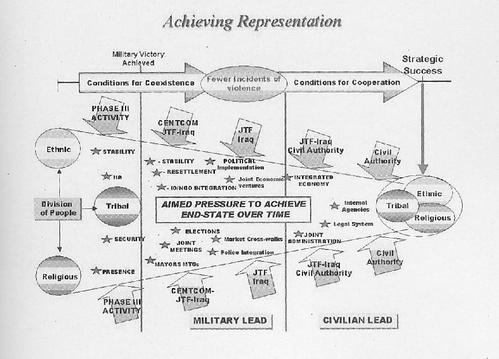
Via Crooked Timber, may I respectfully present the complete, detailed, and oh, so specific version of the Iraq "exit strategy?"
Yeah, it's PowerPoint. That should tell you all you need to know.
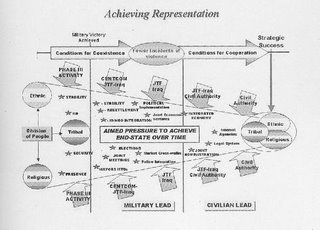
Yeah, it's PowerPoint. That should tell you all you need to know.
It seems Matt Bai kind of gets it...
From a soon-to-be--in the Magazine in the NYT:
In the aftermath of the primary, Democrats settled on the idea that Lieberman fell because of his support for the Iraq war. This was technically true, in the same way that a 95-year-old man might technically be said to die from pneumonia; there were, to say the least, underlying causes. The war was a galvanizing issue, but Lieberman's loss was just the first major victory for a larger grass-roots movement. While that movement is identified with young, online activists, it is populated largely by exasperated and ideologically disappointed baby boomers. These are the liberals who quietly seethed as Bill Clinton worked with Republicans to reform welfare and pass free-trade agreements. After the ''stolen'' election of 2000 and the subsequent loss of House and Senate seats in 2004, these Democrats felt duped. If triangulation wasn't a winning strategy, they asked, why were they ever asked to tolerate it in the first place? The Web gave them a place to share their frustrations, and Howard Dean gave them an icon.
Iraq has energized these older lapsed liberals; for a generation that got into politics marching against Vietnam, an antiwar movement is comfortable space. But it was the yearning for a more confrontational brand of opposition on all fronts, for something resembling the black-and-white moral choices of the 1960's, that more broadly animated Lamont's insurgency. Connecticut's primary showdown (which now appears to be headed for a sequel in November) marked an emphatic repudiation not just of the war but also of Clinton's ''third way'' governing philosophy - a philosophy not unlike the Republican ethos of ''compromise'' and ''pragmatism'' that so infuriated Reagan conservatives.
If history were to repeat itself, this outpouring of new liberal passion would portend trouble for the party's establishment candidates in 2008 (especially one possible candidate whose last name happens to be Clinton). But there is at least one crucial difference between insurgents of the 1970's and today. When Bell ran for the Senate in 1978, he was so obsessed with his plan to slash taxes that he went to the extraordinary length of bringing in Arthur Laffer, the renowned conservative economist, to draw his famous Laffer Curve at a news conference in Trenton. By contrast, Lamont's signature proposal as a primary candidate - and the only one anyone cared to hear, really - seemed to be the hard-to-dispute notion that he is not, in fact, Joe Lieberman. He offered platitudes about universal health care and good jobs and about bringing the troops home but nothing that might define him as anything other than what he is: an acceptable alternative.
Leaders of the Netroots, as the Internet activists have been named, will tell you that big ideas are way overrated in American politics - that you first have to master the business of getting elected before you can worry about how to govern. (Most powerful Democrats in Washington now believe this too.) But even with legions of outraged conservatives at his back, Reagan would not have taken over his party in 1980 - let alone the White House - had he not articulated an affirmative and bold argument against his party's status quo, vowing to devolve the federal government and roll back détente with the Soviets. Passion and fury started the revolution, but it took a leader with larger vision to finish the job.
Friday, August 11, 2006
Little Tommy Friedman is serious money
Via David Sirota's post today on Kos, Sirota quotes his blog quoting Washingtonian magazine...
You'd think that the NY Times would have more columnists representative of its readership, and less addicted to the current power structure.
Really, "full disclosure" ought to be a tight requirement for all major media columnists, pundits, and talk radio hosts.
As the July edition of the Washingtonian Magazine notes, Friedman lives in "a palatial 11,400-square-foot house, now valued at $9.3 million, on a 7½-acre parcel just blocks from I-495 and Bethesda Country Club." He "married into one of the 100 richest families in the country" - the Bucksbaums, whose real-estate Empire is valued at $2.7 billion.
Let's be clear - I'm a capitalist, so I have no problem with people doing well or living well, even Tom Friedman. That said, this does potentially explain an ENORMOUS amount about Friedman's perspective. Far from the objective, regular-guy interpreter of globalization that the D.C. media portrays him to be, Friedman is a member of the elite of the economic elite on the planet Earth. In fact, he's married into such a giant fortune, it's probably more relevant to refer to him as Billionaire Scion Tom Friedman than columnist Tom Friedman, both because that's more descriptive of what he represents, and more important for readers of his work to know so that they know a bit about where he's coming from.
Mind you, I don't think everyone needs to publish their net worth. But Friedman's not everyone. He's not just "doing pretty well" and is not just any old columnist. He's not just a millionaire or a multimillionaire - he's member of one of the wealthiest families in the world, and is one of the most influential media voices on the planet, who writes specifically about economic/class issues. If politicians are forced to disclose every last asset they own, you'd think at the very least, the New York Times - in the interest of basic disclosure - should have a tagline under Friedman's economic columns that says "Tom Friedman is an heir to a multi-billion-dollar business empire."
You'd think that the NY Times would have more columnists representative of its readership, and less addicted to the current power structure.
Really, "full disclosure" ought to be a tight requirement for all major media columnists, pundits, and talk radio hosts.
5 will get you ten Townhall.com will delete this:
The shocking thing to me is only 51% of Dems get that right now: if Bush were to "succeed," we'd be unemployed, poor, with no security in our old age, with no health care, with no education, with born humans equated legally to blastulae and brain dead popele and constantly in "fear" of "terrorists."Which is a repsonse to this.
The depths to which the modern Republican party have sunk never lose their ability to shock me. In the 1990s, I - and many other progressives- couldn’t stand Bill Clinton but I didn't root for him to fail, although some Republicans - Jesse Helms comes to mind- made the equivalent of death threats against him.
Adam Nagourney: Times shill
I blogged about it on Kos here.
I wish Harper's would put "The Last of England" from the November 2005 issue up.
As the blurb on the cover web page puts it, "Churchill gave Londoners courage, Blair is serving them fear."
Indeed, and how much more so the Bush regime vs. Roosevelt.
I wish Harper's would put "The Last of England" from the November 2005 issue up.
As the blurb on the cover web page puts it, "Churchill gave Londoners courage, Blair is serving them fear."
Indeed, and how much more so the Bush regime vs. Roosevelt.
Subscribe to:
Posts (Atom)


