Monday, May 15, 2006

Rush LImbaugh and reality

Rush Limbaugh said:


If you've ever watched Law and Order, CSI, whatever, or any other program, you know that law enforcement can go get phone records from any phone company, track cell phone calls to find out who was where when. They produce alibis, they produce suspicion, they produce guilt, any number of things. The idea that this is some sort of secret stuff, have you run the
numbers on what all this would take? There are 300 million Americans, folks. How many of those Americans, how many of us do you think use the phone? Give me a conservative guess of the 300 million. (interruption) Two-hundred million? Okay, 200 million Americans use the phone. Okay. Sixty-five percent of Americans use the phone, use cell phones. They're using cell phones so much you can't walk around without seeing somebody on their phone. They're on their phone constantly. Some people are on the phone when they're not on the phone. They want you to think that they are talking when they are not. The cell phone is a new radio. You can't drive down the street without seeing someone on the phone in their car. They're everywhere.

The reason I mention that is, how much time per day do 200 million people spend talking on the phone? Let's be conservative and say that 200 million Americans talk 30 minutes a day on the phone. (interruption) I know Snerdley doesn't think that. We are just being conservative because you have to factor, I don't talk on the phone. Somebody is using my 30 minutes so we'll average it out. Now these numbers, by the way, come from a subscriber to my website, Gary Karsten. If you got 200 million people talking 30 minutes a day, what you have is six billion talk minutes or 100 million talk hours. Let's say businesses use the phone two hours a day. A hundred thousand businesses, another 12 million talk minutes or 200,000 talk hours, now we're at 100,200,000 talk hours per day. Per day. It would take 4,175,000 people at 24 hours a day to listen in on all of that, and that's probably a low number. Do we have that kind of workforce?

The point of this, even though these are ballpark numbers, ladies and gentlemen, the idea that people are being listened in on -- the president denied it yesterday -- the idea that people are being spied on, it is physically impossible. It simply isn't possible. The collection of these records, the purpose is probably nothing more than creating a database for when something needs to be learned when other indicators pop up about who may be talking to who, planning what. You know, what is amazing about this to me is that before 9/11, we didn't connect the dots. On 9/12, the nation started cat calling, "Why didn't we connect the dots? They knew this and they knew that, but they weren't talking. Why didn't they know that?" Now, this is why I say, do we need a bird flu pandemic or another terrorist attack to get us back in focus here? All we are trying to do is connect the dots, or be able to connect the dots if and when another attack is planned so we can stop it.

Everybody is going nuts. Actually, everybody is not going nuts because the Washington Post has a story today, "A majority of Americans initially support a controversial National Security Agency program to collect information on telephone calls made in the United States in an effort to identify and investigate potential terrorist threats, according to a Washington Post-ABC News poll. The new survey found that 63 percent of Americans said they found the NSA program to be an acceptable way to investigate terrorism, including 44 percent who strongly endorsed the effort. Another 35 percent said the program was unacceptable, which included 24 percent who strongly objected to it. A slightly larger majority--66 percent--said they would not be bothered if NSA collected records of personal calls they had made."


But Jane Hamsher picked up the subtext. And now we know it was pretty much for political reasons this wiretapping was done.

How to read, "Conservative Christians Criticize Republicans"

I am completely cyncical about this by now:

WASHINGTON, May 13 — Some of President Bush's most influential conservative Christian allies are becoming openly critical of the White House and Republicans in Congress, warning that they will withhold their support in the midterm elections unless Congress does more to oppose same-sex marriage, obscenity and abortion.

"There is a growing feeling among conservatives that the only way to cure the problem is for Republicans to lose the Congressional elections this fall," said Richard Viguerie, a conservative direct-mail pioneer.

Mr. Viguerie also cited dissatisfaction with government spending, the war in Iraq and the immigration-policy debate, which Mr. Bush is scheduled to address in a televised speech on Monday night.

"I can't tell you how much anger there is at the Republican leadership," Mr. Viguerie said. "I have never seen anything like it."

In the last several weeks, Dr. James C. Dobson, founder of Focus on the Family and one of the most influential Christian conservatives, has publicly accused Republican leaders of betraying the social conservatives who helped elect them in 2004. He has also warned in private meetings with about a dozen of the top Republicans in Washington that he may turn critic this fall unless the party delivers on conservative goals.


First of all, let's be clear: there is no way these radical Christianists are going to leave the Republican party- they are one and the same by and large, especially where these groups hold political dominance.


Rather, this is a call to "rally the base," and to do it by a very odd kind of bribery/extortion: clowns like Dobson are basically telling their sheep to watch for politicians pandering to them, after which point inevitably a) Republicans will indeed pander to them, and b) the Dobsons will bless Republican voting - as they have for years now.

In fact this same scenario has gone on for years now. People should be used to it by now. Even the Times took note of it:

Christian conservative leaders have often threatened in the months before an election to withhold their support for Republicans in an effort to press for their legislative goals. In the 1990's, Dr. Dobson in particular became known for his jeremiads against the Republican party, most notably in the months before the 1998 midterm elections.


Sunday, May 14, 2006

And even more on the Bush "boom!"

Link

IMF acts to avoid markets meltdown

Heather Stewart, economics correspondent
Sunday May 14, 2006
The Observer


The International Monetary Fund is in behind-the-scenes talks with the US, China and other major powers to arrange a series of top-level meetings about tackling imbalances in the global economy, as the dollar sell-off reverberates through financial markets.

Amid tumultuous trading, which sent the dollar to its lowest level in a year against the euro in late trading on Friday and gave the FTSE its worst day for three years, the IMF was working privately to exercise its new powers to bring decision-makers together.

At the IMF's Spring Meetings last month, its managing director, Rodrigo de Rato, was handed new responsibilities to carry out 'multilateral surveillance', assembling groups of relevant countries to discuss critical issues in the global economy. With the long-predicted dollar bear market sending ripples throughout the world, the IMF is keen to use its powers as soon as possible.

Analysts believe the weakening of the dollar is the beginning of a long-awaited readjustment in the global economy. After the Federal Reserve appeared to hint last week that it could pause in its series of interest rate rises, attention in the markets switched to the weaknesses of the US economy.

David Bloom, currency strategist at HSBC, described the switch of focus as a 'regime change'. 'I'm saying don't use the philosophical methodology you used last year: chuck it away. The market has wholesale changed the way it looks at the world,' he said, predicting that the euro could rise to $1.40 over the next 12 months, from its current level close to $1.29.

Few analysts expect IMF discussions to result in a concerted deal on stemming the dollar sell-off; but governments and central banks will want to avoid a crisis.

'We are in meltdown mode,' said David Brown, chief European economist at Bear Stearns. 'It's all being whipped up into a bit of a selling frenzy. The dollar has a massive portfolio of negatives against it: it's the long-term problems of the trade deficit, and the government's budget deficit.'

Bloom warned that 'phase two' of a sell-off would cause turmoil in the equity markets, as on Friday, when both the Dow Jones and FTSE saw sharp losses. 'I'm expecting an increase in volatility and uncertainty across the board,' he said.

Brown added that the dollar's woes were likely to be exacerbated by central banks shifting their reserves towards other currencies, including the euro. 'Asian central banks have been buying fistfuls of dollars as the flipside of their massive current account surpluses. They're long dollars.'


Yeah.... what a "boom!"


More BS from Adam Nagourney...

Why does the NY Times publish this nonsense?

Indeed, some Democrats worry that the worst-case scenario may be winning control of Congress by a slim margin, giving them responsibility without real authority. They might serve as a foil to Republicans and President Bush, who would be looking for someone to share the blame. Democrats need a net gain of 6 seats in the Senate, and 15 seats in the House. "The most politically advantageous thing for the Democrats is to pick up 11, 12 seats in the House and 3 or 4 seats in the Senate but let the Republicans continue to be responsible for government," said Tony Coelho, a former House Democratic whip. "We are heading into this period of tremendous deficit, plus all the scandals, plus all the programs that have been cut. This way, they get blamed for everything."

Mr. Coelho quickly added, "Obviously, from a party point of view we want to get in and do things, but I'm talking about the ideal political thing."

Of course, no Democrat is going so far as to say that he or she hopes the party fails, and party leaders are doing everything they can to avoid this outcome.


No Democrat hopes the party fails, but "some Democrats" - unnamed- "worry that the worst-case scenario may be winning control of Congress?"

Nonsense, and it's telling that Nagourney quotes the usual Beltway suspects here, without actually making his case.

Look, suppose the Dems take the House and not the Senate: it gives them the ability to demand a platform of equal height to the Repubs everywhere, since Mr. About-30% is a lame duck who will himself be under "increasing scrutiny."

What a waste of virtual newsprint.

"State secrets?" They're our "state secrets."

When you read stuff like this you simply know you're dealing not with people interested in protecting us from enemies, but rather you're dealing with common criminals who are trying to hide their crimes:

The federal government has moved to crush a class action lawsuit filed in San Francisco that accuses AT&T of illegally giving the government data on the communications of millions of Americans, claiming the suit would cause ``exceptionally grave harm'' to national security were it to be tried.

The lawsuit involves matters so secret they can't be discussed without revealing how the United States is tracking down terrorist enemies, according to a motion filed late Friday night by the U.S. Department of Justice in U.S. Northern District Court.

Filed in January by the Electronic Frontier Foundation, the suit accuses the phone company of helping the National Security Agency scoop up and ``data-mine'' the records of millions of domestic and international telephone and Internet communications without search warrants. The lawsuit was filed after press accounts in December of a massive government telephone snooping operation.

It gained traction late last week with a report in USA Today that said AT&T, Verizon and BellSouth were helping the NSA monitor the phone calls of tens of millions of Americans. The report caused an uproar in Washington.

Though not a defendant in the lawsuit, the Justice Department seeks to intervene with a ``states secrets privilege'' over information that reasonably could be expected to surface during a trial. It is asking for a hearing June 21 on its motion...

While neither confirming nor denying the allegations in the lawsuit, the motion asserted that courts have affirmed a president's right to monitor for foreign intelligence purposes without a warrant.

``Everything that might actually give somebody an opportunity to respond to what they're saying is hidden in the secret parts,'' complained Lee Tien, staff attorney with the Electronic Frontier Foundation. ``They don't come out and say what is a state secret in this case.''


My phone calls are my private business and intellectual property. They are not "state secrets." And even so, Létat c'est nous. We are the folks who are ultimately the power in this country, despite pretensions to the contrary by George W. Bush and his supporters.

If they're secrets, they're our secrets, and in this case, the immediacy of needs of defense are outweighed by our ability to exercise our power as a people: to bring those in government who are guilty of crimes to justice.

Rove is expected to be frogmarched shortly (hopefully as Joe Wilson wanted it). It's time that this NSA affair was brought out into the open.

One other thing: the Bush' regime's argument is nonsense on its face. Suppose there are indeed secret national technical means for eavesdropping on communications. (There are, of course.) How would disclosure of that - obvious to anyone "skilled in the art" allow people to get around it other than the way they do now- the way the Mafia has for decades? Measure and countermeasure are so well known by now, that it would be absurd to think this gambit is anything other than an attempt to obstruct justice.

Saturday, May 13, 2006

More insight on the "Bush Boom"

John Hussman has some hypothetical strategies:

Avoiding deep losses requires investors to recognize that market risk sometimes isn't worth taking, particularly when stock valuations are rich and competing yields are rising. On average, about 40% of the gains in the typical “bull market” are wiped out by the subsequent “bear market,” though the individual figures vary widely. The retracement from rich valuations is often deeper. Unless one believes that market turns can be precisely identified and that short-term market forecasting is a fruitful effort (I don't – good managers know their skills but aren't unrealistic about them), it turns out that it is often necessary to forego some portion of bull market gains in order to avoid periods of substantial market loss.

Here's a historical fact that I don't recommend as a timing tool or investment strategy, but is true nonetheless. Had an investor sold the S&P 500 index anytime it reached a price/peak earnings ratio of 19 (i.e. 19 times the highest level of earnings achieved to-date), and then simply sat in Treasury bills, possibly for years, reinvesting in stocks only when the S&P eventually declined to 14 times earnings, that investor would have captured the entire historical return enjoyed by S&P 500, with substantially lower volatility and risk exposure.

Even easier, suppose that an investor sold the S&P 500 at 19 times record earnings, and just sat out of the market until the S&P 500 eventually dropped 30% from its prior highs (say, on a weekly-closing basis). Nothing more. Just sell at the first point of overvaluation and then sit around waiting for a plunge. That strategy would have placed an investor out of the stock market nearly 30% of the time, yet would have produced total returns of 13.03% annually since 1940 (versus 11.90% for a buy-and-hold approach), and 13.67% since 1970 (versus 12.96% for a buy-and-hold).


Read the rest of it, but also note: as of today, DIA is over 25X earnings, and SPY is almost 25X.


The market is slated either to go way up or way down next week
:

SAN FRANCISCO (MarketWatch) -- Stock market bulls hope economic reports in coming days will show inflation concerns that have dented equities recently are overdone.
But bears fear the data could confirm growing worries that high energy costs and a falling dollar will lead to more inflation and interest-rate hikes, crimping corporate profits and consumer spending.
A Tuesday report on April producer prices and a consumer price reading the following day will be closely watched, as will housing data and industrial production numbers, also on Tuesday.
"If these indicators counter the prevailing inflationary story, then the market can rally again," said Barry Hyman, equity market strategist at New York-based broker dealer Ehrenkrantz King Nussbaum. "If these data points corroborate inflationary concerns then the correction continues."
On Thursday, stocks logged their biggest one-day decline since January, drubbed by worries that rising commodity prices will translate into higher inflation and prompt the Federal Reserve to raise interest rates again in June. ...

While the market has managed to recover from similar, short corrections this year, Hyman isn't optimistic this time. On Wednesday, his firm began advising clients to sell stocks into strength and jettison holdings that have performed well recently.


I have for now sold IGE and IYF, and the basic materials ETF. The money was nice. Let's see whether the Bush bust continues next week.


Incidentally, Thinkprogress notes that "Fox News'" take on the tanking market was "the market was peeved over the spy scandal."


You could have been reading my blog and making more money, and I don't know much more than squat about the market. Anyone who's been really following this knows that the market dived because the Fed indicated it would keep raising rates (giving a "measured" decline in the dollar instead of a rout.)

Euro-Jesus and McBuddhism...


What's up with that ubiquitous Euro-Jesus anyway? Why is he on sale in China like that (the photo above, which accompanies this article in today's Times, depicts "Chinese Catholics," includes Euro-Jesus.)

I never understood why a historical Jesus was never pictured as, you know, middle-eastern looking. Sure, yeah, whatever, there's historically brown haired semites, and what-not, but really, what "biblical" evidence is there that Jesus looked like Jurgen Prochnow?

I have a theory about this, and it's not a pretty theory: Euro-Jesus is sold in places like Coca-Cola: it's an exotic Western thing.

Christians have used an African Jesus to close the sale too with believers; and I suppose there are Asian Jesii. But I find it odd that Catholics are using Euro-Jesus in China, and there likely is a reason.


On the grounds of the Daibosatsu Temple in upstate New York, there sits a statue of a very European-American, 20th century "Buddha." There really isn't a problem making buddhas and boddhisattvas of any ethnic group one would want, because being a buddha isn't limited to one individual or one ethnic group.

I would hope that Buddha isn't being sold in the US as an "exotic Eastern thing," and I certainly would abhor - can't even comprehend- what McBuddhism would look like.

But frankly, I don't care, my own reasons for practice have to do with experience and results and who I am rather than the exotic.

I would hope that Christians get the same thing out of their path, but given all the "pointing to outside," I'm not so sure.

Friday, May 12, 2006

Hugh Hewitt can't handle the truth...and has nothing but contempt for those who "agree" with him.

I dislike Andrew Sullivan's writings for many reasons, but his recent pronouncement of "Christianist" agitators (heh heh just try getting "Buddhistist" off your tongue) is spot on. And sure enough not only does Hugh Hewitt get into high dudgeon over it, but he repeats the same nonsense he's repeated whenever confronted with the theocratic threat:

Again, send me a list of 25 prominent "Christianists" with their demands for theocracy. How about 20? 10? 5?


Oddly enough Hewitt links to Sullivan's update on "Christianism." And guess what...?

Besides Hewitt, Sullivan names David Barton, Rick Santorum, Robert George, and references an article that mentions the American Life League, and of course "Focus on the Family." You'd think that'd be enough for Hewitt.

But Hewitt has such great contempt for his readers that he thinks none of them are going to read the Salon excerpt of Michelle Goldberg's book Kingdom Coming...

On November 13, 2003, Moore was removed from his position as chief justice of the Alabama Supreme Court after he defied a judge's order to remove the 2.6-ton Ten Commandments monument he'd installed in the Montgomery judicial building. On the coasts, he seemed a ridiculous figure, the latest in a line of grotesque Southern anachronisms. After all, Moore is a man who, in a 2002 court decision awarding custody of three children to their allegedly abusive father over their lesbian mother, called homosexuality "abhorrent, immoral, detestable, a crime against nature, and a violation of the laws of nature and of nature's God upon which this Nation and our laws are predicated," and argued, "The State carries the power of the sword, that is, the power to prohibit conduct with physical penalties, such as confinement and even execution. It must use that power to prevent the subversion of children toward this lifestyle, to not encourage a criminal lifestyle." He's a man who writes rhyming poetry decrying the teaching of evolution and who fought against the Alabama ballot measure to remove segregationist language from the state constitution.

To the growing Christian nationalist movement, though, Roy Moore is a martyr, cut down by secular tyranny for daring to assert God's truth.

It's a role he seems to love. The battle that cost Moore his job wasn't his first Ten Commandments fight. In 1995, the ACLU sued Moore, then a county circuit judge, for hanging a Ten Commandments plaque in his courtroom and leading juries in prayer. As Matt Labash recalled in an adulatory Weekly Standard article, "The conflict's natural drama was compounded when the governor, Fob James, announced that he would deploy the National Guard, state troopers, and the Alabama and Auburn football teams to keep Moore's tablets on the wall."

That case reached an ambiguous conclusion in 1998, when the state supreme court threw out the lawsuit on technical grounds. By then, Moore had become a star of the right. Televangelist D. James Kennedy's Coral Ridge Ministries raised more than $100,000 for his legal defense fund, and Moore spoke at a series of rallies that drew thousands. His right-wing fame helped catapult him to victory in the 2000 race for chief justice of the state supreme court.

Moore installed his massive Ten Commandments monument on August 1, 2001, and from the beginning, he and his allies used it to stir up the Christian nationalist faithful. He gave videographers from Coral Ridge Ministries exclusive access to the courthouse on the night the monument was mounted, and on October 14, D. James Kennedy started hawking a $19 video about Moore's brave, covert installation on his television show...

A few days before Bush's second inauguration, The New York Times carried a story headlined "Warning from a Student of Democracy's Collapse" about Fritz Stern, a refugee from Nazi Germany, professor emeritus of history at Columbia, and scholar of fascism. It quoted a speech he had given in Germany that drew parallels between Nazism and the American religious right. "Some people recognized the moral perils of mixing religion and politics," he was quoted saying of prewar Germany, "but many more were seduced by it. It was the pseudo-religious transfiguration of politics that largely ensured [Hitler's] success, notably in Protestant areas."

It's not surprising that Stern is alarmed. Reading his forty-five-year-old book "The Politics of Cultural Despair: A Study in the Rise of the Germanic Ideology," I shivered at its contemporary resonance. "The ideologists of the conservative revolution superimposed a vision of national redemption upon their dissatisfaction with liberal culture and with the loss of authoritative faith," he wrote in the introduction. "They posed as the true champions of nationalism, and berated the socialists for their internationalism, and the liberals for their pacifism and their indifference to national greatness."

Fascism isn't imminent in America. But its language and aesthetics are distressingly common among Christian nationalists. History professor Roger Griffin described the "mobilizing vision" of fascist movements as "the national community rising Phoenix-like after a period of encroaching decadence which all but destroyed it" (his italics). The Ten Commandments has become a potent symbol of this dreamed-for resurrection on the American right.

True, our homegrown quasi-fascists often appear so absurd as to seem harmless...

Still, it's worth noting that thousands of Americans nationwide have flocked to rallies at which military men don uniforms and pledge to seize the reins of power in America on behalf of Christianity. In many places, local religious leaders and politicians lend their support to AVIDD's cause. And at least some of the people at these rallies speak with seething resentment about the tyranny of Jews over America's Christian majority...

Roy Moore and Rick Scarborough are Baptists, D. James Kennedy is a fundamentalist Presbyterian, and John Eidsmoe is a Lutheran. All of them, however, have been shaped by dominion theology, which asserts that, in preparation for the second coming of Christ, godly men have the responsibility to take over every aspect of society.

Dominion theology comes out of Christian Reconstructionism, a fundamentalist creed that was propagated by the late Rousas John (R. J.) Rushdoony and his son-in-law, Gary North. Born in New York City in 1916 to Armenian immigrants who had recently fled the genocide in Turkey, Rushdoony was educated at the University of California at Berkeley and spent over eight years as a Presbyterian missionary to Native Americans in Nevada. He was a prolific writer, churning out dense tomes advocating the abolition of public schools and social services and the replacement of civil law with biblical law. White-bearded and wizardly, Rushdoony had the look of an Old Testament patriarch and the harsh vision to match -- he called for the death penalty for gay people, blasphemers, and unchaste women, among other sinners. Democracy, he wrote, is a heresy and "the great love of the failures and cowards of life."

Reconstructionism is a postmillennial theology, meaning its followers believe Jesus won't return until after Christians establish a thousand year reign on earth. While other Christians wait for the messiah, Reconstructionists want to build the kingdom themselves.


I've said it before and I'll say it again: genocide fucks things up far worse than the reprehensible abomination of attempting to wipe out a whole bunch of people- it spawns crap like Rushdoony's ideas.

Even so, it is clear that this is as much, if not more a present danger to America than Communism ever was.

And Hewitt - I respect his intelligence- is completely complicit in all of this, which leads me to believe that he indeed is part of the problem.

Meanwhile on the oddball religious right fringe...

Donald Wildmon's "Agape Press" is touting an "online graduate degree program in science education" courtesy of the "Institute for Creation Research."

Here is a veritable treasure trove of sham and wingnuttiness...my particular favorite is the admissions area...

Take, if you will, the application form. Check out the Gothic font where it says "Graduate School." Looks really official, don't it?

And they want to know:


  • If the applicant's been divorced
  • How many kids the applicant's got
  • If you are transferring from another school (!)
  • The "college level" science, math, and science education courses the applicant has had (I can't even remember all the ones I took! I guess that doesn't qualify me, does it?)
  • What the prospective student's high school transcript looks like!
  • My GRE scores (unfortunately for them, I never took one.)
  • Whether the prospective student or not is "in agreement with the tenets" of ICR (hard to find the link now, but basically you have to agree to be a creationist)
  • Last (on this list), but not least, "Have you personally accepted Christ as Savior, and have you committed yourself to the discipline of His Lordship?" and "What church do you attend?"


Now you say, "How much could this cost?" Good question. For "33 semester hours," they want $6600.00 plus evidently $1100.00 in "special fees," and for applicatons, etc., another $800.00 or so bucks, for a grand total of about $8500.00.

Good business they've got considering they're accredited by the prestigious "Transnational Association of Christian Colleges and Schools."

And no doubt some poor folks are plunking down money for this.

Reality and Delusion in Markets...

The very day the market did this:


Stock prices fell sharply and broadly yesterday as investors worried that rising oil prices would quicken the pace of inflation and force policy makers to raise interest rates further.

The abrupt drop, which was the largest since January, came after several days of modest but steady increases in the Dow Jones industrial average, which as recently as Wednesday was within 80 points of its record high. It also came a day after the Federal Reserve indicated that it was ambiguous about whether it would raise rates later this year.

The Standard & Poor's 500-stock index fell 1.3 percent yesterday, to 1,305.92, with all but 59 of the stocks in the index losing ground. The Dow Jones industrial average declined 1.2 percent, to 11,500.73, and the Nasdaq composite index fell 2 percent, to 2,272.70.

Though consumer prices excluding energy and food have risen only modestly thus far, investors and policy makers are increasingly concerned that higher gasoline and commodity prices coupled with faster economic growth will drive up inflation in the coming months.

In March, one measure of inflation favored by the Fed — prices for personal spending excluding food and energy — rose at an annual rate of 2 percent, the upper end of a range the Fed considers healthy, from 1.8 percent in February.

The price of gold, which has soared this year and is considered a safe haven during periods of rising inflation, rose 2.2 percent yesterday, to $721.50 an ounce.

"Inflation is creeping into the mind-set here in a bigger and bigger way," said Jim Paulsen, the chief investment strategist at Wells Capital Management.

The inflationary threat in higher energy prices was heightened as crude oil climbed for a third day. The June contract rose 1.6 percent, to $73.32 a barrel, on the New York Mercantile Exchange. Nationally, retail gasoline prices averaged $2.88 a gallon yesterday, up from $2.69 a month ago, according to AAA.

Mr. Paulsen said the signs of inflation coupled with a weaker dollar, which has fallen 8.3 percent against the euro so far this year, have introduced a new element of pessimism to the market.
...


Joe Carter at the Evangelical Outpost happily and helpfully posted this
:

he undisputable fact is that we are in an economic boom, and have been for some time. Yet a Gallup survey shows that 64% believe the economy is getting worse. Only 33% described it as good, 40% as fair, and 23% as poor. And this was before gas prices leapt more than 30 cents a gallon!

The pessimistic attitudes, however, don’t match the evidence...


(From which follows a swath of cherry-picked and outdated stats, or stats which are contaminated by "averages" rather than more accurate quantiles.)

I suspect this is a meme you're going to hear from the right for a while: forget how bad you have it, the economy's doing just fine!

Sure enough Tony Snow is already pimping this meme:

NEW YORK In his first week in the job, new White House Press Secretary Tony Snow is already having issues with CBS News, and slamming The New York Times and USA Today.

Snow has fired off several emails to reporters. One rapped the Times for continuing to “ignore America’s economic progress,” while another hit USA Today for a “misleading Medicare story.”


But Marketwatch today has a better perspective:

SAN FRANCISCO (MarketWatch) -- Americans' debt levels are rising, but not because we can't resist charging the latest plasma television to our credit card, according to a new report.
Instead, consumers' debt burden jumped higher in recent years because wages grew slowly even as costs increased on items that most of us don't consider frivolous, such as mortgages, health insurance and college tuition, according to a study by the Center for American Progress, a liberal think-tank, in Washington, D.C.
Middle-income families felt squeezed more than most, devoting a median 20% of their income to debt payments in 2004 - even at a time of low interest rates -- up from 18% in 2001. U.S. households overall spent a median 18.3% of income on debt payments in 2004, up from 16.9% in 2001, according to the report, which is based largely on data from the Federal Reserve Board's Survey of Consumer Finances.
And more families entered the group of seriously indebted: 13.7% of households faced debt payments greater than 40% percent of their income in 2004, up from 12.8% in 2001.
Looking at households' overall debt load, Americans' debt rose to a median 108% of income in 2004, up from 78% of income in 2001, with middle-income people facing the steepest rise, to a median 114% of income from 80% in 2001, according to the report.
"The middle-class squeeze [is driven by] stagnant income growth in the face of very sharp price increases for big-ticket items such as homes and education," said Christian Weller, author of the report and a senior economist with the Center for American Progress.


So we're going to see "who are you going to believe, me or your lying checkbook" from these clowns for a while.

Thursday, May 11, 2006

Lin-Chi

Here. And here.


From the 2nd link:

When students today fail to make progress, where's the fault? The fault lies in the fact that they don't have faith in themselves! If you don't have faith in yourself, then you'll be forever in a hurry trying to keep up with everything around you, you'll be twisted and turned by whatever environment you're in and you can never move freely. But if you can just stop this mind that goes rushing around moment by moment looking for something, then you'll be no different from the patriarchs and buddhas. Do you want to get to know the patriarchs and buddhas? They're none other than you, the people standing in front of me listening to this lecture on the Dharma!


From the first link:

It is most urgent that you seek real, true perception and understanding, so you can be free in the world and not confused by ordinary spiritualists. It is best to have no obsessions. Just do not be contrived. Simply be normal. You impulsively seek elsewhere, looking to others for your own hands and feet. This is already mistaken.


And:

Because you grasp labels and slogans, you are hindered by those labels and slogans, both those used in ordinary life and those considered sacred. Thus they obstruct your perception of objective truth, and you cannot understand clearly.


People might not like it when you renounce -isms. You may be suspect to them. But can there be another way, really?

Nothing to add, really.

Bush is a truly unabashed liar...

Bush says "US spying is not widespread," but it's hard to conclude that he's doing anything other than lying...

President Bush today denied that the government is "mining or trolling through the personal lives of innocent Americans," as Democrats expressed outrage over a news report describing a National Security Agency program that has collected vast amounts of telephone records.

The article, in USA Today, said that the agency did not listen to the calls, but secretly obtained information on numbers dialed by "tens of millions of Americans" and used it for "data mining" — computer analysis of large amounts of information for clues or patterns to terrorist activity.

Making a hastily scheduled appearance in the White House, Mr. Bush did not directly address the collection of phone records, except to say that "new claims" had been raised about surveillance. He said all intelligence work was conducted "within the law" and that domestic conversations were not listened to without a court warrant.

"The privacy of all Americans is fiercely protected in all our activities," he said. "Our efforts are focused on Al Qaeda and their known associates."


Focused?

Yeah. Right.

"Are you telling me that tens of millions of Americans are involved with Al Qaeda?" Senator Patrick J. Leahy of Vermont, the committee's ranking minority member, asked angrily.


Who would have thought that USA Today would actually have, you know, news?


The National Security Agency has been secretly collecting the phone call records of tens of millions of Americans, using data provided by AT&T, Verizon and BellSouth, people with direct knowledge of the arrangement told USA TODAY.

The NSA program reaches into homes and businesses across the nation by amassing information about the calls of ordinary Americans — most of whom aren't suspected of any crime. This program does not involve the NSA listening to or recording conversations. But the spy agency is using the data to analyze calling patterns in an effort to detect terrorist activity, sources said in separate interviews...

"It's the largest database ever assembled in the world," said one person, who, like the others who agreed to talk about the NSA's activities, declined to be identified by name or affiliation. The agency's goal is "to create a database of every call ever made" within the nation's borders, this person added.

For the customers of these companies, it means that the government has detailed records of calls they made — across town or across the country — to family members, co-workers, business contacts and others.

The three telecommunications companies are working under contract with the NSA, which launched the program in 2001 shortly after the Sept. 11 terrorist attacks, the sources said. The program is aimed at identifying and tracking suspected terrorists, they said.

The sources would talk only under a guarantee of anonymity because the NSA program is secret.

Air Force Gen. Michael Hayden, nominated Monday by President Bush to become the director of the CIA, headed the NSA from March 1999 to April 2005. In that post, Hayden would have overseen the agency's domestic call-tracking program. Hayden declined to comment about the program.

The NSA's domestic program, as described by sources, is far more expansive than what the White House has acknowledged. Last year, Bush said he had authorized the NSA to eavesdrop — without warrants — on international calls and international e-mails of people suspected of having links to terrorists when one party to the communication is in the USA. Warrants have also not been used in the NSA's efforts to create a national call database.

In defending the previously disclosed program, Bush insisted that the NSA was focused exclusively on international calls. "In other words," Bush explained, "one end of the communication must be outside the United States."


So we know that he's been caught in at least one lie: this isn't just international-domestic calls. Wanna guess that there's more?

The nice economy we've got...

A couple of articles on Marketwatch really give a good sense of the zeitgeist...

First, about all that nationalization of Bolivia stuff.
..

The price citizens of Venezuela and Bolivia are paying for having elected Hugo Chavez and Evo Morales will only steepen, "as it appears likely that both leftist leaders will expand state interference in the energy sector into the mining industry," said Brien Lundin, editor of Gold Newsletter. "Production, as well as economic growth, will decline as a result."
Peru may even enter the picture with the 2006 presidential candidate Ollanta Humala already saying he would force foreign-mining companies to renegotiate contracts and candidate Alan Garcia saying mining companies could face higher taxes and royalty payments, according to CNN.
The prospect of nationalization could further feed a rally in metals that's already lifted gold futures to more than 26-year highs above $700 an ounce. Silver prices have climbed above $14 an ounce to their highest levels since 1983, and copper's reached record levels above $3.60 per pound...

In Bolivia, the biggest concerns are for silver, tin and zinc production; in Peru -- it's copper and gold; and in Venezuela it's gold, aluminum, copper, nickel and zinc...

"The greater concern is potential spillover to Peru," which is a major producer of gold and copper, said Hill, pegging 2005 gold output at 207.8 metric tons, or 8.2% of global production, and last year's copper output at 510,000 metric tons, or 3% of global production.
Miners with exposure in Peru include Newmont Mining, Barrick Gold, Phelps Dodge and "potentially Inco
should its acquisition of Falconbridge proceed," he said.


Looks to me like it's the shareholders of those companies that would pay the price, if the nations tried to keep the mines open.

One other quote from the article bears repeating:

John Stafford, editor of Stafford's Investment Strategy Letter, said that "political incompetence ... always restricts production [and] these Socialists represent the debtor class -- so they will hyper-inflate away the small remaining value of their worthless paper currencies to pay off debts in cheaper paper currency units."


Sounds like George Bush's folks, not "soicalists." Brazil's done very well with a "socialist"in power.

Meanwhile, with the global economy balanced on a knife edge, the Treasury department wasn't going to shake things up by branding China a currency manipulator.

Of course, reading the Treaury's report, there's kind of a subtext that the Chinese don't like the situation they're in, and would love to detach themselves from the dollar, particularly if the US economy is going to decline anyway. They don't want to run away from it all at once though.

Wednesday, May 10, 2006

Republicans raise your taxes!

Yeah, yeah it's hyperbole, but it's the sort of hyperbolie that Repubs use agsint those of us who favor fiscal responsiblity. Only in this case, it's actually pretty irresponsible.

WASHINGTON, May 10 — The House of Representatives approved a $69 billion bill to extend President Bush's tax cuts for two more years this afternoon, sending the measure to the Senate, where passage is expected by Thursday.

The House vote was 244 to 185, with nearly all Republicans voting in favor. Although most Democrats voted no, more than a dozen voted in favor. The measure also temporarily blocks a big jump in the alternative minimum tax.

The stage for this afternoon's vote was set on Tuesday, when Republicans from the House and Senate reached agreement on a tax package. Assuming the package clears the Senate, which seems virtually certain, it will lock in one of Mr. Bush's signature tax cuts through 2010 and give Republicans a victory at a time when most of their other efforts have stalled.

But the bill falls far short of Mr. Bush's original goal, which was to make permanent all of his major tax cuts from 2001 and 2003. Nor did Republican leaders work out their differences on a separate measure that would extend scores of other tax cuts that expired at the end of last year.


Of course they're bankrupting the country.

Fall down seven times get up eight....


It's useful to have one of these around when you want to teach your kid the values of 持久 (じきゅう), "jikyuu" or persistence despite how you may feel about your efforts.

Especially when your son is taking martial arts and you explain to him that this figure, which does not tip over easily, represents the guy who taught Zen and martial arts to the Shaolin monks...

Tuesday, May 09, 2006

Coming next: peak water

The loonie hit 91 cents to the US dollar today.

Meanwhile...

President Bush hadn’t been in office eight months when he first mused in public about bringing Canadian water to the American Southwest. And no sooner had 2006 begun than former U.S. ambassador Paul Cellucci told a Canadian audience that their resistance to selling water south was “odd.”

If so, it is oddness shared by 69 percent of Canadians, according to a 2002 poll by the Centre for Research and Information on Canada. But then, Cellucci, probably the least popular ambassador the United States has ever sent to Ottawa, has been politically tone deaf for some time.

Still, he may have a point. Canada has 20 percent of all the world’s fresh water, to slake the thirsts and irrigate the crops of only 0.5 percent of the world’s population. With the United Nations estimating that almost two-thirds of everybody, or almost 5.5 billion people, will face chronic water shortages by 2050, you’d think the Canadians could ship a few gallons elsewhere, especially if they get paid for it.

After all, if water is going to become as scarce as the United Nations suggests, the forecasters who predict that water will be “the next oil” -- the resource that nations go to war over -- could be right. And keeping it from all those thirsty billions would become morally as well as geo-politically untenable.

Not that what Bush, Cellucci et al. have in mind is providing succor to the parched patches of Africa or Asia. What they’re talking about is making sure that the suburbanization of greater Las Vegas, Phoenix, and smaller metropolises in the Southwest is not impeded by lack of H20.


Buy PHO, and EWC...

Ah Mah Dih Ne Jad....

Hard to remember that name for some reason... anyway, Mahmoud makes a funny in today's London Times:


The people will scrutinise our presidencies. Did we manage to bring peace, security and prosperity for the people or insecurity and unemployment? Did we defend the rights of all people around the world or imposed wars on them, interfered illegally in their affairs, established hellish prisons and incarcerated some of them? Did we bring the world peace and security or raised the spectre of intimidation and threats?


I can see George W. Bush's reply: "Who cares what they think?" Besides, he's a lame duck, who has managed to not bring peace, security, and prosperity, hasn't defended the rights of people around the world, etc., etc. and so forth. Not that the Iranians running their government are nice folks- I think they're seriously disturbed.

But given W's track record, why should Ahmadinejad expect Bush to care about any of this?

Left wing noise machine

Celebrate it.

Meanwhile, I have some cool stuff to do which I can't discuss...

Monday, May 08, 2006

A bit of forgotten history...

Evidently Alan Greenspan wasn't exactly open with Congress way back when...


Beginning in 1965, the Fed started to release paraphrased transcripts of Federal Open Market Committee meetings with a five-year lag.
A decade later, Fed Chairman Arthur Burns faced down a threat to Fed secrecy when a Georgetown law student brought a suit under the Government in Sunshine Act, challenging the 45-day delay in releasing the Fed's directive on monetary policy.
Burns devised a poor substitute, the so-called "minutes" of FOMC meetings, which are still issued by the Fed. They are a poor substitute for transcripts because they provide no attribution for opinions expressed in the meetings, except a sentence or two when there is the occasional negative vote.
Burns told the Congress that the transcripts were "routinely disposed of" and unavailable to the public.
For 17 years, this lie stood until Rep. Gonzalez began battling Fed Chairman Alan Greenspan. Gonzalez was chairman of the House Financial Services Committee.


In 1992 and 1993 Gonzalez sent letters to Greenspan, asking whether public transcripts of their FOMC meetings would impair Fed policy making.
Gonzalez sent shock waves into the Greenspan Fed when he suggested legislation requiring videotapes of their FOMC meetings to be released in sixty days.
Although Gonzalez had no knowledge of the transcripts, he could not believe that the central bank of the United States did not keep complete records of its policy-making meetings. He invited Greenspan and the top Fed decision-makers to testify in October 1993.
The Fed bank presidents and governors had specific written inquiries from Gonzalez to describe any records kept of FOMC meetings. They were curiously unresponsive about FOMC records. One president testified about doodles he made at the meetings and later discarded. No one mentioned the 17 years of transcripts.
Rep. Maurice Hinchey, D-N.Y., probed Greenspan for a straight answer.
Greenspan replied: "There is no permanent electronic record that is correct. We obviously have rough notes."
Gonzalez believed the Congress had been misled. He turned on the heat.
One Fed bank broke ranks.
Officials at the Cleveland Fed notified the committee that there had been a FOMC conference call four days before the hearing to plan the strategy of not mentioning the cache of secret transcripts.
The transcript of that phone call reveals deliberate planning by Greenspan and his staff to mislead the Congress.


It's for things like this that Bush and his party must go...

From an op-ed in today's NY Times:

Specifically, the president and some of his supporters say reporters and publishers have violated a provision of the 1917 Espionage Act, which provides in part that anyone in unauthorized possession "of information relating to the national defense, which information the possessor has reason to believe could be used to the injury of the United States" who willfully communicates it to any person not entitled to receive it "shall be fined under this title or imprisoned not more than 10 years, or both."

But for at least three reasons, such threats are largely empty. First, the provision was never intended to be used against the press. When the Espionage Act was proposed by President Woodrow Wilson, it included a section that would expressly have made it a crime for the press to publish information that the president had declared to be "of such character that it is or might be useful to the enemy." Congress overwhelmingly rejected that proposal, with members of both parties characterizing it as "un-American" and "an instrument of tyranny."

Second, if the 1917 act were meant to apply to journalists, it would unquestionably violate the First Amendment. Laws regulating speech must be precisely tailored to prohibit only speech that may constitutionally be proscribed. This requirement addresses the concern that overbroad laws will chill the willingness of individuals to speak freely.

Not surprisingly, because the act was drafted before the Supreme Court had ever interpreted the First Amendment in a relevant manner, it does not incorporate any of the safeguards the court has since held the Constitution requires. For example, the provision of the act is not limited only to published accounts that pose a "clear and present danger" to the nation. For this reason, it seems clear, any prosecution of the press under it would be dismissed out of hand by the judiciary.

Third, if Congress today enacted legislation that incorporated the requirements of the First Amendment, it could not apply to articles like those published by The Times and The Post. Such a statute would have to be limited to articles that, first, do not disclose information of legitimate and important public interest and, second, pose a clear and present danger. Nobody could deny that articles like those on secret prisons and electronic surveillance of Americans clearly concerned matters of legitimate and important public interest; nor could the administration show that such disclosures created a clear and present danger of serious harm to the national security.


The Bush regime and its supporters simply do not want to be accountable to the people, their employers. And for that reason, they are unfit to be in positions of power at the very least, and in my opinion represent a clear and present danger to the liberty of Americans themselves.

This sort of thing has been hyped by Powerline, especially, which to me makes them apologists for tyrants.

I think they protest too much...

Professional research societies are evidently complaining about a proposed bill to make government funded research public 6 months after they appear in journals.

It's a rare point where I might agree with Liberman and a Republican: many individuals publish their own works on line that appear in journals, so why not?

Oh, yeah, they want to hold the copyright on materials.

Speaking of things I don't know much about....the U.N. Charter

In a passing reference to "Chapter 7 of the U.N. Charter," I saw in the NY Times this morning, it occurred to me that I, like probably 99.9% of all people, had never read the damned thing.


Well, here it is: the U.N. Charter.


I bet there's a great deal of fodder in there that makes it crystal clear why extreme rightists have opposed it for years.

Sunday, May 07, 2006

Karl Rove is worried about investigations if Dems take control? He ought to...

If they committed crimes, Times, it's not "partisan:"

The prospect of the administration spending its last two years being grilled by angry Democrats under the heat of partisan spotlights has added urgency to the efforts by Karl Rove and Mr. Bush's political team to hang on to the Republican majorities in Congress.

Newly shorn of the daily policymaking duties he took on after the 2004 campaign and now refocused on his role as Mr. Bush's chief strategist, Mr. Rove is facing an increasingly difficult climate for Republicans, and an increasingly assertive Democratic Party.

The ambitious second-term agenda he helped develop has faltered even with a Republican Congress. His once-grand plans for creating a broadened and permanent Republican majority have given way to a goal of clinging to control of the House and Senate.

The prospect of Democrats capturing either, however, may be one of the best weapons Mr. Rove has as he turns to what he has traditionally done best: motivating his party's conservative base to turn out on Election Day.

We're all terrorists now...

At least that's what I infer from Nacho.

In a wonderfully Orwellian twist, the Virginia manual on terrorism and security awareness quotes a violent revolutionary on its front page without irony.

Tips on raising a Buddhist family...

Never take a ravenously hungry 4 year old to a temple; he will without hesitation ask for food, and if the monks are average monks, they live rather sparsely and will indeed give the shirt off their backs to anyone who asks.

Money of course is always accepted, but I imagine it's a hassle for people to have to replenish what they didn't anticipate using anyway, so feed the kid first.

Trust me on this...

Evidently they really do hate us for our condoms...

The NY Times Magazine reports on a "war on contraception" that's been going on more or less under the radar; many folks poo-pooed the idea that Supreme Court justices would vote to overturn Griswold v. Connecticut, the decision that made contraception legal throughout the US...

The wheels of history have a tendency to roll back over the same ground. For the past 33 years — since, as they see it, the wanton era of the 1960's culminated in the Supreme Court's Roe v. Wade decision in 1973 — American social conservatives have been on an unyielding campaign against abortion. But recently, as the conservative tide has continued to swell, this campaign has taken on a broader scope. Its true beginning point may not be Roe but Griswold v. Connecticut, the 1965 case that had the effect of legalizing contraception. "We see a direct connection between the practice of contraception and the practice of abortion," says Judie Brown, president of the American Life League, an organization that has battled abortion for 27 years but that, like others, now has a larger mission. "The mind-set that invites a couple to use contraception is an antichild mind-set," she told me. "So when a baby is conceived accidentally, the couple already have this negative attitude toward the child. Therefore seeking an abortion is a natural outcome. We oppose all forms of contraception."

The American Life League is a lay Catholic organization, and for years — especially since Pope Paul VI's "Humanae Vitae" encyclical of 1968 forbade "any action which either before, at the moment of or after sexual intercourse, is specifically intended to prevent procreation" — being anti-contraception was largely a Catholic thing. Protestants and other non-Catholics tended to look on curiously as they took part in the general societywide acceptance of various forms of birth control. But no longer. Organizations like the Christian Medical and Dental Associations, which inject a mixture of religion and medicine into the social sphere, operate from a broadly Christian perspective that includes opposition to some forms of birth control. Edward R. Martin Jr., a lawyer for the public-interest law firm Americans United for Life, whose work includes seeking to restrict abortion at the state level and representing pharmacists who have refused to prescribe emergency contraception, told me: "We see contraception and abortion as part of a mind-set that's worrisome in terms of respecting life. If you're trying to build a culture of life, then you have to start from the very beginning of life, from conception, and you have to include how we think and act with regard to sexuality and contraception." Dr. Joseph B. Stanford, who was appointed by President Bush in 2002 to the F.D.A.'s Reproductive Health Drugs Advisory Committee despite (or perhaps because of) his opposition to contraception, sounded not a little like Daniel Defoe in a 1999 essay he wrote: "Sexual union in marriage ought to be a complete giving of each spouse to the other, and when fertility (or potential fertility) is deliberately excluded from that giving I am convinced that something valuable is lost. A husband will sometimes begin to see his wife as an object of sexual pleasure who should always be available for gratification."

As with other efforts — against gay marriage, stem cell research, cloning, assisted suicide — the anti-birth-control campaign isn't centralized; it seems rather to be part of the evolution of the conservative movement. The subject is talked about in evangelical churches and is on the agenda at the major Bible-based conservative organizations like Focus on the Family and the Christian Coalition. It also has its point people in Congress — including Representative Roscoe Bartlett of Maryland, Representative Chris Smith of New Jersey, Representative Joe Pitts and Representative Melissa Hart of Pennsylvania and Senator Tom Coburn of Oklahoma — all Republicans who have led opposition to various forms of contraception.

R. Albert Mohler Jr., president of the Southern Baptist Theological Seminary, is considered one of the leading intellectual figures of evangelical Christianity in the U.S. In a December 2005 column in The Christian Post titled "Can Christians Use Birth Control?" he wrote: "The effective separation of sex from procreation may be one of the most important defining marks of our age — and one of the most ominous. This awareness is spreading among American evangelicals, and it threatens to set loose a firestorm.. . .A growing number of evangelicals are rethinking the issue of birth control — and facing the hard questions posed by reproductive technologies."...

Many Christians who are active in the evolving anti-birth-control arena state frankly that what links their efforts is a religious commitment to altering the moral landscape of the country. In particular, and not to put too fine a point on it, they want to change the way Americans have sex. Dr. Stanford, the F.D.A. adviser on reproductive-health drugs, proclaimed himself "fully committed to promoting an understanding of human sexuality and procreation radically at odds with the prevailing views and practices of our contemporary culture." Focus on the Family posts a kind of contraceptive warning label on its Web site: "Modern contraceptive inventions have given many an exaggerated sense of safety and prompted more people than ever before to move sexual expression outside the marriage boundary." Contraception, by this logic, encourages sexual promiscuity, sexual deviance (like homosexuality) and a preoccupation with sex that is unhealthful even within marriage.


When I mentioned that I was reading this article to my wife, she replied without hesitation: Why don't they just cut their penises off?

I didn't want to get into depth, but this had already been covered by Christians in history. You'd never know it from the entry on Origen in the Catholic New Advent Encyclopedia on line, but he was a eunuch fo his deity.

I agree with my wife.

Saturday, May 06, 2006

It would be nice if reporters actually reported...

I see that ABC recently had a story on JuBus...

On the one hand, Judaism bans idol worship yet followers find no problem in placing a statue of Buddha in a family shrine along with Jewish relics. My favorite quote in the article comes from Marc Lieberman, a San Francisco ophthalmologist who set up a historic dialogue between the Dalai Lama and Jewish leaders in 1989. "I'm a healthy mosaic of Judaism and Buddhism," Lieberman told the LA Times. "Is that fair to either religion? Fair schmair! It's what I am."


Hahahahaha...those funny JuBus...don't they know their god is a jealous god?

They don't know "how many" JuBus there are...so this is newsworthy because you found a couple of 'em...? (OK, I know a few myself. And...?)

Understanding anyone's religious beliefs — or their combination of beliefs —requires a suspension of analysis that reporters are supposed to be known for. Still, there are a few clues.


Bill Redeker, you flatter yourself and your profession...

Buddhism is one of the most forgiving and accepting religions on earth. I remember being told by my friend Hisayo Sakata in Tokyo, "In Japan, we are born Shinto but die Buddhist. Our belief is not founded on guilt or any supreme being but on acceptance and the belief that we should help the poor, treat others with compassion, and essentially follow the golden rule." How does that square with the customs and tribalism of Judaism? "We accept everyone," Hisayo said as she and I threw a couple of coins into the donation box at a temple (or was it a Shinto shrine?) and clapped our hands twice.


Dude, if it's got orange arches, it's a shrine, and if you clapped at a temple it's not considered polite...you'd think this guy would have taken the time to get up to speed in Japan enough to know one from the other...

You would have think that the guy would have at least gone to the trouble to go to the Tricycle website to find Bernie Glassman and get a quote from him...but I guess Redeker's content reading what was in the LA Times first.

As for myself, I don't really parse JuBus very well. This whole thing of comparing religious traditions is pretty much hot air, although as a Buddhist, I think eventually there's something lacking in explicitly theistic traditions.

"Everybody knows the fight is fixed the poor stay poor and the rich get rich -that's how it goes"

And, with the likely exception of your own life and your friends and loved one's lives, ...ok, for the moment, in cyberspace, there's no better place to see that than the typical Times "regular folks" interviews about the sucky economy:

BRANDON, Fla., May 2 — As a rule, when Americans feel financially pinched, the causes are clear: high unemployment, soaring interest rates, depressed home values and a wilting stock market.

But many Americans now say they are feeling squeezed in the absence of these factors. Their concerns are instead centered on a combination of high gasoline prices, creeping insurance costs and the pressure of a large number of adjustable-rate mortgages, now jumping to market rates, that helped to fuel one of the largest housing booms in American history.

Though they may not fear for their jobs or worry about long-range financial health — national polls show a general satisfaction with the economy — their kitchen-counter economy is an increasing source of everyday anxiety.

"We're really worried about a lot of things," said Nancy Tuttle, co-owner of a vending machine business in the suburbs here. "The cost of gas, the cost of house insurance, the cost of medical insurance, it's just everything."

The increase in prices, particularly of gasoline, is taking a political toll on President Bush, even in a Republican area like these suburbs. A recent nationwide CBS News poll found that only 33 percent of those surveyed approved of Mr. Bush's job performance and that 74 percent disapproved of his handling of the gasoline issue.

"We went from totally believing in Bush to really having our doubts," said Wayne Toomey, who owns a house with Ms. Tuttle in the nearby suburb of Parrish. "It comes down to his lack of care about gas prices."


I personally don't know anyone who has a "general satisfaction with the economy." Not a single person- even the most looney-tunes, several hearts and and stars short of a box of Lucky Charms conservatives I know think the economy's going in the toilet.

Yeah, the stock market's doing well. For the moment. Nobody expects that to last.

I guess these lucky duckies who feel satisfaction with the economy will be the ones who will go to Europe this year and be shocked, shocked at the exhcange rate of the dollar to the Euro...


And I also await the inevitable NY Times article on the same.

Friday, May 05, 2006

"Duh!"

Via Brad de Long, this retrospectively penetrating glance into the obvious:

What happens if you lower the cost of something? People buy more of it. What if you raise the cost? People buy less of it. So: what happens if the federal government reduces taxes and runs a deficit -- thus lowering the "cost" of government? People will "buy" more government. This actually makes a strange kind of sense -- if there are no additional taxes to cause you pain, why shouldn't you support big government?
And if the Cato Institute says it, it can't be some liberal idea...

Theocrats on the move- watch the subtext

Via this diary by Susan G. on Kos, I learn of some marathon bible reading stunt at the Capitol to achieve a theocratic agenda.

It's important to have the event so close to the Capitol, says co-director Terry Shaffer Hall, citing Biblical accounts of the reading aloud of sacred texts at times of national renewal. "Most of the foreign visitors who join us for the reading can't read the Bible from the seat of their own government. It's precious to do it here," she says.

Starting with the book of Genesis, the Marathon will end with the reading in unison of the last two chapters of the book of Revelation. Organizers extended hours for this year's event, "so that the children who participate don't have to read so fast," Ms. Hall adds.

(I'm sorry but here's a brief tangent. I wonder if they ever thought of setting their bible reading to John Cage's "As Slow as Possible.")

It turns out they're planning to be playing that tune in Germany for the next 600+ years...

HALBERSTADT, Germany, May 4 — If you miss Friday's musical happening at St. Burchardi Church in this eastern German town, no worries. There is always 2008. And the next year. And the one after that.

In fact, you have about six more centuries to hear developments in the work being performed, a version of a composition by John Cage called "As Slow as Possible." A group of musicians and town boosters has given the title a ridiculously extreme interpretation, by stretching the performance to 639 years...


The only limitations on the length of the performance are the durability of the organ and the will of future generations.

For anyone keeping records, the performance is probably already the world's longest, even though it has barely begun. The organ's bellows began their whoosh on Sept. 5, 2001, on what would have been Cage's 89th birthday. But nothing was heard because the musical arrangement begins with a rest — of 20 months. It was only on Feb. 5, 2003, that the first chord, two G sharps and a B in between, was struck. Notes are sounding or ceasing once or twice a year — sometimes at even longer intervals — always on the fifth day of the month, to honor Cage, who died in 1992.

There are eight movements, and Cage specified that at least one be repeated. Each movement lasts roughly 71 years, just four years shy of the life expectancy of the average German male. There is no need to wait for the end of a movement for late seating: St. Burchardi is open six days a week, and the notes have been sounding continuously.


So it'd be a good thing if they wanted to read their bibles that long, as long as they didn't do it on public property.

At any rate a couple of things in the first article on the bible readers struck me:


"I'm concerned that the Capitol not be presented as a purely secular building," says David Barton, the founder of WallBuilders, a Texas-based group committed to "educating the nation concerning the Godly foundation of our country." Also the No. 2 in the Texas Republican Party, Mr. Barton drafted a 20-page memo refuting points in the draft text for the Capitol Visitors Center. Circulated by then-majority leader Tom DeLay, the memo became a flashpoint in the final deliberations over the language of the exhibition.

"The Bible had a huge impact on the signers of the Constitution," says Barton, who says he has led hundreds of members of Congress on his Spiritual Heritage Tour of the Capitol. With the change in House leadership from Tom DeLay to Rep. John Boehner (R) of Ohio, "I'm not sure how many of our ideas will be included," he adds.

Striking a balance between a glowing personal faith and respect for the beliefs (or nonbeliefs) of others is a theme of much current scholarship.

"For American politics, the KJV, either quoted directly or as a model of discourse, could not be more significant," said conservative theologian Mark Noll, in Washington last month for a talk at the Library of Congress on "The King James Version of the Bible in American History."

"When the language of the KJV was everywhere the common public language, it was very easy to bestow a sacred aura on public discourse," he says. "Politicizing the Bible can be a risk both for politicians and the faithful," he adds. But "if the Bible gets out of the public square, it's left entirely to the Internet and movies and TV - the lowest common denominator."


David Barton for the longest time has been caught in the religious revisionism movement. The now defunct "Institute for First Amendment Studies" used to have good dirt on him, and the intrepid may still find that.

But what really struck me was the last bit: the internet is the "lowest common denominator?" Think about that...

Where the hell else can you read translations of ancient, medieval, East Asian and other sources?

Where else can you read about real Information Theory, rather than the crackpot stuff cooked up by creatonists?

Where else can you read about how the internet works?

Where else can you learn what's taught at MIT , for free?

Where else can you see, whenever you want, what they do at the Shaolin Temple Overseas Headquarters?

Where else can you translate any word you want virtually into Japanese without paying anything more than for access?

Where else can you read good translations of Buddhist writings for free?

Where else can you watch videos on the Japanese relocation of WWII?

Really, people go to the internet because there's more information there.

The real reason folks like Mark Noll disparage the internet is that they don't want to share attention with anyone or anything, in my opinion.

Got any other off-the beaten track links? Put 'em below.


Thursday, May 04, 2006

William Dembski claims he has a "new contribution" to "Intelligent" "Design."

Here.

To which I retort: an independence assumption? Ha!

It needs a more thorough going over the coals, but suffice it to say there's probably nothing new here, and I will bet that some of the assumptions of randomness etc. are simply silly.

Billmon on the recent economic trends

Read it. Captures Bush as the evil Jimmy Carter ("sharks with frickin' laser beams on their heads") in the economic sense. (Last 2 links: HT: georgia10@kos.)

I was reading the IMDB quotes from Austin Powers as I was doing a research literature review yesterday. I hope my guffaws didn't interrupt anyone...

The hell of white collar unemployment...

Via this diary on Kos, I learn of a book by Barbara Ehrenreich I'd overlooked on the career makeover folks.

Like those self-help books, if you need one, it's largely because you think you need one.

Network of course. At any job don't fuck with the locals- your co-workers. Be innocent as doves and cunning as foxes. Engage the system. Work hard and do your best. Think about your career in the grand scheme of things. After a while things are inevitably beyond your control, but "don't close doors, keep an escape clause because you might lose the big applause."

Otherwise, what the heck else do you need?

So while I think Ehrenreich's book is probably useful to illustrate the atomization of our work force and all that, it's kind of obvious.

The dangers of Leet...

I didn't know there was a danger from people inventing languages...

Wednesday, May 03, 2006

Interesting factoid from the IEEE


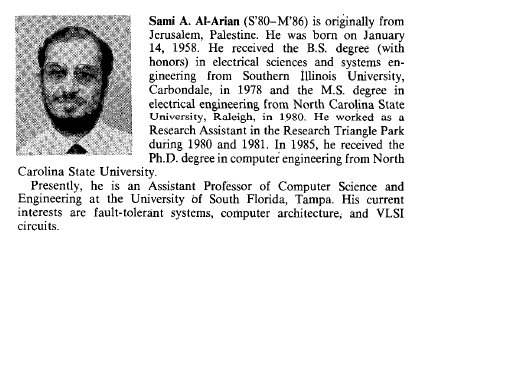
Sami al Arian, who was recently involved in pleading guilty to some charge to stop the government's crusade against him, was born in "Jerusalem, Palestine," according to this 1987 IEEE Journal article.

It's 1979 all over again...

The Jimmy Carter parallels to George W. Bush are starting to become eerie.

Carter - who has since done a better job being ex-president than anyone - was a bit cloying with his religiosity; so weas George W. Bush, but he also sucked up to the theocratic wing of the religious right. But where the real parallels are apparent is Iran and the economy.

But this is too much:


LONDON (MarketWatch) -- European shares gained ground on Wednesday, led higher by commodity-based stocks and gains from companies such as Deutsche Bank reporting first-quarter figures on one of the busiest earnings day for Europe of the quarter.
London's FTSE 100 (UK:UKX: news, chart, profile) added 0.2% at 6,095, the Paris-based CAC-40 (FR:1804546: news, chart, profile) gained 0.4% at 5,262, and Frankfurt's DAX Xetra 30 (DX:1876534: news, chart, profile) increased 0.4% at 6,073.
The pan-European Dow Jones Stoxx 600 index (ST:SXXP: news, chart, profile) increased 0.4% at 341.08, with gains for resource and oil and gas stocks such as miner Rio Tinto (RIO ) outstripping other sectors for the second day.
Crude-oil futures were trading just under $75 a barrel, and June-dated gold futures were trading around $674 an ounce.
A similar theme was seen in U.S. stock market the previous day. Wall Street shares ended higher after solid earnings reports and a rally in oil, mining and metals shares lifted the Dow Jones Industrial Average to a six-year high and the S&P 500 index to its best level in more than five years. See Market Snapshot.
Silver up over 40 cents per ounce on the day. Dollar heading down agains the euro.

He's doing a heckuva job, Bushie.


Tuesday, May 02, 2006

"Net Neutrality" - a balanced view...

Sorry Atrios, while the recent Washington Post article on "net neutrality" is a bit overblown, they do have a point, up to a point. I more agree with Richard Bennett on this than most of the lefties, to be honest. Here's why:


  • Indeed when the net was brought out, the "Quality of Service"- making sure data is delivered to you meeting certain requirements on throughput, delay, and jitter was not well thought out. The one internet standard for this, RSVP, is not well deployed at all.

  • When the internet was cooked up, nobody really did think it would be used for interactive high quality video services. It's a miracle that the jerky videos we see on Crooks and Liars work at all.

  • The true vision of the net is the decentering of traditional sources of the media, as lefties intuitively get. But this decentering won't happen if the service providers really do choke the pipe, because new applications demand more resources on the net. Information will find a way around, or will get its method out using other methods. But, as everybody who's dealt with this business really knows, in the long run, it's the applications that drive the infrastructure requirements, just like it's the expected traffic on the bridge and the length of the river that determine the structure of the bridge and the number of lanes. It's much like the "parkways" of the New York area: they were designed without accepting that buses could use them, and now buses cannot use them (overpasses are too low). Today they're as choked as the LIE.

  • There ought to be an implied warranty of usability- my battle cry against the horrendous dial-up services provided by the likes of Microsoft and others. But this is easily accomplished within the framework of the existing 'net, and buy guarantees of access and minimal standards of throughput and bandwidth.

  • Like it or not, some folks will fly first class, and like it or not, many more folks will fly coach. The trick for providers is to make first class cheaper than the competition. (That's not trivial, and it's a profoundly interesting problem that I didn't know how to solve 12 years ago.)

  • The real issue for "net neutrality" is that an advanced internet needs to be built, financed, and initiated through the government help, like it is in Korea, Japan, and China. That's why our access charges are so steep relative to these places. Put big pipes everwhere, and the high class QoS services can easily coexist with the best effort folks. That's an issue of capital infrastructure deployment and build-out, which in the US, with its lack of centralized planning for such things, doesn't exist. Hopefully rapid deployment of true competitive access schemes (Broadband Power Line, WiMax) might alleviate this problem. But that takes a new policy, committment, and intervention, with a quid-pro-quo of warranties of operability.


So let's stop the "they're going to get us" and get real technology deployment so that once and for all, we can put the kibosh on traditional broadcast media.

Monday, May 01, 2006

Word of the Day: Détournement

I never realized that Stephen Colbert was avant garde culture...

Obviously, Colbert is not the first ironic warrior to train his sights on the powerful. What the insurgent culture jammers at Adbusters did for Madison Avenue, and the Barbie Liberation Organization did for children's toys, and Seinfeld did for the sitcom, and the Onion did for the small-town newspaper, Jon Stewart discovered he could do for television news. Now Colbert, Stewart's spawn, has taken on the right-wing message machine.

In the late 1960s, the Situationists in France called such ironic mockery "détournement," a word that roughly translates to "abduction" or "embezzlement." It was considered a revolutionary act, helping to channel the frustration of the Paris student riots of 1968. They co-opted and altered famous paintings, newspapers, books and documentary films, seeking subversive ideas in the found objects of popular culture. "Plagiarism is necessary," wrote Guy Debord, the famed Situationist, referring to his strategy of mockery and semiotic inversion. "Progress demands it. Staying close to an author's phrasing, plagiarism exploits his expressions, erases false ideas, replaces them with correct ideas."

But nearly half a century later, the ideas of the French, as evidenced by our "freedom fries," have not found a welcome reception in Washington. The city is still not ready for Colbert. The depth of his attack caused bewilderment on the face of the president and some of the press, who, like myopic fish, are used to ignoring the water that sustains them. Laura Bush did not shake his hand.


Political Washington is accustomed to more direct attacks that follow the rules. We tend to like the bland buffoonery of Jay Leno or insider jokes that drop lots of names and enforce everyone's clubby self-satisfaction. (Did you hear the one about John Boehner at the tanning salon or Duke Cunningham playing poker at the Watergate?) Similarly, White House spinmeisters are used to frontal assaults on their policies, which can be rebutted with a similar set of talking points. But there is no easy answer for the ironist. "Irony, entertaining as it is, serves an almost exclusively negative function," wrote David Foster Wallace, in his seminal 1993 essay "E Unibus Pluram." "It's critical and destructive, a ground clearing."


And yes, it is amusing to hear GI Joe say, "Let's go shopping!"

Nobody likes Bush that much any more...

And the oil nations don't really care...

President George W. Bush, already weakened at home by the soaring cost of oil, is finding that it's also eroding his ability to achieve his foreign-policy goals.

``It's a geopolitical nightmare,'' says William Cohen, a former Republican senator from Maine and defense secretary under President Bill Clinton who is now chairman of the Cohen Group, a Washington-based consulting firm. Such nations as Iran, Russia and China ``don't see us as the colossus that can cause them any harm, either by our economy or by our prestige.''

Record-high energy prices are weakening Bush's prospects of assembling an international coalition to counter Iran's nuclear ambitions. They are diminishing his chances of influencing energy-rich nations such as Russia and isolating troublesome ones including Venezuela and Sudan. And they are straining U.S. economic and diplomatic ties with China, whose oil needs are skyrocketing.

Prices show no signs of abating in the last two-and-a-half years of Bush's presidency, with oil futures hovering near $72 a barrel through the November 2008 presidential election. That's creating a windfall for oil-producing nations that may thwart Bush's goal of promoting democracy and free markets from Asia to the Middle East and halting the spread of nuclear arms...

``The high crude prices have tied Bush's hands,'' says David Goldwyn, president of Goldwyn International Strategies, a Washington-based consulting firm, and an assistant energy secretary during the Clinton administration. ``These very high prices really empower other leaders to act with impunity.''

It isn't only oil producers that are ignoring U.S. wishes. China, the world's second-largest consumer of petroleum products behind the U.S., is seeking energy resources wherever it can find them. That includes negotiating for investments in nations such as Iran, Nigeria and Sudan, where Bush is seeking to improve human rights and push democracy.

Chinese President Hu Jintao followed his April 20 visit to the U.S. with a trip to Nigeria, Africa's biggest oil producer, to seek drilling rights. China has accounted for more than 40 percent of the growth in global oil demand during the past four years, according to the U.S. Energy Information Administration.

Russian President Vladimir Putin has frustrated the Bush administration by rolling back democratic rights in his country and seeking to dominate former Soviet republics. Putin has also been reluctant to pressure North Korea and Iran to not develop nuclear weapons. He has resisted U.S. efforts to impose sanctions on Iran, as has China.


He's a regular right-wing Jimmy Carter, Bush is.

Bernanke's getting his initiation...

The London Times doesn't like him today.


I actually don't see the point of raising interest rates given that high oil prices will almost certainly choke the economy.

And of course the folks in Washington probably want the dollar to slide.

Still, be wary of US equities that aren't valued by commodities for now, I'd say.

Ah, globalization...