Showing posts with label Asian Buddhism. Show all posts

Tuesday, October 22, 2013

The Asian Version of the Dharma Money Issue

I was recently asked by a Christian person whether or not there was a similarity between asking for indulgences that the Catholic Church of yore used to have and, in Asia, the practice of offering money in Buddhist temples followed by a chant/offering of incense.  The Christian used to think it was similar.

I was at a loss for words temporarily (other than to say, well, you'd have to deeply understand karma and interdependence), mostly because the topic at hand wasn't the topic of this blog post; it was a tangent to a more important topic.  I wasn't exactly satisfied with my answer...of course a better answer came to me later:

  • When one offers money at a temple, like everything else at a temple, one just does it, and does it wholeheartedly.  In effect, the act of offering at a temple is the offering of one's own life itself at that moment.  In that sense, it's more like the Christian communion in reverse than the other way around.

  • Typically, though people often come to the temple indeed for some reason such as a sick relative, what they say isn't an "I'd like to get something" prayer of course; it's an invocation of the form "Homage to X."  It's declarative.

  • I was however not off-base with the words karma and interdependence.  Most Buddhist chants when they aren't declarative, are in the 2nd person, but the identity of the 2nd person is not of course, separate from the chanter.  In Buddhism, of course, there is the principle of no-self.  So who is invoking what to whom, or who could possibly be trying to get something from whom?

  • Of course, there is the money for services thing, but that's not wholly unreasonable, I'd point out. Temples have to operate on budgets too.

There, that's better.

Saturday, October 19, 2013

Huguosi (護国寺), "Protect the Nation Temple" - Emerging Buddhism?

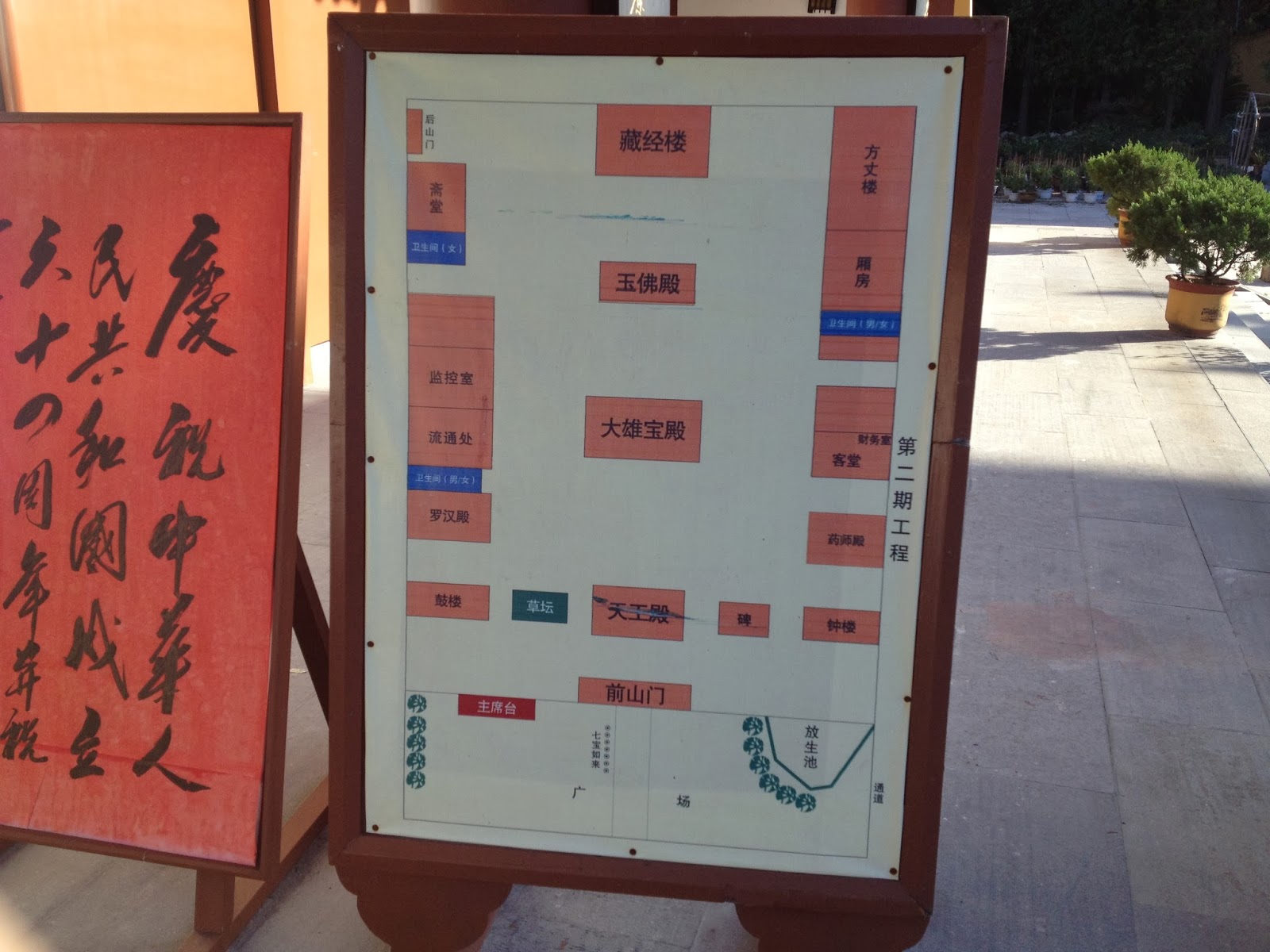
On my recent trip to China I stopped off in Wenzhou.  I had a chance to visit 護国寺.  Evidently there used to be a 護国寺 in Beijing, but it was destroyed in the 1950s. So originally 護国寺 was about protecting the nation in imperial times. You can read into the name of the temple now all kinds of cynical things about the government, but about my visit there, well, it's clear the people going there don't seem particularly cynical about it.  Like many temples this one seems brand spanking new; in fact construction is still going on there.  It's evidently a Pure Land temple - no 禅堂 to be seen, but typically the schools of Buddhism tend to mix.

In the main hall (2nd picture down) there was a chanting service going on with lots of lay people being led in chanting by a monk, on a Saturday mid-afternoon.

I saw a bunch of blue collar guys - in their 20s- entering the temple smoking cigarettes, and having a regular Chinese bro early fall afternoon, laughing loudly.  A few minutes later  a monk was showing these guys how to offer incense, which they reverently did.

Say what you will about China and religion, but on this day, 護国寺 was bringing people calmness and tranquility and peace, and yes, compassion.   You might say China is trying to co-opt Buddhism, but I might point out it seems to be the other way around as well.  Wenzhou tends to have a high population of Christians (yeah, there's brand spanking new Christian churches there too) but it's clear that there's a resurgence of Buddhism amongst people here.

So just to let you know, there's more forms of emerging Buddhism than you can shake a stick at, which of course you can't.


Wednesday, September 25, 2013

Even in academia, this is a pretty serious offense, isn't it?

Despite what some denialists say,  even in the corporate world, there's a lot of effort made to get the science right, because the company wants to be able to make informed decisions.  It may not propagate the right science to the world at large, but at least it tries to figure out what's going on my experience  of my career of working at over 4 companies.  (Yes, that's 5.)

Seriously, if someone working in my organization was found to be deliberately making results up, results that were defining our company's future  he'd be fired. 

So I had to scratch my head when I read Jundo Cohen's piece on Brian Victoria the other day, and asked myself, "Where is that guy?"  And I read it again when I saw Jundo had sent me an e-mail asking me about his piece at Sweeping Zen.  But, Jundo, truth be told, I really started asking that when I read this at the Zen site: D. T. Suzuki and the Question of War by one Kemmyō Taira Satō, translated in collaboration with Thomas W. Kirchner.  Satō is a Shin Buddhist priest; unfortunately (I'm a bit pressed for time especially today) I wasn't able to look up further credentials of Satō  other than being a "scholar."  But as I'll explain shortly that doesn't matter so much.

Victoria, like Cohen, are Soto Zen priests.  Victoria is well-known in our neck of the woods for writing Zen at War, which did point out that there was some pretty nasty things said by Hakuun Yasutani, who has directly or indirectly influenced much of Zen in the West, including the Maezumi White Plum folks. (Yasutani's been said - I forget where - to have created a new school of Zen apart from Soto/Rinzai but I forget where I read that, incidentally.)

Victoria has been associated with Antioch University; assuming that last link is still valid apparently he can be contacted at:  bvictoria@antioch.edu .  Time permitting, I may try to contact him in the next few days, because it behooves all concerned to come to some kind of agreement here. I encourage Jundo to do so as well.

What does Victoria think of what Satō  wrote? Why does that matter? From the Zen site:


Despite its many contributions, however, Zen at War left me with the impression that the author, in his desire to present as strong a case as possible, often allowed his political concerns to take precedence over scholarly accuracy. This was especially the case with regard to his portrayal of Daisetsu Teitarō Suzuki (1870–1966), whom Victoria depicts as an active supporter of the Japanese WWII war effort. This is a very serious accusation, given the importance of the issues raised in Zen at War.

I had the opportunity to become closely acquainted with Suzuki and his views on war when I worked at the Matsugaoka Bunko 松ヶ岡文庫 in Kama- kura under his guidance from 1964 until his death in 1966. This period of contact with Suzuki, as well as my own study of his works in the years since then, have left me with an impression of Suzuki and his thought that is far dif- ferent from the picture presented by Victoria. This disparity, combined with the desire to set the record straight, have inspired the present attempt to clarify what I regard as Suzuki’s true attitude to war.

All scholars employ quotations from relevant texts to support and develop their arguments, and are of course at liberty to select those passages that best suit their purposes. Even so, Victoria’s highly selective citations from Suzuki’s works often seem motivated less by a desire to clarify Suzuki’s actual views than by a determination to present a certain picture of the man and his work. As I read Zen at War, wondering if Suzuki had indeed taken the positions that Victoria attributes to him, I checked each and every quotation against the original Japanese texts, an experience that left me with a number of ques- tions regarding his use of Suzuki’s writings. Ideally, every position attributed to Suzuki in Zen at War deserves close reexamination, but considerations of space do not allow this. I will attempt, nevertheless, to evaluate the points Victoria raises and the evidence he presents as I clarify what I feel are Suzuki’s true views. In the process I will quote rather liberally from his works in order to provide the reader with as a full a context as possible. 


I've read most of Satō's piece and the charges he makes are pretty serious.  Either Victoria was working from highly edited texts himself, or was indeed cherry-picking quotes, but if Satō is to be believed, in any event D. T. Suzuki's not represented based on the context of what Suzuki wrote.  In particular, Suzuki's views of Japan after the war, and his views of Nazi Germany appear to be significantly misrepresented, though in the latter case,  it would not surprise me if a resurrected Suzuki would admit to harboring racist feelings in the 1930s.  But then that was the norm throughout the world then, and to a large extent is now.

One of the interesting notes in the piece was that Suzuki not only had deep connections with  Sōen Shaku (釈 宗演), the first man to bring Zen to America (and the 4th generation of myself), but also Imakita Kōsen (今北洪川)  Shaku's immediate ancestor.

Another point of contention, a serious one, in my opinion, is the idea that Zen and Buddhism should be automatically linked to pacifism.   This is absurdly ahistorical not simply considering the history of Japan, and famous Buddhists such as Suzuki Shōsan,  but geez, going all the way back to Shaolin-si, at least.

So I'm left scratching my head,  if the above is true, why would Victoria have written what he's written?  Does he plan to correct the record if  the critics are found to be true?  And how can that be done?  And what of the academic institutions linked to him? What's their position?

It is true that there was some horrible things done in the name of Buddhism in Japan during the 1930s-1940s.   But that doesn't justify faulty scholarship, if that's the case, here, which though I haven't read the Japanese, seems to be the case if the English versions of what I'm reading are accurate.


Saturday, September 21, 2013

The West has no monopoly on Buddhist scandals

From Thailand comes this story:


Thailand has seized nearly $800,000 worth of assets, including a Porsche and a Mercedes-Benz, from a monk who was disrobed for a controversial trip in a private jet, authorities said Friday.
Thailand's Anti-Money Laundering Office (AMLO) said Wiraphon Sukphon was suspected of deceiving people to give him donations.
"Monks can receive donations and must use them for the benefit of the public, not for private use and their own personal comforts," Police Colonel Seehanat Prayoonrat, secretary of the AMLO, told AFP.
Wiraphon went by the name Luang Pu Nen Kham to bolster his claims to be the reincarnation of a famous miracle-performing monk.
The disgraced cleric, who is believed to be abroad, is also being sought in Thailand on suspicion of having sex with an underage girl around a decade ago while he was a monk, and of fathering a child with her.


See also here. Apparently this guy milked something like $0.77 million which probably goes a lot farther in Thailand than it does here. 

The fact is, humans will have scandals.  If someone is a kind of Buddhist service provider, choose one that not only adheres to a code of ethics with which you feel is ethical. 


Tuesday, May 22, 2012

Tricycle interviews the Angry Asian Buddhist

I'm really glad to see Tricycle publishing an interview with arunlikhati,  which deals with some of the issues of culture and ethnicity that tend to distort some of the way in which "Buddhist media" portrays "Buddhism."

As I commented over at arunlikhati's place, I tend to experience these issues too in odd ways.  The other night before my trip I was practicing Wing Chun with a Vietnamese professional guy.  His French was impeccable, but yes, I was (slightly)  surprised that he was illiterate in 漢字.  (Yes I know Vietnamese has been Romanized since the French, and yes I know Vietnamese isn't a Sino-Tibetan languague, but just because an Asian language has loan-words from Chinese, and just because there are non-Sino-Tibetan 漢字 languages not written in 漢字 whose users are literate in 漢字 doesn't mean that all educated speakers of non-Sino-Tibetan Asian languages know 漢字. )

So it's good to see this kind of dialog taking place.

Monday, February 06, 2012

A few areas for possible upcoming posts...or perhaps short takes...

I'll be on travel much of this week, but I wanted to sketch out a few ideas that might make interesting posts for the future:

  • "Rights" - do they exist?  I'm remind of this by reading a post on Kos about the sexual agenda of the Religious Right. A passage appears there to the effect of "Maybe you don't believe in common descent or evolution. Even though I think that's a foolish belief, you are entitled to it, but common descent is nonetheless true."  While for the purposes of everyday social engagement and politesse it's useful to treat people with the respect the presumption of rights would entail, and while for legal purposes it's crucial, especially at present to act with the presumption of certain rights and powers arranged, the construction of such rights, to me, appears at odds with how the world is experienced.
  • The Dalai Lama appeared on a Michael Palin travel documentary show.  (See here.) To be honest, the reactions of the Dalai Lama when he sat down with Palin were interesting to say the least. Two things stood out: Firstly, the Dalai Lama seemed to laugh a bit too much - I frankly couldn't figure out why, because the laughter seemed in some spots either forced or not exactly matching the tenor of the conversation.  But the other thing that stood out was a point where Palin noted that he was bound for Tibet after visiting Dharmsala.  It was strikingly clear that the Dalai Lama, like any of us, still deals with attachments.   The only other thing that stood out here - alluded to by Palin - was the degree to which the Dalai Lama/Tibet in exile thing is an enterprise.  The tragic implication is that people have quite a bit invested in this "in between" condition of Tibet/China/Dharmsala.  
  • On doing things that are difficult: I have been meaning to address this.
  • Interesting times: I'm living in them. Hopefully some mistakes will be profitable.

Thursday, December 08, 2011

Suzuki-roshi, somewhat different interpretations, but it's all OK

I finally re-read Barbara's post on Suzuki-roshi & dragons, and added a comment, as you can see there.  To be honest, I'm not entirely satisfied that I captured what I wanted to say in the comment, which I'll get to in a bit, but I wanted to go somewhere else first.

Suzuki-roshi is/was another one of those guys about whom Stuart Lachs has written a "corrective" on saying, basically, a) he was really really human, despite what the posthumously written intro to his most widely known book would imply, and b) he therefore made what we'd refer to as "mistakes" if we were talking about any other Tom, Dick or Harry.  I won't bother to go find Lachs' piece on Suzuki-roshi, just because as a guy who's been involved with such cultural things for a while now, none of it is surprising - while the Japanese Zen school has sent outstanding teachers and exponents to the West, they've also at times sent exponents of their "B Team," which is kind of a common practice at certain international companies - they send the exponents of the A Team when they really want to expand, and they send exponents of the B Team when they want to move a potential (or actual) problem to the "Somebody Else's Problem Field," to use a term from Douglas Adams. But in this context, let me just say a lot of us can learn a lot from the B Team.

I remember getting that book "Zen Mind, Beginner's Mind" long ago, and when I first picked it up, it was frankly incomprehensible to me, and later on it made a heck of a lot of sense, since I guess I was somewhere that needed the relative sanity expressed there.  Later on, when I started reading Dogen (yeah, I have read Dogen), I realized that some of Suzuki-roshi's extrapolations on bits in Dogen, quite frankly, weren't obvious in the plaintext meaning of Dogen.  But then again, it being Zen and all that, Suzuki's narrative is not all that different, ultimately, than my interpretation.

Back to Barbara's post.  Barbara's relating a story about a guy who was so enamored of dragons that he got to meet a real dragon, and was shot through with stark terror on the encounter. She notes that Dogen commented, "I beseech you, noble friends in learning through experience, do not become so accustomed to images that you are dismayed by the real dragon."  Her explanation that we shouldn't mistake outward forms and images for the "real thing"  is pretty good, and my comment is sort of OK, but I think I'm not going far enough in my comment.  To actually give up one's attachments - to realize that one has  the power to get all beings to transcend suffering is to realize that the "dragon" of our True Nature has unfathomably infinite power compared to the "worm" of our attachment driven little mind that I don't think you can cross that threshold without a bit of fear and trepidation.  It's scary to be able to give up everything, including the desire for enlightenment itself,  just as it is to consider that death means "giving it all up."  So, the idea of the serene Buddha, the images of the thousand armed Regarder of the World's Cries,  so calm and all that, isn't the being that actually has the power to give it all up.  The moon beats the finger pointing to it like a gong.  And it's easy to get dismayed that this bag of decaying flesh, home to more microbes than there are homo sapiens on the planet,  is actually an expression of that True Nature. 

And, it's why folks like Warner constantly rail against "Big Mind," but that's kind of a digression. 

At such a point, when one encounters this fear, there's actually something that can be done, which I'll get to later, but for now, Douglas Adams' advice is pretty good: Don't Panic.

Tuesday, December 06, 2011

So much spiritual hucksterism...so little time...

I'm a busy guy of late, what with work, family, and the various practices in which I'm engaged.  So, here's a few quick pointers on the absurdity I read nowadays...

Of course we Mahayana Buddhists vow to save, or help  all sentient beings ourselves, in the sense of the transcendence of suffering.  But in no way is that a function of how much we can pay nor how much abuse we're willing to take, or whether we check our brains at the door when we go for some sort of teaching.  

Also don't believe everything Maurice Shonen Knegtel wrote there at that link, as if I had to write that.  Especially this part is risible:

Teaching, practice and realization took place in everyday activity, like farming, walking through the mountains, drinking tea, cleaning, or just talking. Probably they did not sit that much in formal zazen, and the early Masters rarely talk about sitting practice. Zen was not yet formalized with rituals and ceremonial practices, as it was later in Sung China (Tenth to Fourteenth Century A.D.), Korea, Vietnam and Japan. Early Chan was a living religion, not dependent on forms like teisho (formal teaching), zazen (formal sitting) or daisan (formal interview). Enlightenment was found and expressed in daily activities. And the way of teaching of the old Masters was very similar to that of Gautama the Buddha. Students were led to a place where they are one with the Dharma and express it. Genpo Roshi’s Big Mind process offers the same living religion in a playful game of giving voice to whatever dharma is coming up and by skillfully practicing the same ‘wonder of teaching’ as Gautama the Buddha and early Chan Masters did. 
 It's risible because its Orientalism and revisionism just oozes right through every word, including the instances of "a" and "the."  That Lin Chi didn't depend on his teishos - even if they weren't called that - is absurd.  What the hell does Shonen think he was doing when he ascended the high seat? He wasn't thinking "Gee, this is just like what 'Big' 'Mind" is going to be in a thousand some-odd years." 

And for Void sakes, "Big" "Mind" isn't an "everyday" activity!   There's 8.6% unemployment! Their everyday activity, I assure you, isn't mucking around with "voices."  The "everyday" activity of the working monastics (and laity) consisted of, you know,  activities performed every day. No special process or mind games were needed, playful or not.

These guys have completely forgotten, it seems, what it is to be ordinary.  And, it seems, Shonen might have confused the Dharma with a "conflict of interest," the conflict of interest being his personal investment of time and energy and effort, and I'd bet, gelt, into the Merzel Thing, and, of course, the practice of the Dharma.

All right.  Enough of my rant for today.


Tuesday, November 29, 2011

Buddhism and race, from a guy of European descent nearer to it than most...

I'm not big on identity politics, which is to say I don't often write about race matters exclusively.  I often do write about cultural matters on the other hand, and to the extent race is a social construct (and race is a social construct to an extent that it's almost useless, as far as I'm concerned to deny the proposition) I guess in that sense I do write about race as culture.

As a guy with very frequent contact with Asian folk, who's conversant in Japanese (in limited topic areas; I can't really do botany, Jungian psychology and art criticism in Japanese), with an Asian wife, with Asian in-laws, with a 1/2 Asian grand niece (who's beautiful & bears a slight resemble to my son), who travels to Asia frequently, I'm quite sympathetic to Arun's point here (among other places), though I don't think he actually goes far enough, or perhaps he, too is too provincial (sorry Arun).

As I noted on my comment on that post, I don't think many Buddhists from American institutions don't quite get what they're missing (though in many cases the American-of-European-descent flavored Buddhism is light years beyond no Buddhism at all.)  The narrative is pretty pervasive: The Asian Teachers of Old came to America; They Taught a Select Group of Americans (mostly of European descent), and The Great Teachers of Old had all this Strange Asian-ness that - don't worry - the next generation of teachers has washed away so it's not as strange as it may appear, dear newcomer.

There's may be a reason there's also these stories about "how come there's no new young people coming into the temples anymore" by the way. And I think that reason's connected to the changing notions of race and minority in America; of course I have a particularly distorted global view of things; I bet I have seen more CNN International than everyone else in the Buddhist blogosphere combined.   Maybe more sumo wrestling, too (which, for the record, when your're jet-lagged, can keep you up on a Saturday afternoon with the same ethos that one brings to rubbernecking in a traffic jam, but I digress.)

People, I think, want more of the "real thing."  They don't see the "exotic" as "alienating" like they used to, except perhaps in Alabama.  At least that's they way that I see it on the coasts, in my admittedly rarefied circle of people in which I circulate.  But, suffice it to say, that circle mingles with people who mingle with other people who...you get it...6 degrees and all that. 

I spent the "Black Friday" day entertaining folks who I'm proud to call my friends and their families.  One family consisted of a Chinese immigrant who met her Lebanese immigrant husband at some company in the Bay Area.  An other family consisted of two immigrants from China who immigrated when they were kids (if I recall correctly it was both of them); both of whom had had a grandparent who...wait for it...was an American or Canadian.

It's all mixed up. 

Like I said, many of the folks don't seem to know what they're missing.  Some folks - like Danny Fisher - do seem to have somewhat frequent contact with Asian Buddhists (but I can't really tell; I don't know him personally, only blogosphere-ly.)  But - and here I kind of part ways with Arun - the notion of Buddhism and racial constructs, whether consciously observed, ignored, or otherwise - is about as impermanent and empty as you can get.

I've sat zazen in temples in South Korea, China, Japan, Hawaii, and numerous other places in the USA.  I've spoken with clerics and practitioners from all those Asian countries about the way Buddhism is practiced in their country.  Do I have a better handle on "Asian Buddhism" than Arun? Than Danny Fisher? 

I don't really know, and I largely don't care; I am grateful though that I have, within the confines of my Platinum Elite status, been able to meet and converse with a very diverse group of teachers.   I'm sure though that my particular experiential deformation doesn't make me or Arun or Danny Fisher any more or less Buddhist than they are or are not.

But this I'll say: much of what I see in the Buddhist blogosphere, and in American-of-European-Descent Buddhism is like the Buddhist analog of  Chinese food in American restaurants.  Sure, it's made according to a recipe that's been in restaurants for years, but the Chinese folk order stuff that "Westerners" wouldn't touch.

And they don't know what they're missing.  Not that what the Americans are ordering isn't Chinese food; it's just that there's so much more.

I do think Arun has a point, or at least is in the direction of a good point; I don't really know his background, but I do know that race and cultural issues are more complicated than a simple paean to "diversity" or denial that there's an issue in the first place would imply.  I also think there's another larger point behind what Arun's saying too - which I'll tangentially bring up here.  Much of the "Buddhist media" to me is reminiscent of a phenomenon that the defunct Spy magazine used to satirize with the recurring feature "Logrolling in Our Time."  In that feature Spy would present book-jacket blurb recommendations from authors of books who also wrote books which had book-jacket blurb recommendations from the authors of the first-mentioned books...if you catch my drift...It all sometimes seems like a Hey Let's Pat Everybody on the Back Club for Being Good Buddhists!

Of course, I'm not a member of that club...and I think, after all these years,  there might have been some wisdom after all in Groucho Marx's dictum that "I wouldn't joint any club that would have me as a member,"  though I guess the popular kidz evidently feel otherwise.    But it is really true about that old saw about the flower doesn't have to shout out loud to be fragrant and beautiful. It's really true.  But it's sad about the popular kidsz.


I think that's enough for today, but I'll  leave with one point, that underscores this, that I've not seen mentioned ever in the Buddhist blogosphere. Maybe Kobutsu Malone can corroborate what I'll say and expound further on my point, which is: Did you know Eido Shimano had Japanese students?  What ever happened to them? What ever happened to Seung Sahn's Korean students?

I've no idea.

Wednesday, September 14, 2011

Cringe inducing...

That's how I'd describe this recent article on  the Washington Post website on "Shaolin" films and "spirituality," by way of introducnig “Shaolin,” a "new" movie starring Jackie Chan and Andy Lau.

“Most people don’t realize kung fu is internal and external, a peaceful and a martial application, and a Shaolin movie will include both, while most kung fu movies are about anger and shooting,” says Ric Meyers, author of “Films of Fury: The Kung Fu Movie Book.”
“Shaolin is all about spirituality, karma, your well-being,” adds Doris Pfardrescher of Well Go USA, which is distributing “Shaolin.” All other martial-arts films are “ just about action, fighting,” she adds, “but Shaolin is about religion, spirituality, being with Buddha.”

 It gets worse.


But Shaolin did not become just an Asian phenomenon. The 1970s TV series “Kung Fu” featured David Carradine as a Shaolin monk. Wu-Tang Clan named their first hip-hop album “Enter the Wu-Tang (36 Chambers)” — the 36 Chambers being a reference to a Shaolin movie. The animated hit “Kung Fu Panda” was influenced by Shaolin martial-arts styles. In the “Kill Bill” movies, Uma Thurman is taught martial arts by a Shaolin monk. And even the cartoon series “The Simpsons” helped establish the monastery’s cultural bona fides when Homer visited it during a trip to China.
Since the Shaolin craze began, martial arts have become fairly ubiquitous in movie fight scenes — hits such as “The Matrix” and “Crouching Tiger, Hidden Dragon” helped popularize the form — but Shaolin remains an iconic name and style all its own. “A lot of other martial-arts films are just throwing out different styles,” says Reid, “but when you see a bald-headed monk in a martial-arts film, you know it’s a Shaolin monk. Other movies are just entertainment. The Shaolin movies are a way to tell the audience about the Shaolin martial arts.”

 It might be a bit much, I know, to expect the Washington Post to actually produce an article evocative of what kung fu actually is, let alone why a Buddhist might do such things.  But 2 minutes of googling would have told the author that Pai Mei wasn't a Shaolin monk.

And the "new" movie "starring" Jackie Chan (he has what is almost a supporting role but isn't quite the main point of interest in the story)  is most notable for its implicit flavor of Chinese nationalism more than anything, which, as far as I'm concerned, is not a problem, but would otherwise be expected these days.  Perhaps more to the point, though, is why this film has a Buddhist message (which is more explicit than the nationalist message): because of a warlord's greed, a violent struggle ensues which ultimately takes the life of his daughter, and the only way the warlord can ultimately live with himself is to renounce his past and take up a life with the Shaolin monks, on the eve of their temple's (latest) destruction.  And that story is poignant regardless of any branding.

Then again, the whole story of Buddhism in China in the past century or two is rife with struggle and endurance that people in America barely understand at all, myself included.

Ah, well whatever.

Saturday, March 26, 2011

There's still proteges of Frederick Lenz out there! And a thing or two to refresh you.

You'd think that by this time pretty much everyone who does any kind of a "spiritual" practice might have heard of the dreaded Frederick Lenz.  Many of us in the blogosphere have written of the Frederick Lenz Foundation and its notorious ties to some of the big names in Western Buddhism, including, it would seem, Dennis Merzel and James Shaheen of Tricycle fame.   It's really sad that this is the case: Tricycle should come with a warning label or something.  They were originally started, I think - I could be wrong - with money from the Rockefeller Foundation or something like that.  That's not much of a problem for me: There's no sense in not using money that pretty much everyone knows was ill gotten for good.  The issue though, is that unlike the Lenz Foundation, the Rockefeller Foundation never really peddled defenses of the infamous activities of the Standard Oil company.  Get it?

(BTW, as a guy with dozens of patents to my name I bristle at the notion of referring to Lenz's bilge as "intellectual property," but alas, it does fit the definition.)

But it appears there are still  teachers out there - who don't seem to be associated with Lenz Foundation largesse - who are actually "teaching." One of them is Tony "Shiva" Chester.

Shiva was born as Tony Chester. The experience of God awareness at age five set his life on a path of esoteric exploration and spiritual evolution. With his teacher’s grace, he crossed a threshold into enlightenment at age 36. His path remains full of unexpected epiphanies, visions and a deep awareness of the divine.
Shiva is a powerful teacher who consciously transmits sacred energy in his seminars, retreats and pilgrimages, and personal interactions. His approach is eclectic and draws from various religions and philosophies. A Westerner, he grounds the mysteries of the ancient world in a modern and often humorous way.


Doesn't this tell you all you need to know about this man?

Ok, now that I've gone all H. L. Mencken on you here's some stuff that should be more uplifting:

  • On the other hand if you aren't particular about the sword being made in Japan, there appears to be an excellent forge in Zhejiang province.  I wonder if it's significantly cheaper.
  • It appears that the rebels are gaining ground in Libya.  The short answers are as to why this is not George W. Bush's Iraqi war are: 1) They're trying to prevent what happened in the 50s in Iran. 2) We're on the right side here.  Personally I'm ambivalent about this because even with the reasonably good intentions of some on this (and make no mistake it is a fact that oil figures prominently in this), its unknown how it will play out.  Karma and all that you know.

Thursday, March 10, 2011

It's the 45th annniversy of his death, not the 55th

But otherwise, this article in the Japan Times on D. T. Suzuki is well worth reading. I am amazed at how great his influence was - I am impressed that Abraham Maslow, one of the bright lights of the more human ways of organizing workers of the twentieth century, was influenced by him, according to this article.


The postwar era marked the heyday of American Freudianism and its humanistic offshoots — and Suzuki, teaching Zen Buddhism at Columbia University in the 1950s, was at the epicenter of creative psychological thought. Only months before Horney's death in 1952, she accompanied Suzuki and colleagues on a tour of Japanese Zen monasteries and emphasized the importance of his notion of "whole-heartedness" as a vital feature of mental health. Fromm became close friends with Suzuki, and in 1957, sponsored him as a guest speaker for a conference on Zen and psychoanalysis held in Cuernavaca, Mexico. Several years later, the two coauthored an influential book on this topic; like many others, Fromm was greatly touched by Suzuki's personal warmth and kindness.
Abraham Maslow, guru of motivational psychology, was another humanistic thinker inspired by Suzuki during these years. Maslow, who pioneered in studying what he called "peak experiences" — that is, sudden moments of joy and meaning — was excited by Suzuki's concept of sono-mama or suchness, as an element of mystical awareness. Sponsoring Suzuki's lectures at Brandeis University, Maslow also regarded Suzuki's Zen teaching of muga, or total absorption, as vital for a psychology of well-being and growth.
It is an historical irony, though, that Suzuki had much less impact on Japanese psychology than on its humanistic development in the U.S. and Europe. Why so? Because during the postwar years, Japanese psychologists were eager to establish their field as a rigorous experimentalist science, akin to biology, and looked askance at philosophical or spiritual thinkers. As the Jungian scholar Dr. Shoji Muramoto of Kobe City University of Foreign Studies comments, "Unlike in the West, Suzuki's relevance to modern psychology has hardly been appreciated in Japan outside of a few journal articles. Nevertheless, he was perhaps the first Zen philosopher to deal with Zen as an object of academic study in its philosophical basis and psychological aspects, as well as its history."
After retiring from Columbia University in 1957, the elderly Suzuki returned to Japan, where he kept up an active, international schedule of writing, attending conferences, lecturing and receiving awards for his lifetime achievements.
Until his death in 1966 at age 95, he influenced a new generation interested in the relevance of Eastern thought — particularly Zen Buddhism — for contemporary civilization. For instance, his writings on Zen meditation later contributed to mindfulness training for health care professionals as a valued therapeutic tool — and now sponsored by dozens of medical schools in the U.S. and elsewhere.
As Suzuki astutely saw, the world was hungry for Eastern spiritual wisdom. His final words? "Don't worry. Thank you! Thank you!"


Saturday, February 12, 2011

Update on the Karmapa Situation

I mentioned about the situation here. Early reports had said (can't find them now!) that the Indian police had cleared the Karmapa of wrongdoing, but like any government with a policy agency, they're still hanging on to this like a pit bull.

And so I'm led to believe the Karmapa is innocent here, just from the behavior I've read about from the government in question here.

Friday, February 11, 2011

The Asia Times Perspective on the Karmapa: Very Complicated Stuff Here

I generally don't read the Asia Times as much as I used to do.  This Hong Kong based media outlet publishes analysis that is, unique sometimes, to say the least.  Nobody I think can say that this stuff is American or Taiwanese PRC "propaganda," that's for sure.

So its recent article on the Karmapa makes for some interesting reading. If the article has any credibility there may be more to this inter-sect rivalry, and, according to them, some basis for suspecting PRC involvement in these things. 

The Kagyu sect - also known as the Black Hat sect by virtue of the magical headgear woven of goddess hair worn by the Karmapa on ceremonial occasions - disputes the presumption of the Dalai Lama to speak on its behalf. Kagyu adherents point out that the Karmapa holds precedence as a reincarnation over the Dalai Lama since the Karmapa reincarnation was initiated over 100 years before the first Dalai Lama was enthroned. The seat of the Karmapa was the Tsurpha monastery inside the present-day PRC; the 16th Karmapa fled to Sikkim with the Kagyu sect's most important regalia and treasures, and established an imposing new seat called Rumtek a few miles outside the Sikkimese capital of Gangtok.

This institutional friction was exacerbated in the 1960s when the Dalai Lama's decidedly un-Buddhist brother, Gyalo Thondup - who was the US Central Intelligence Agency liaison for the secret war against the Chinese occupation of Tibet - spearheaded the creation of a "united front" that would centralize the control of the fractious emigre community and sects under the control of the government in exile in Dharmsala. The other sects were apparently loathe to bow to Gelugpa control and formed their own political organization, the "Fourteen Settlements" group under the leadership of Gungthang Tsultrim.

In 1977, Gungthang was assassinated. His assassin allegedly told police that he had been paid $35,000 to commit the crime by the government-in-exile, and further alleged that he had been promised a bounty of double that amount to kill the current Karmapa. [1]

Efforts to centralize control of the emigre community collapsed, leaving a residue of bad feeling between Gelugpa and Kagyu leaders.

The situation was complicated by a split within the Kagyu sect itself upon the death of the 16th Karmapa in 1981.The conflict boils down to the rivalry between two Rinpoche in the Kagyu order, Tai Situ Rinpoche and Shamar Rinpoche ("Rinpoche" is an honorific typically applied to reincarnated lamas).

They have battled for decades over control of Rumtek and its ecclesiastical and worldly treasures (which are now in legal limbo; Indian courts have awarded control to a trust established by Shamar Rinpoche, but the local government has not taking the politically traumatic step of evicting the partisans of Tai Situ Rinpoche, who actually occupy the facility).

They also continue to battle over the very identity of the 17th Karmapa.

Tai Situ Rinpoche claimed to have found a secret note from the 16th Karmapa that directed him to the boy subsequently acknowledged by the Dalai Lama and enthroned in 1992 as Ogyen Trinley Dorje, the 17th Karmapa.

Shamar Rinpoche had none of that, asserting that a dream led him to a different Karmapa, one Trinley Thaye Dorje, whom he quietly brought to India from the PRC and enthroned in 1994.

Adherents of Shamar Rinpoche consider Ogyen Trinley Dorje's acknowledgement by the Dalai Lama as a piece of low, Gelugpa skullduggery. An America student of Shamar Rinpoche, Erik Curren, wrote a book on the Karmapa controversy titled "Buddha's Not Smiling". Talking to Asia Times, Mr Curren characterized the elevation of Ogyen Trinley Dorje as a virtual coup d'etat against the Kagyu sect by the Dalai Lama, with the intention of elevating an easily-manipulated son of nomads to the position of Karmapa.


And not only that...

The most useful accusation against Ogyen Trinley Dorje - one that attracted the close and hostile attention of the Indian security apparatus-is that his patron, Tai Situ Rinpoche, is colluding with the PRC to extend Chinese influence into India's Himalayan border regions...

A 1998 suit filed by a follower of Shamar Rinpoche further accused Tai Situ Rinpoche-and the Dalai Lama and his brother-of scheming to seize Rumtek, destabilize Sikkim, and hand it over to the Chinese. [3]

Certainly, beyond pleasant Buddhist platitudes concerning universal brotherhood, Tai Situ Rinpoche has made no secret of his efforts to re-establish his position inside Tibet with the help of the Chinese government.

He has rebuilt his traditional seat, Palpung Monastery, in western Sichuan province. His lavish website offers gorgeous views of the monastery and states that 300 students and 50 monks reside there.

For its part, the Chinese government appears to encourage the establishment of Tibetan organizations overseas that are affiliated with partisans of Tai Situ Rinpoche and promote Ogyen Trinley Dorje as the Karmapa.

In India, Tai Situ Rinpoche's reception has been less friendly. The Indian government banned him from entry into India from 1994 to1998 (he travels under a Bhutanese passport). His travel to the Himalayan border regions is restricted to Himachal Pradesh, where the Tibetan government in exile is located, and where his main facility inside India, Palpung Sherabling, is located. He cannot travel to the Northeast, Jammu/Kashmir, or Sikkim, where Rumtek is located. [4]
If you sit back and think about all of this for a few moments,  the existence of these charges and counter charges should not be surprising.  It comes from mixing religion and politics.  It arises also (read more in the article) that there are local geopolitical ramifications between a rapprochement of the Tibetan Buddhist community inside and outside Tibet/China that go beyond Tibet/China; namely, into India itself.

I've not written much about this thing except to say something like, "I really don't know what's going on but you have to expect countries to expect things of people living within them, and there are laws to follow." To which I'd add: And you can't expect the countries to not act like geopolitical entities, especially when they're big geopolitical entities who appear to each other to be in a zero sum game.  And, to the Western Buddhist blogosphere: Don't presume automatically anything about anything here.  To non-partisan parties here it is strange that the moment some outside agency raises some critique of these folks, it's always "Those Bad Non-Tibetans!" kind of response.  This is especially true given that China and India have been historical enemies forever.   That's why I maintain that judgment by those who aren't intimately familiar with the situation (and I for one am not) is premature to say the least.

I don't have an axe to grind in this  at all, except to say that I've really liked Western followers of the Karmapa I've met in the Portland area.   I hope they all work it out.  And I'm sure that there are those who will respond that all I'm doing is regurgitating PRC propaganda or some such hoo-hah.  But stuff happens behind closed doors.

Monday, December 06, 2010

Reality?

Barbara writes, in what might be a different context from where I'm going here:

The whole issue of what is REAL or NOT REAL is problematic, of course, since phenomena that most westerners would sort into "real" or "not real" bins are all projections of mind, neither real nor not-real. Until we realize that, we all "believe" all manner of things. I suspect part of the reason there's such a disconnect between much Asian and western Buddhism isn't a difference in Buddhism itself but the different belief systems we drag into it in the beginning.
So a westerner might originally think that Buddhism is something like psychology. Someone coming into Buddhism from a culture steeped in animism (such as Shinto) might interpret Buddhism through an animistic filter. Both views fall short, but they aren't "wrong" as long as we don't stick there.


As a confluence of the side-effects of recent discussions in this blogosphere about quantum mechanics,  the desire to improve my general ability to make scientific explanations, and the serendipitous confluent interest of colleagues I have recently become interested in the exploits of Richard Feynman

What's interesting about Feynman is ... pretty much everything.   And a guy like Feynman should pretty much demolish all the stereotypes, prejudices, and preconceptions that folks might have about "most westerners" and "scientists," because Feynman was nothing if not the quintessence of the modern western scientist.  He was a rather well-rounded guy, to say the least.  He's a the guy folks like us look to as a role model.  Did ya get that people?

I don't recall hearing the term  "cargo cult science" a while back further than recently, but here's what  Feynman said about this category of "sciences" that included psychology:

There is one feature I notice that is generally missing in "cargo cult science." It's a kind of scientific integrity, a principle of scientific thought that corresponds to a kind of utter honesty — a kind of leaning over backwards. For example, if you're doing an experiment, you should report everything that you think might make it invalid — not only what you think is right about it; other causes that could possibly explain your results; and things you thought of that you've eliminated by some other experiment, and how they worked — to make sure the other fellow can tell they have been eliminated.

I could take about fifteen other quotes from him on that page; but here's my point of this post: the whole question of what "is" and what "is not" is not that relevant either to the scientist/engineer or to at least this Zen/Chan Buddhist: it's the question, the "interrogation"  the care and attentiveness that are what's important.  "What is This?" is one of the most famous koans, and, I've found, very useful.

Is it true that Most Westerners are This Way and not That Way?  Is  it true that "phenomena that most westerners would sort into 'real' or 'not real' bins are all projections of mind, neither real nor not-real?"

And yes this post is self-referential: question what I wrote here.


Does it matter that it was Feynman who said, "[Doubting the great Descartes] was a reaction I learned from my father: Have no respect whatsoever for authority; forget who said it and instead look what he starts with, where he ends up, and ask yourself, 'Is it reasonable?'"

To the point of Barbara's post, with the above in mind, I ask myself, is what that person on that forum board said reasonable

It is undeniable that in China, there is a wide variance of Buddhist attitudes and beliefs towards various things like reincarnation, "deities" and so forth,  but in Japan, people simply do not parse religion in  a way that lends itself to what we generally talk about (again, check the generalization!) when we speak of religious belief.

I've been to quite a few Buddhist temples myself in Japan,  and to say that Japanese Buddhist temples do not express the concepts of "beliefy" things metaphorically is to completely misunderstand Japanese Buddhism of at least several influential Mahayana schools.

Question that.

Sunday, December 05, 2010

Speaking of misconceptions of Buddhism...

One of the big ones is vegetarianism.   We're not all vegetarians.  The Dalai Lama himself for the longest time wasn't a vegetarian.   Oddly enough,  in my experience, there's two sets of people for whom this seems somewhat prevalent.  The first group comprises American convert Buddhists who often expect that other Buddhists should be vegetarians or that they themselves should be a vegetarian as part of being Buddhist or that they feel bad because they're not vegetarian and they're Buddhist.  The second group I have found comprises non-religious  Chinese people whose experience with Buddhism seems to be encounters with Chinese vegetarian Buddhist monks, and therefore expect all "good" Buddhists to be vegetarian.

So next time I encounter a representative from the latter group, I'll ask them to explain what I observed in my local Chinese live seafood market yesterday (click image for detailed view):


It's the closest thing to a real  Dharma Burger I've ever seen - it's KFC Dharma!

Tuesday, November 23, 2010

Buddhist practice and philosophy, memetics, the jukebox theory of meaning, and impermanence

I'm getting concerned a bit I'm going off on a philosphical/semantic tangent here, but I think there's another bit or two to be said about the whole line of discussion of cultural interactions with Buddhism here, sparked by yet another post by Barbara on her blog.  

She says
It's easy to criticize the cultural accommodations made by Buddhism in Asia over the years, but we in the West also are creatures of our conditioning, and realization requires breaking out of that conditioning.  People who want to make Buddhism over to accommodate the "rational" West have no idea what they are doing.
I think she could have rephrased slightly when  she says, "we in the West" need to "break out of our [Western] conditioning" as a prerequisite for realization.  From the standpoint of non-duality, from a viewpoint of "forget both" it is more a point of being able to live with the fact that the contradictions have been present in the past and to some extent still exist today.   It does not mean ignoring the difference, or denigrating the difference, but staring the difference right in the face, as it were, and seeing it as it is.  But that's really a very minor quibble; I think we're in rare strong agreement here.


These concepts of "Eastern" and "Western" anyway are rather impermanent in and of themselves.  I don't know how deeply memetics parallels genetics, but the latter is being actively studied by communications and information theorists, and as a guy involved in that business, I have more or less an educated but layman's side interest in those topics.  In fact, right now it is somewhat related to the question of to what extent a communication system adaptable from its messages transmitted and received.  Communication systems might seem far afield from genetics, but there are some striking parallels now being explored by information theorists. (It is also of practical value therefore to communications systems researchers.) 

Is the message in the jukebox or in the recording? So asked Douglas R. Hofstadter in Gödel, Escher, Bach.  Is the jukebox itself a message containing all possible messages the jukebox can transmit?  Maybe the jukebox and the message are the wrong paradigms for this sort of thing.  Maybe they're even wrong for playing music one wants to "store" as a copy of some piece.  In terms of genetics the model is clearly poor (and it is almost certainly for memes as well).

Genes are exchanged in a mating system between two pairs of mates, and the particular  genes  taken from each parent seems somewhat random, as best as we can determine today.  By 10 generations there is less than 5X 10⁻⁴ of any one 10th generation or earlier ancestor, on the average, in the descendant, assuming a random exchange of genes.  Mutations happen, and that's how evolution proceeds.  The genome - the "message" corrupts the jukebox  and vice-versa (as well as "noise" such as viruses corrupting both the message and the jukebox).

Similarly it might be with ideas.  The old concepts of "Western" and "Eastern" will, given enough time, recede into something that will become something different entirely from what was previously. Thought viruses will latch onto other ideas.  Concepts such as a literal reincarnation will almost certainly die out if there can be no way these ideas pass the giggle test, just as Odin worship has died out.  If anyone's Buddhist practice depends on that, they've got a problem.  But I can't, myself, imagine such a practice.

Ultimately the practice itself should deal with things that are themselves a bit more stable than ideas about how to think about how to cultivate wisdom, generosity and compassion, but rather the cultivation of these things themselves.

Sunday, October 17, 2010

Travel Reading: Tokyo Vice

Since I travel a lot, and follow my father's tradition of taking "junk reading" where I go, I often read to pass the time in Economy Class.  I heartily recommend "Tokyo Vice" by Jake Adelstein as an accurate snapshot of recent years in Japan, though, frankly, it's a Japan with which I am most decidedly not well acquainted.  I am no angel by a long shot.  But I never liked Roppongi (too much like Time Square before Mickey Mouse infested it), and as Adelstein notes, we foreigners aren't always welcomed in Kabukicho.

That said, it is an amazing read.  It follows the early career of Jake Adelstein, a Japanese language reporter for the Yomiuri Shimbun, culminating in his standoff with yakuza boss  Goto Tadamasa,  head of the Goto-gumi, which was affiliated with the largest Yakuza group in Japan, the Yamaguchi-gumi.

This book has it all for someone who might write a blog like mine. It has organized crime (yes, I often quote Goodfellas and Christopher Walken parts to my co-workers). It has Buddhism (Adelstein evidently studied Zen Buddhism while in college, and  Goto Tadamasa has, according to the latest info, become an osho, at least to my knowledge).

It even has the "Burning House" parable from the Lotus Sutra.
What is most important to me is the sense of loss. You cannot read Adelstein's book without sympathizing with his sense of his own wrongdoing, and his taking the responsibility for it, without hope of a "Get out of jail for free card."  Jake Adelstein moved far and wide from the temple in which he used to stay, but wound up doing great good in exposing the very real issues of human trafficking in Japan while still managing to keep himself from being whacked by the Yakuza that was not widely known. And it's written by an American with Buddhist sentiments.

Anyway this book is a great read; it's part "subculture of Japan" you probably never heard about, (OK, maybe Brad Warner did) , it's part Raymond Chandler, and it's part the honest feelings of someone with a target on his back because he knew stuff about the Yakuza

I still have a very good post about the issues of Chan and Buddhism in general in China, and the amazing story of the people involved. 

Saturday, August 28, 2010

Asian Buddhism and the Death Penalty

I won't comment more on a recent posts  in the Buddhist blogosphere that compared Western Buddhism to Asian Buddhism, and this post is not about that.  Asian cultures are different, and not all in a good romantic way compared to the West.

There's a lot of dirt everywhere these days.


In the New York Times today there is an article on the Japanese execution chambers - they hang folks still, but like the US, it takes a long time to exact their death penalty. Shoko Asahara is still not dead, according to Wikipedia.  The description of the  execution chamber and the Japanese execution protocol goes like this:

The journalists were led through the chambers, one by one: a chapel with a Buddhist altar where the condemned are read their last rites; a small room, also with a Buddha statue, where a prison warden officially orders the execution; the execution room, with a pulley and rings for the rope and a trapdoor where the condemned inmate stands; and the viewing room where officials witness the hanging.
The inmate is handcuffed and blindfolded before entering the execution room, officials said. Three prison wardens push separate buttons, only one of which releases the trapdoor — but they never find out which one. Wardens are given a bonus of about $230 every time they attend an execution.
Satoshi Tomiyama, the Justice Ministry official who later briefed the foreign news outlets and others excluded from the tour, said that wardens take the utmost care to treat death row inmates fairly and humanely.
The Buddha statues can be switched with an altar of the indigenous Japanese Shinto religion for followers of that faith, he said. For Christians, the prison provides a wooden cross. Inmates are given fruit and snacks before their execution, and sentences are not carried out on weekends, national holidays and around the New Year.
Mr. Tomiyama read a statement from a warden who carries out executions but did not identify him by name. Executions “are carried out somberly, and the tension is enough to make my hand shake,” he quoted the warden as saying. 

 The article also notes, that with its 99% conviction rate, there's a good chance that Japan's got innocent people on their death row.

Japan is not alone; there is Singapore as well.

JOHOR BAHRU: If clemency is granted from Singapore President Sellapan Ramanathan, Malaysian drug trafficker Yong Vui Kong said that his greatest wish would be to join the anti-drug campaign and guide other young people on the edge to return to the right path.
He said that he might have become a criminal who stops at no evil and brings great devastation to the community today if he was not arrested by the police at that time.
Yong, who has been imprisoned in Singapore's Changi Prison over the past three years said that he is no longer afraid of the uncertain date of the execution.
He said, "I'm not afraid of death anymore! However, I hope to try my best helping more people learn the Buddha dharma before I die."
Yong was sentenced to death after being convicted of drug trafficking when he was 18 years old. Over 100,000 Malaysians had signed to support a petition requesting clemency for Yong from the Singapore President.

 Singapore, of course, is famously aggressive when it comes to executing drug traffickers; there are signs in its airports informing those who've already arrived that they get the death penalty if they've brought narcotics into the country illegally.

Yong's case is particularly poignant.


Vui Kong's mother was depressed most of the time as she felt sad about the impoverished conditions she was living in, the abuse she was enduring and most of all, that she could not provide better for her children. She missed her children badly. Vui Kong was the only one who stayed with her in that place of pain. Her other children had been scattered around Malaysia after the parents' divorce.

His mother, who worked as a dishwasher,earning RM$200 a month, was also beaten and scolded often by others. The young Vui Kong did not know why, even when his mother did nothing wrong. All these had an adverse effect on Vui Kong, witnessing the violence and abuse heaped on his mother.

It was because of this that, at the age of 12, he decided to leave the estate. He lied to his mother that he had found someone to be his godfather and would go and live with him. The truth, however, was that he planned to find work and help take his mother away from his grandfather and that house.

Of course, being so young, Vui Kong ended up in a worse state than his mother. He was soon kicked out of the house of his "godfather". This "godfather" was in fact an operator of an illegal casino and a gambling machine, or horse machine, as Vui Kong described it.

He was on the street and had to beg friends to put him up. He went hungry many-a-time and took on odd jobs such as washing cars for RM3 a day. It was a hard time for me, he said. He lived this way for a couple of years or so.

One day he visited his mother. He saw that she was starving herself. "She ate some rice and little vegetables. Other times, she would eat rice with just one or two fried bananas which cost 2 cents each," he explained. "Why're you starving yourself?" he asked his mother. She answered that she was saving up so that when her children got married, she would be able to give them some money. When Vui Kong heard this, he turned away and cried. His mother was always thinking of her children, despite her own circumstances.

It was this incident which made Vui Kong decide to go to Kuala Lumpur (KL), the capital city of Malaysia. There, he would definitely be able to find good jobs and make money to help his mother. This, he resolved to do. But at the moment, he had no money to even buy a ticket to KL. And so he took on a job in Kota Kinabalu, in Sabah. After a couple of months, he saved enough for a plane ticket to KL.

There is a petition to sign. I think this is a much more worthy cause than fuming about restoring honor to America.  It is honorable, I think, to ask for clemency in this case.